
Memro
Long-term memory layer for AI agents and coding tools with typed memories, a reasoning graph, and contradiction detection, available via MCP, SDKs and CLI.
At a Glance
For hobbyists, local development, and self-hosted agents.
Engagement
Available On
Listed Nov 2026
About Memro
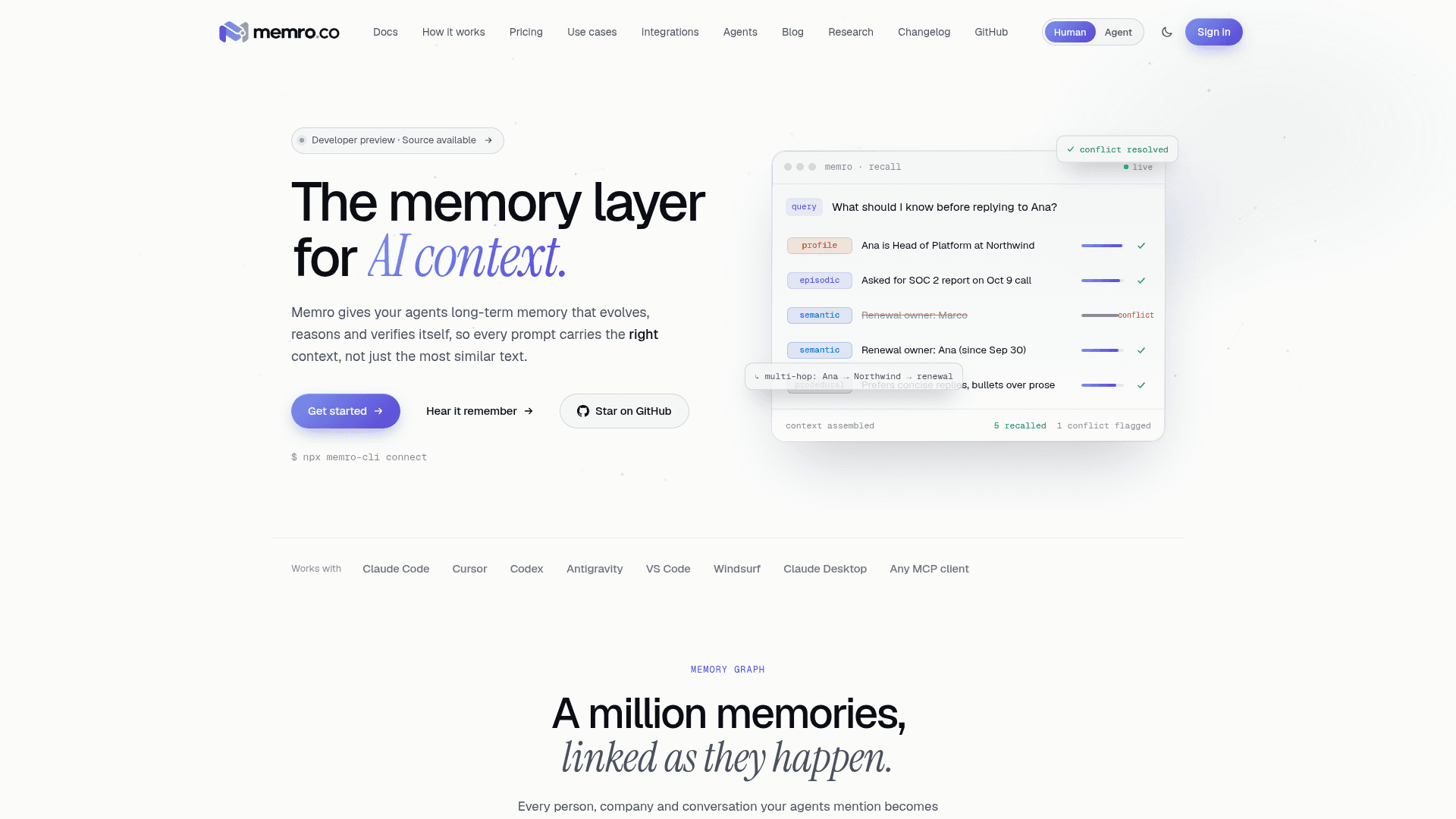
Memro is a long-term memory layer for AI agents and AI coding tools, made by Memro. It stores what happens as typed memories, consolidates them into lasting facts, and returns relevant, current context before each prompt. It is available as a hosted cloud service or as a source-available, self-hosted server.
What It Is
Memro sits between an agent's data and its model. Agents write observations with remember() using one of four memory types (episodic, semantic, procedural, profile), and read them back with recall(). Recall combines vector cosine similarity with PostgreSQL full-text search using Reciprocal Rank Fusion, plus a reasoning graph that follows relationships across multiple hops. The project says this differs from a plain vector database because it adds consolidation over time and contradiction detection.
Shared Memory for Coding Tools
Running npx memro-cli connect signs the user in and configures Claude Code, Cursor, Codex, Antigravity, VS Code, Windsurf, Claude Desktop and other MCP clients with the hosted MCP server. The README describes a shared memory in which a decision told to one tool can be recalled by another in a later session. A Claude Code plugin is also documented.
How Memory Evolves
- Narrative logs consolidate into summarized facts.
- Likely contradictions between older and newer facts are flagged with update relations, and superseded memories can be marked with
resolve_conflict(). - Each agent has an ed25519 keypair, requests are signed, and memory is exportable.
- The dashboard shows a memory graph that draws up to the newest 5,000 memories at a time.
Deployment and SDKs
The server is written in Go on PostgreSQL with pgvector and can be self-hosted with Docker Compose. Official SDKs exist for Python, TypeScript and Go, alongside an MCP server and CLI. The code is source-available under the PolyForm Noncommercial License 1.0.0: self-hosting is free for non-commercial use, while commercial use goes through Memro Cloud or a commercial license. The README also mentions syncing team context from Slack, GitHub, Linear, Notion and other connectors.
Community Discussions
Be the first to start a conversation about Memro
Share your experience with Memro, ask questions, or help others learn from your insights.
Pricing
Free
For hobbyists, local development, and self-hosted agents.
- 100,000 stored tokens
- 5,000 queries / month
- 100 MB monthly ingest
- PolyForm Noncommercial self-host (source-available, not OSI-approved)
- CLI & MCP support
Builder
For developers running multiple coding agents and active copilots.
- 1,500,000 stored tokens
- 25,000 queries / month
- 1 GB monthly ingest
- All platform features included
- Pay via Dodo or x402 USDC
Pro
For engineering teams building multi-agent systems and services.
- 6,000,000 stored tokens
- 150,000 queries / month
- 5 GB monthly ingest
- All platform features included
- Pay via Dodo or x402 USDC
Scale
For high-throughput production fleets and enterprise agent workloads.
- 25,000,000 stored tokens
- 1,000,000 queries / month
- 20 GB monthly ingest
- All platform features included
- Pay via Dodo or x402 USDC
Capabilities
Key Features
- Typed memories (episodic, semantic, procedural, profile)
- Hybrid recall with vector search and full-text search via RRF
- Multi-hop reasoning graph
- Contradiction detection with update relations
- Memory consolidation over time
- Ed25519 agent identity with signed requests and exportable memory
- MCP server for persistent memory in MCP clients
- One-command CLI connector
- Python, TypeScript and Go SDKs
- Self-hosting with Docker Compose
- Memory graph dashboard
- Claude Code plugin