
MiroFish
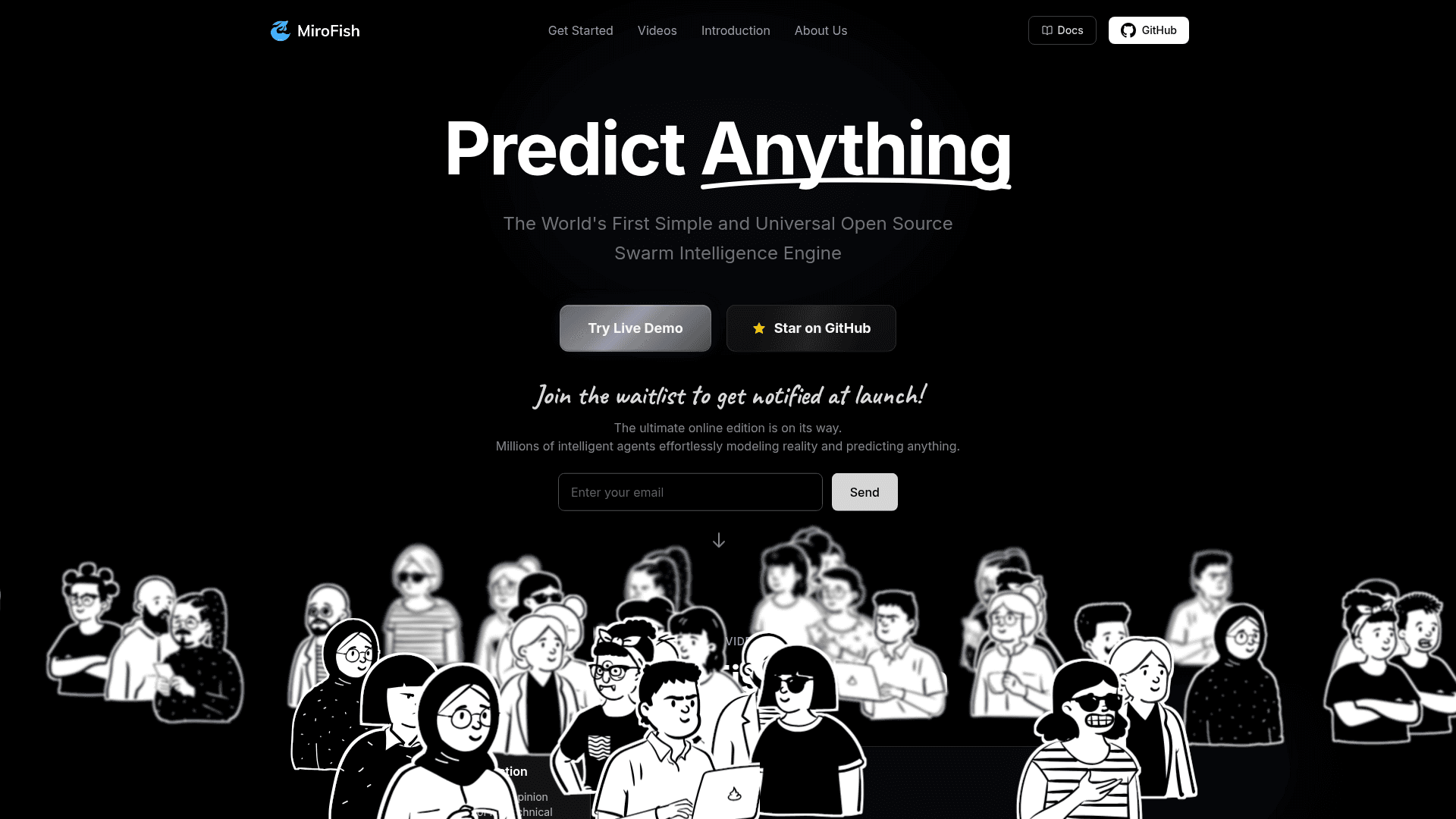
An open-source swarm intelligence engine that uses thousands of multi-agent simulations to predict outcomes in finance, public opinion, policy, and creative scenarios.
At a Glance
About MiroFish
MiroFish is an open-source AI prediction engine built on multi-agent swarm intelligence, developed under the incubation of Shanda Group. It extracts seed information from real-world inputs — such as breaking news, policy drafts, financial signals, or novel text — and automatically constructs a high-fidelity parallel digital world where thousands of agents with independent personalities, long-term memory, and behavioral logic interact and evolve. The project is licensed under AGPL-3.0 and its source code is publicly available on GitHub.
What It Is
MiroFish is a swarm intelligence simulation engine designed to make prediction of complex social, financial, and narrative outcomes accessible through a five-step automated workflow. Rather than relying on statistical models alone, it simulates emergent group behavior by running thousands of AI agents through a constructed digital environment, then generates a detailed prediction report and an interactive world users can query. The engine is described by the project as "the world's first simple and universal open source swarm intelligence engine."
How the Five-Step Workflow Operates
The end-to-end pipeline covers the full prediction lifecycle:
- Graph Construction: Seed extraction from user-supplied materials, individual and collective memory injection, and GraphRAG construction to encode relationships.
- Environment Setup: Entity relationship extraction, persona generation for each agent, and injection of simulation parameters via a configuration agent.
- Simulation: Dual-platform parallel simulation, automatic parsing of prediction requirements, and dynamic temporal memory updates as the simulation progresses.
- Report Generation: A ReportAgent equipped with a rich toolset interacts deeply with the post-simulation environment to produce a structured prediction report.
- Deep Interaction: Users can chat with any individual agent in the simulated world or converse with the ReportAgent to explore specific questions.
Target Scenarios
The project homepage lists six primary use cases:
- Finance / Investment: Simulating investor sentiment shifts and behavioral decisions for strategy rehearsal.
- Government / Think Tank: Forecasting public reactions to policy announcements before release.
- Enterprise / PR: Modeling how crisis events spread on social media and how public sentiment evolves.
- Brand / Marketing: Testing marketing strategy effectiveness in a virtual social environment.
- Entertainment / Creative: Building character worlds from novels or scripts and simulating plot developments and possible endings.
- Academic / Research: Providing controlled social simulation environments for social science research on information propagation and group behavior.
Architecture and Dependencies
MiroFish is built primarily in Python (≥3.11, ≤3.12) with a Node.js frontend (18+). The simulation engine is powered by OASIS (Open Agent Social Interaction Simulations) from the CAMEL-AI team. Agent memory is handled via Zep Cloud, and the LLM backend supports any OpenAI SDK-compatible API — the README recommends Alibaba's Qwen-plus model via the Bailian Platform. Deployment is supported via source code or Docker Compose, with the frontend running on port 3000 and the backend API on port 5001.
Update: v0.1.2
The latest release is v0.1.2, published in March 2026. The repository was created in November 2025 and has seen active development, with the last push recorded in August 2026. The project has accumulated significant GitHub attention since launch. An online edition described as "the ultimate online edition" is listed as forthcoming, with a waitlist available on the project homepage. Demo videos on Bilibili cover a Wuhan University public opinion simulation and a prediction of the lost ending of Dream of the Red Chamber based on the first 80 chapters.
Community Discussions
Be the first to start a conversation about MiroFish
Share your experience with MiroFish, ask questions, or help others learn from your insights.
Pricing
Open Source
Fully free and open-source under AGPL-3.0. Self-host via source code or Docker.
- Full source code access
- Source code and Docker deployment
- Multi-agent swarm simulation
- GraphRAG construction
- ReportAgent report generation
Capabilities
Key Features
- Multi-agent swarm intelligence simulation
- GraphRAG construction from seed materials
- Automatic persona generation for thousands of agents
- Long-term and temporal memory for agents
- Dual-platform parallel simulation
- Automated prediction report generation via ReportAgent
- Interactive chat with any simulated agent
- Natural language prediction requirement input
- Docker and source code deployment options
- OpenAI SDK-compatible LLM backend support
- Zep Cloud memory integration
- Public opinion forecasting
- Financial decision simulation
- Policy impact simulation
- Creative narrative deduction