
MNE-Python
Open-source Python package for exploring, visualizing, and analyzing human neurophysiological data such as MEG, EEG, sEEG, ECoG, and NIRS.
At a Glance
MNE-Python, open-source Python package for analyzing human neurophysiological data, licensed under BSD-3-Clause.
Engagement
Available On
Listed Nov 2026
About MNE-Python
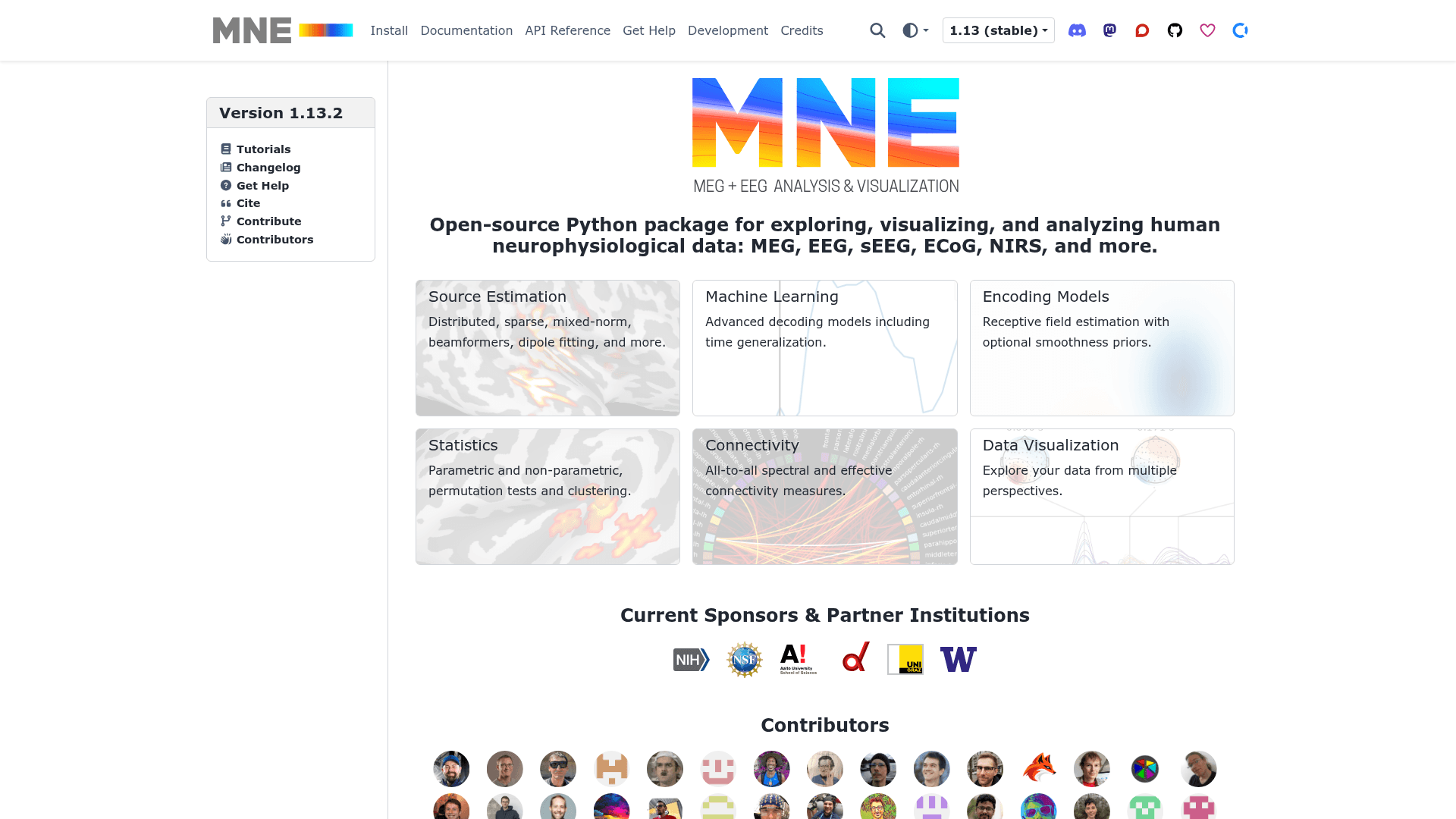
MNE-Python is an open-source Python package developed by the MNE Developers for exploring, visualizing, and analyzing human neurophysiological data, including MEG, EEG, sEEG, ECoG, and NIRS. The documentation site lists version 1.13.2 as the current stable release, alongside a 1.14 development version.
What It Is
MNE-Python is a scientific analysis library for neurophysiology researchers. Users work with recordings in Python, applying documented analysis methods and producing visualizations of their data. The project is released under the BSD 3-Clause license and hosted on GitHub.
Analysis Capabilities
The homepage highlights several areas of analysis, each linked to tutorials:
- Source estimation, including distributed, sparse, mixed-norm, beamformer, and dipole-fitting methods.
- Machine learning, with decoding models including time generalization.
- Encoding models, such as receptive field estimation with optional smoothness priors.
- Statistics, covering parametric and non-parametric tests, permutation tests, and clustering.
- Connectivity, with all-to-all spectral and effective connectivity measures, documented through the related mne-connectivity project.
- Data visualization, to explore data from multiple perspectives.
Documentation and Community
The site provides installation instructions, tutorials, an API reference, a changelog, citation guidance, and contribution guides. Support channels include a Q&A forum, Discord office hours, and Mastodon.
Community Discussions
Be the first to start a conversation about MNE-Python
Share your experience with MNE-Python, ask questions, or help others learn from your insights.
Pricing
Open Source
MNE-Python, open-source Python package for analyzing human neurophysiological data, licensed under BSD-3-Clause.
- BSD 3-Clause license
- Source estimation
- MEG, EEG, sEEG, ECoG, NIRS data analysis
Capabilities
Key Features
- Source estimation (distributed, sparse, mixed-norm, beamformers, dipole fitting)
- Decoding models including time generalization
- Receptive field estimation with optional smoothness priors
- Parametric and non-parametric statistics, permutation tests and clustering
- Spectral and effective connectivity measures
- Data visualization
- Support for MEG, EEG, sEEG, ECoG, and NIRS data
- Tutorials and API reference