
Moonshine Voice
Open source on-device toolkit for real-time speech to text, text to speech, and voice agents across web, mobile, desktop, and IoT.
At a Glance
Moonshine Voice toolkit code is MIT licensed and runs on-device with no account or API keys. Models are MIT by default; legacy non-streaming non-English STT models use the non-commercial Moonshine Community License; TTS/G2P models and data have separate licenses.
Engagement
Available On
Alternatives
Listed Nov 2026
About Moonshine Voice
Moonshine Voice is an open source toolkit from Moonshine AI (Useful Sensors, Inc., dba Moonshine AI) for developers building real-time voice agents and applications. Speech recognition, intent recognition, and text to speech run on the user's device, with no account or API key required.
What It Is
Moonshine Voice is a cross-platform voice library plus a set of speech models trained from scratch. Developers use it to add live transcription, spoken responses, and conversational voice flows to apps. The README lists support for Python, JavaScript/WASM, iOS, Android, macOS, Linux, Windows, and Raspberry Pi. A quick start is pip install moonshine-voice followed by a command-line microphone transcription.
Speech and Language Coverage
Speech to text is documented for English, Spanish, German, Mandarin, Japanese, Korean, Vietnamese, Tagalog, Ukrainian, and Arabic. Text to speech covers 16 languages, including English, Spanish, French, Hindi, and Japanese. The project says its models range from ones with higher accuracy than Whisper Large v3 down to tiny 1MB models. The website also cites a 6.65% HuggingFace OpenASR Leaderboard average versus 7.44% for Whisper Large v3, and these are vendor-published claims.
Browser Demos and Apps
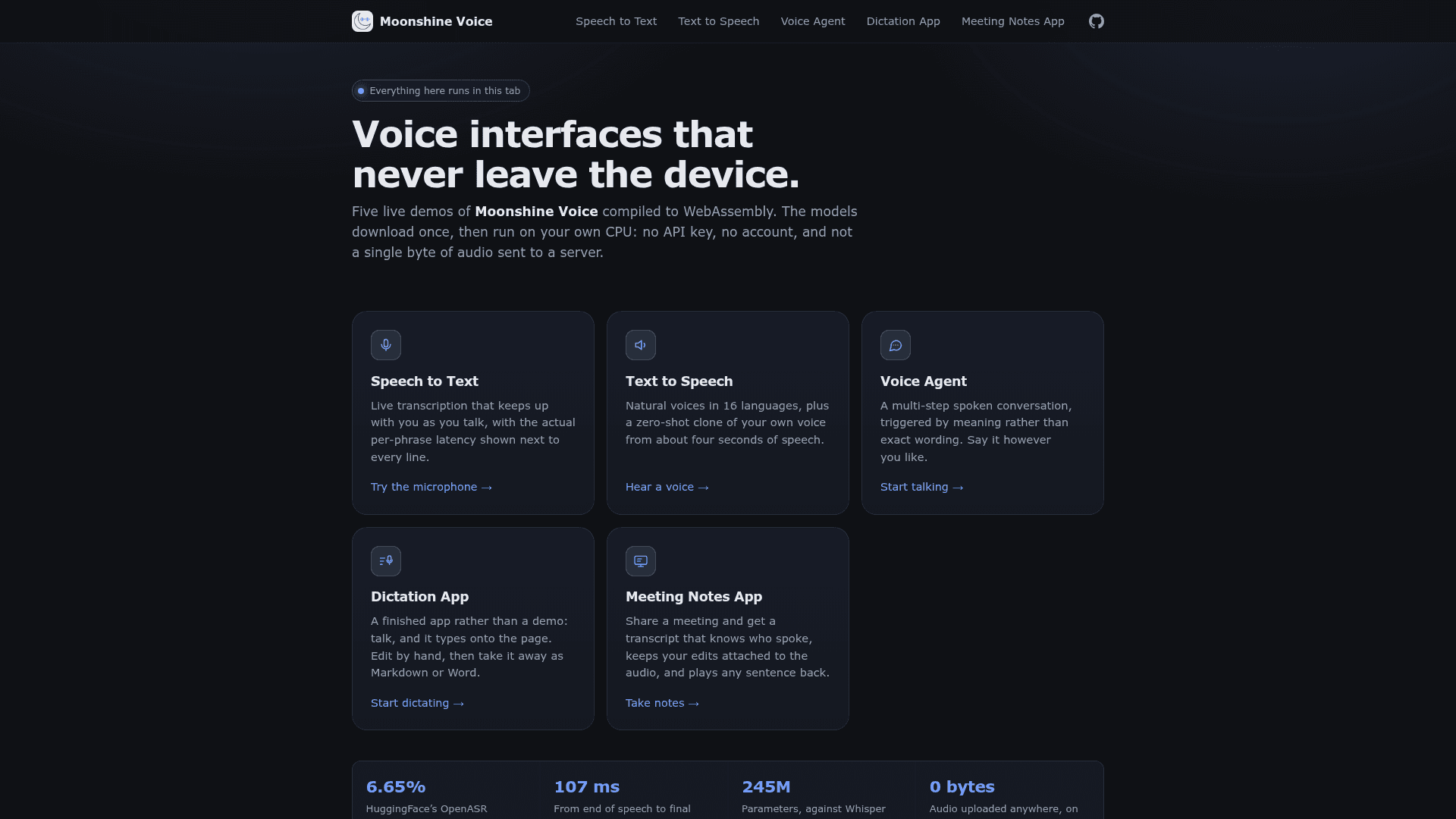
The Moonshine website offers WebAssembly demos that run in the browser tab, and says audio is never uploaded. They include live speech to text, text to speech with zero-shot voice cloning from about four seconds of speech, a voice agent triggered by meaning, a dictation app that exports Markdown or Word, and a meeting notes app with speaker-aware transcripts.
Licensing and Developer Resources
The code and most models are MIT licensed. Legacy non-streaming models for non-English languages fall under the non-commercial Moonshine Community License, and text to speech data follows separate third-party terms. Documentation covers a quickstart, library usage, models, and the API reference. An agent skill is provided for coding agents so they use the current API.
Community Discussions
Be the first to start a conversation about Moonshine Voice
Share your experience with Moonshine Voice, ask questions, or help others learn from your insights.
Pricing
Open Source (MIT)
Moonshine Voice toolkit code is MIT licensed and runs on-device with no account or API keys. Models are MIT by default; legacy non-streaming non-English STT models use the non-commercial Moonshine Community License; TTS/G2P models and data have separate licenses.
- Code MIT licensed, apart from core/third-party source
- Models MIT by default, including all streaming STT models and all English models
- Exceptions: legacy non-streaming non-English STT models (Arabic, Japanese, Korean, Mandarin, Spanish Base, Ukrainian, Vietnamese) under the non-commercial Moonshine Community License
- TTS and grapheme-to-phoneme models and data files are licensed under their own terms, not MIT
- Runs on-device, no account or API keys
Capabilities
Key Features
- On-device speech to text with low-latency streaming
- Text to speech in 16 languages
- Zero-shot voice cloning from about four seconds of speech
- Intent recognition and conversational voice agents
- Models from tiny 1MB up to higher accuracy than Whisper Large v3, per vendor
- Cross-platform library for Python, web, iOS, Android, desktop, and Raspberry Pi
- Browser demos including dictation and meeting notes apps
- Agent skill for coding agents
- No account or API key required