
Nanocodex
A headless, library-first Rust SDK for building products around an OpenAI coding-agent stack with retained sessions, typed history, tools, Code Mode, branches, and events.
At a Glance
Fully open-source under MIT OR Apache-2.0. Free to use, modify, and distribute.
Engagement
Available On
Alternatives
Listed Aug 2026
About Nanocodex
Nanocodex is an open-source, headless SDK authored by gakonst that embeds a complete OpenAI Responses agent loop directly into Rust, JavaScript, and Python applications. Released under MIT OR Apache-2.0, version 0.5.0 shipped on August 12, 2026, and the repository has accumulated 430 stars and 50 forks since its creation in July 2026. It is not a provider abstraction or an app server — the public product is an embeddable agent with an owned lifecycle that callers drive through a cheap, cloneable command handle.
What It Is
Nanocodex is a multi-language agent SDK that wraps the OpenAI Responses WebSocket API into a fully managed, owned lifecycle. The core is written in Rust and exposed to JavaScript (Node, browser, WASM) and Python via native bindings. The key design premise is that callers should not have to rebuild prompt ordering, response-ID threading, tool-result routing, compaction, reconnect replay, or subprocess cleanup — Nanocodex owns all of that. The caller keeps the interface, data, memory, infrastructure, and policy. Supported models are the gpt-5.6-sol family (sol default, terra, and luna selections).
Architecture and Module Boundaries
The crate is structured as an Alloy-style facade (nanocodex) over focused lower-level crates:
nanocodex-agent— owned driver, turns, results, events, history policy, snapshots, compaction, branches, and cancellationnanocodex-oai-api— OpenAI auth, typed Responses and Realtime boundaries, persistent transports, managed context, retry, pricing, and Tower clientnanocodex-tools— tool contract, standard workspace tools, shell/process lifecycle, Code Mode, deferred BM25 tool search, MCP (stdio and Streamable HTTP), and remote dispatchnanocodex-observability— optional full-fidelity tracing and application-owned OpenTelemetry/OTLP initializationnanocodex-durability— optional append-only execution journal with memory, SQLite, and Postgres stores
Applications that only need a managed OpenAI conversation can use the lower-level OpenAi → Session → ResponseTurn → Response API without adopting agent policy.
Multi-Language Deployment Model
Each language path runs the same Rust-owned agent lifecycle:
- Rust:
cargo add nanocodex; the primary surface with the full API - Node.js 22.13+:
npm install nanocodex; viem-styleAgent,Actions, andTransportnamespaces - Browser/WASM: runs the Rust agent in a Worker with OPFS filesystem persistence, Pyodide, wasm-clang, browser Git, and optional subagent trees
- Python 3.11+: native PyO3 binding built with Maturin; blocking result waits release the GIL
- Native CLI/TUI: installable on Apple Silicon macOS and x86-64 glibc Linux via a curl installer; built on Ratatui
The JavaScript and Python bindings expose the same turn results, typed events, history, snapshots, branches, and shutdown semantics as the Rust API.
Tools, Code Mode, and MCP
Tools are caller-owned capabilities registered via the typed Tool trait or the #[tool] attribute macro on async Rust functions. The default native workspace runtime supplies bounded exec_command, retained write_stdin sessions, Rust-verified apply_patch, view_image, planning, web search, and image generation. Code Mode presents one compositional JavaScript execution tool to the model; inside a cell, code can loop, branch, fan out with Promise.all, and call typed tools through await tools.<name>(...). MCP is part of the native tools crate — stdio and Streamable HTTP servers are discovered in the background, deferred tools are found with BM25 tool_search, and OAuth persistence, allow/deny lists, bounded concurrent startup, and hot reload are managed at that boundary.
Update: v0.5.0
Version 0.5.0 was published to crates.io on August 12, 2026, and is 100% documented on docs.rs. The release stabilizes the four published crates (nanocodex, nanocodex-agent, nanocodex-oai-api, nanocodex-tools) and the optional nanocodex-observability. Experimental crates — browser, VM, voice, egress, and eval — remain workspace members passing all CI gates but are not yet published to crates.io. The repository's retained benchmark evidence includes a PR #50 release gate where the project reports 39/39 latency gates passed and a 97.879% model-time ratio across a paired 10-turn plus three-fork workload.
Community Discussions
Be the first to start a conversation about Nanocodex
Share your experience with Nanocodex, ask questions, or help others learn from your insights.
Pricing
Open Source
Fully open-source under MIT OR Apache-2.0. Free to use, modify, and distribute.
- Full Rust SDK (nanocodex, nanocodex-agent, nanocodex-oai-api, nanocodex-tools)
- JavaScript bindings for Node.js, browser, and WASM
- Python bindings via PyO3/Maturin
- Native CLI/TUI
- Optional observability, durability, and subagents crates
Capabilities
Key Features
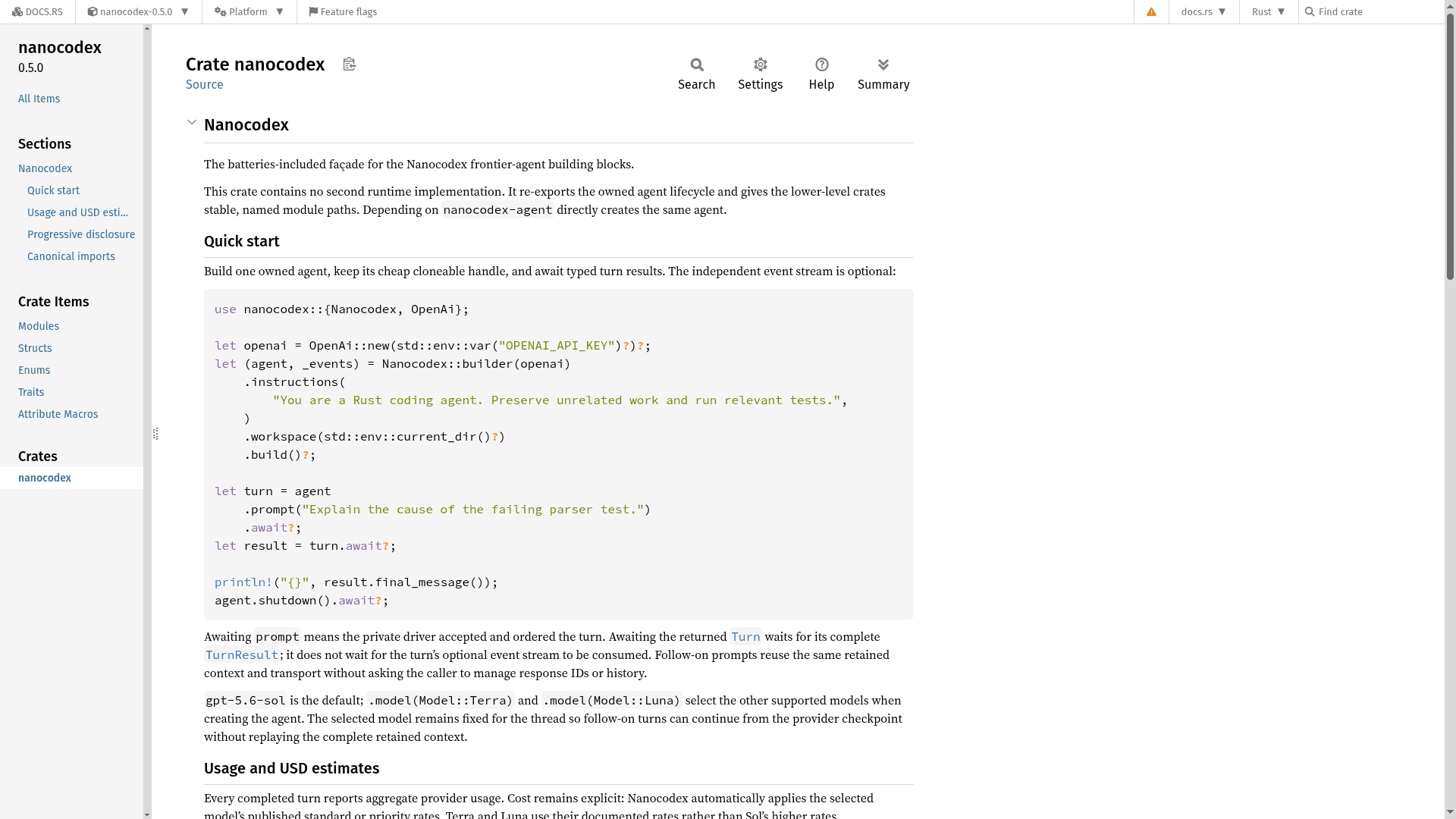
- Owned agent lifecycle with cheap cloneable command handle
- Retained OpenAI Responses WebSocket sessions with typed history
- Ordered turn submission with FIFO prompt queue
- Typed event stream independent from turn result awaiting
- Code Mode: compositional JavaScript execution tool for the model
- MCP support (stdio and Streamable HTTP) with BM25 deferred tool search
- #[tool] attribute macro for defining typed JSON function tools
- Branching: spawn, fork, fork_from, and SessionSnapshot for resumption
- Optional nanocodex-durability: append-only journal with SQLite/Postgres stores
- Automatic USD cost estimation per turn from provider token usage
- Native CLI/TUI consumer built on Ratatui
- JavaScript bindings for Node.js, browser, and WASM
- Python bindings via PyO3/Maturin
- Optional nanocodex-observability with OpenTelemetry/OTLP tracing
- Experimental browser automation (nanocodex-browser) with Chromium control
- Experimental VM workspaces via libkrun (nanocodex-vm)
- Experimental voice input via GPT Realtime (nanocodex-voice)
- Experimental evaluation harness with VM-isolated attempts (nanocodex-eval)
- Subagent task-tree with seven canonical child-agent tools (nanocodex-subagents)
- Cancellation targeting one active or queued turn with subprocess group cleanup