
Nasiko
Open runtime for AI agents that attributes token spend, enforces access policy at a gateway, and routes coding agents and multi-agent workflows across models.
At a Glance
About Nasiko
Nasiko is an open runtime for AI agents from Nasiko Labs. It discovers coding agents already running on a machine, attributes their token spend by harness and model, routes their LLM calls to models you choose, and enforces tool and access policy at a gateway. The source is Apache-2.0 licensed and hosted on GitHub, with a CLI and a Docker-based control plane.
What It Is
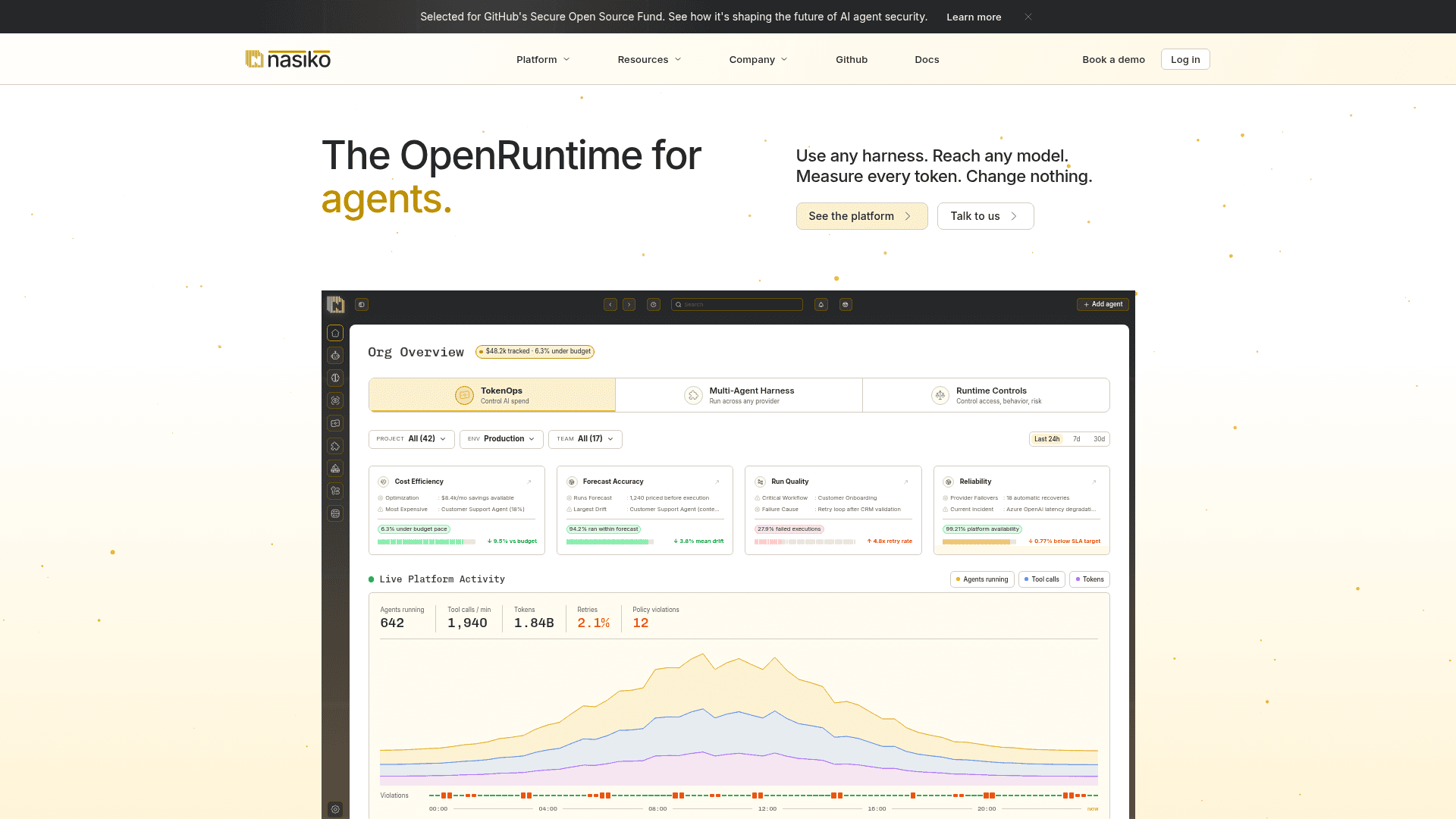
Nasiko is a control plane and runtime layer for agent estates. It addresses three questions: what agents cost, what they can touch, and where they run. A single Rust server hosts the REST API, an LLM router, an MCP gateway, an A2A proxy, an embedded OCI registry, flow guards and an encrypted secrets engine. State lives in Postgres, Redis and S3-compatible storage, with optional OpenTelemetry tracing.
Coding-agent discovery, reporting and routing
The nasiko agents discover command is read-only. It detects Claude Code, Codex, OpenCode and Cursor CLI, and reports version and config location. Session reporting is an explicit opt-in that installs event hooks and queues completed turns locally before delivery to the control plane. Routing is a separate opt-in for Claude Code, Codex and OpenCode. After you register a provider and key once, the harness points at Nasiko. An Anthropic-format request from Claude Code can then be served by an OpenAI key. Cursor CLI routing is listed as not yet supported.
Governance and orchestration
Agents receive a short-lived identity token rather than real provider keys. The MCP gateway gives each agent a permission-filtered catalog of Composio toolkits and custom MCP servers, with per-tool allow, ask or block stances. Flow guards limit depth, fan-out, token budget, timeouts and cycles between agents. Agents that speak A2A v1.0, written in Python, Rust, Go or TypeScript, can be deployed with nasiko deploy or nasiko upload. The platform also supports human-in-the-loop pauses for input or tool approval.
Setup path
The quickest route is Docker Compose, which starts the server with Postgres, Redis, RustFS, an OTel collector, Tempo and Loki. The dashboard is served on localhost:8080. Building the CLI from source requires Rust 1.85 or later. The company site also shows an install script and describes TokenOps cost forecasting, a multi-agent harness and runtime controls.
Community Discussions
Be the first to start a conversation about Nasiko
Share your experience with Nasiko, ask questions, or help others learn from your insights.
Pricing
Open Source (Self-hosted)
Self-hosted Nasiko core released under the Apache License 2.0; free to use, modify and distribute.
- Apache License 2.0 (LICENSE file in repository)
- Self-hosted via Docker Compose
- CLI for deploy, route and chat
- Embedded OCI registry
- MCP Gateway
Contact sales
Commercial plan priced on the runs Nasiko manages, not seats; contact for pricing.
- Pricing scales with runs managed, not seats
Capabilities
Key Features
- Read-only discovery of installed coding-agent harnesses
- Session reporting hooks for Claude Code, Codex, OpenCode and Cursor CLI
- LLM router decoupling inbound protocol from outbound provider
- Cost and token attribution per agent and model via OTel spans
- MCP gateway with per-agent, per-tool allow/ask/block permissions
- Flow guards for depth, fan-out, token budget, timeout and cycle limits
- AES-256-GCM encrypted per-agent secrets
- Embedded S3-backed OCI registry
- A2A agent deployment via CLI or source upload
- Human-in-the-loop pauses for input and tool approvals
- Web dashboard and traces via Tempo, Loki and OTel Collector