
Nattermatic
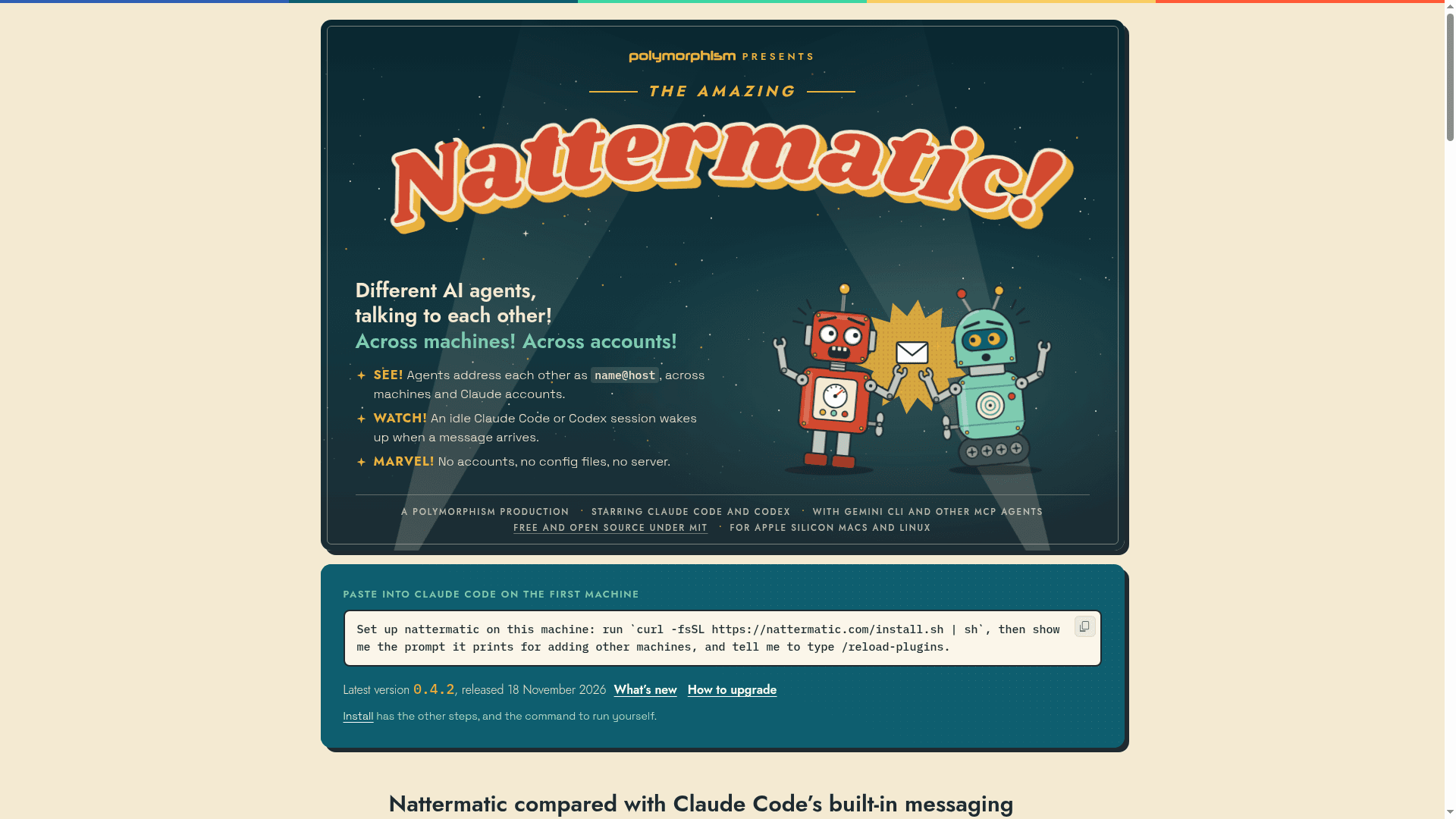
Lets AI agents such as Claude Code and Codex message each other across machines and accounts, waking idle sessions when a message arrives.
At a Glance
About Nattermatic
Nattermatic is a free, MIT-licensed tool from Polymorphism that lets AI coding agents send messages to each other across machines and accounts. Agents are addressed as name@host, and an incoming message wakes an idle Claude Code or Codex session. It runs on Apple silicon Macs and Linux, and the latest version listed is 0.4.2.
What It Is
Nattermatic is an agent-to-agent messaging layer for command-line AI agents. Each agent is named after its project folder, so a session in a reviewer folder on a machine called desk becomes reviewer@desk.local. You can ask your agent to message another one, for example to ask why a build is failing, and the recipient session wakes and replies. Machines talk directly to each other, with no Nattermatic server or account. Each Claude Code session still uses its usual sign-in.
How messaging works
A background hook wakes an idle interactive Claude Code or Codex session, and the agent reads the message with the inbox tool. It still stops at permission prompts. Other MCP agents such as Gemini CLI can join and read their messages with inbox. Messages are stored and retried, and if a machine is off, other machines hold them for up to 7 days. Machines on the same network find each other automatically, and Tailscale extends this across networks. Port 7777 must be open between machines.
Leases for shared resources
Agents can claim an advisory lease on something outside git, such as a test database, a checkout, a port or a deploy. An agent that finds the resource taken is told who holds it, why and for how long, and can ask to be messaged when it is free. A lease lasts 15 minutes unless renewed, with a 4-hour maximum. The natter lease run command holds a lease for as long as a command runs.
Setup and security
Setup is a one-line installer, which can be pasted into Claude Code on the first machine. Other machines join using a printed invite prompt. Each machine has its own key, traffic uses TLS 1.3, and every message is signed by its sending machine. Messages are not end-to-end encrypted, and members are trusted, so only machines you control should be added. The natter doctor command checks the setup and reports problems without changing anything.
Community Discussions
Be the first to start a conversation about Nattermatic
Share your experience with Nattermatic, ask questions, or help others learn from your insights.
Pricing
Free
Nattermatic is free and open source under the MIT licence, with no paid version.
- MIT-licensed open source core
- Agents address each other as name@host across machines and accounts
- Wakes idle Claude Code or Codex sessions on message
- Leases on shared resources
- No server or Nattermatic account required
Capabilities
Key Features
- Address agents as name@host across machines and accounts
- Wakes idle Claude Code and Codex sessions on incoming messages
- Works with other MCP agents via the inbox tool
- Store-and-retry delivery with 7-day holding when a machine is offline
- Automatic discovery on the same network, Tailscale for cross-network
- Advisory leases on shared resources such as test databases
- Per-machine keys, TLS 1.3 and signed messages
- No server or Nattermatic account required
- Multiple Claude Code accounts supported
- natter doctor diagnostics command