Neon
Serverless Postgres-based backend platform with branching, authentication, object storage, functions and an AI gateway for apps and agents.
At a Glance
Engagement
Available On
Alternatives
Listed Oct 2026
About Neon
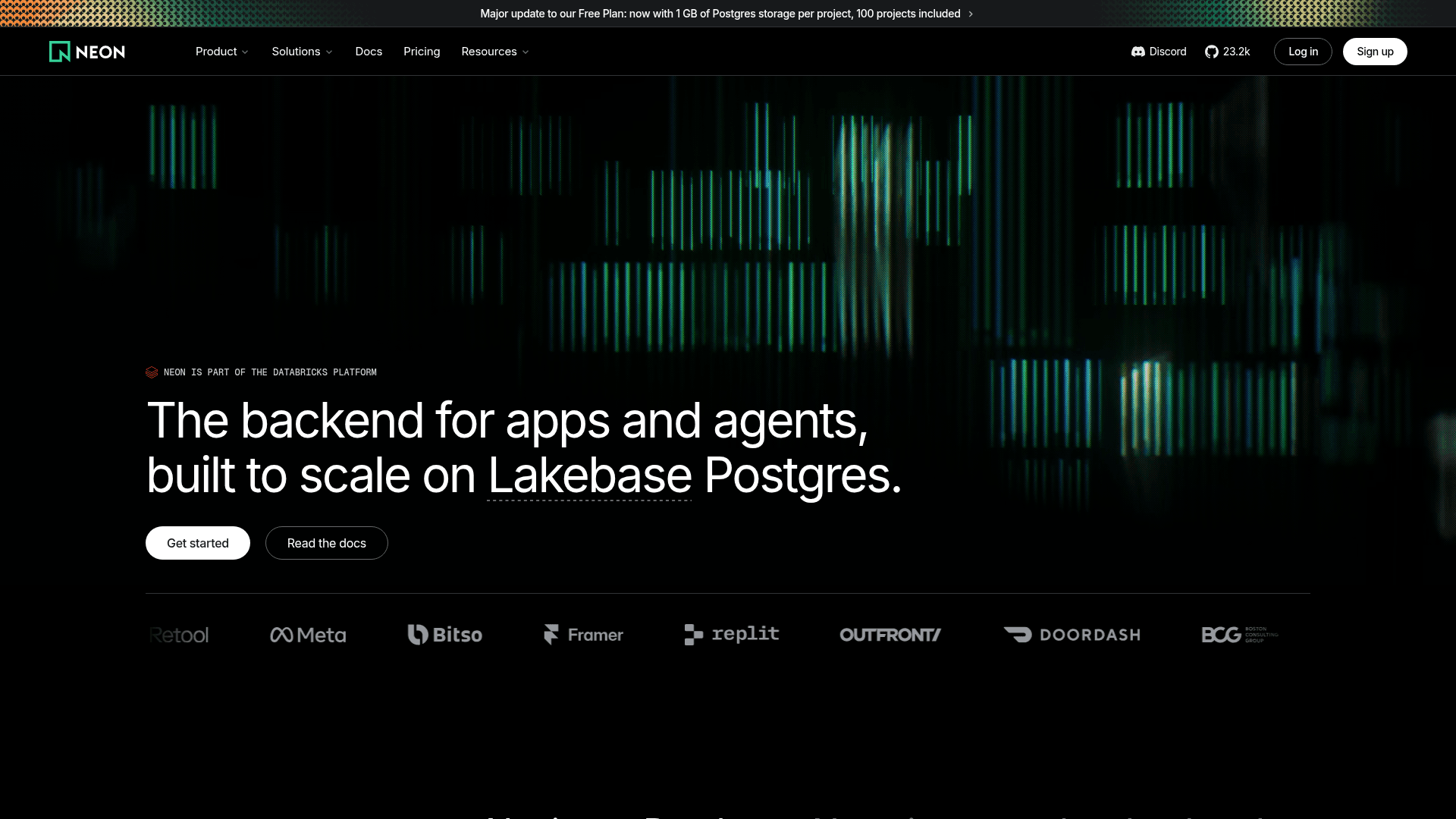
Neon is a serverless backend platform built around Lakebase Postgres and now part of the Databricks Platform, which it has been since May 2025. It combines a branchable Postgres database with managed authentication, S3-compatible object storage, serverless functions and an AI Gateway, and can be operated via MCP, CLI and SDK so coding agents can work with it.
What It Is
Neon is a managed Postgres and backend service aimed at developers, SaaS platforms and agent-driven app builders. Its Lakebase architecture separates storage from compute, and autoscaling adjusts CPU and memory to load. The company says it monitors database load ten times a second. Each database lives in a project with its own connection string, and a npx neon init command is shown for getting started.
Backend Primitives
Beyond the database, Neon offers Managed Better Auth for user authentication, object storage that branches with projects, functions that run close to the data without timeouts, and an AI Gateway that provides one API for frontier and open-source models. It also lists a Data API and search covering vector, keyword and hybrid queries.
Branching and Agent Workflows
Branching lets you create isolated copies of an environment, much like pull requests, and restore to an earlier point instantly instead of relying on manual backups. Neon says agents can create, test and roll back changes in these branches. The company also states that 80% of its databases are deployed by automated agents.
Embedded Postgres for Platforms
Platforms can provision a dedicated Postgres project per user through the API, usually in about a second, with resume from scale-to-zero in around 500ms. Per-project quotas cover active time, compute time, written data, data transfer and branch size, and consumption endpoints return hourly, daily or monthly usage for billing. A claimable-database flow hands out a database without signup; it expires after 72 hours unless the user claims it into a Neon account.
Security and Availability
The site lists SOC 2, ISO 27001, ISO 27701, GDPR, CCPA and HIPAA compliance, and says the platform runs on AWS and Azure. The enterprise page states a 99.95% uptime SLA for enterprise customers.
Community Discussions
Be the first to start a conversation about Neon
Share your experience with Neon, ask questions, or help others learn from your insights.
Pricing
Launch
Usage-based plan with no monthly minimum; typical spend $15/mo for intermittent load, 1 GB.
- 100 projects
- $0.106 per CU-hour
- $0.35 per GB-month storage
- Sizes up to 16 CU (64 GB RAM)
- 10 branches per project included; $1.50 per extra branch-month
- $0.20 per GB-month history storage
- Object Storage $0.023 per GB-month
- Functions: $0.10 per active capacity-hour, $0.025 per waiting capacity-hour, $0.60 per 1M invocations
- AI Gateway at provider list prices (prepaid credits)
- 3-day metrics/logs in UI
Scale
Usage-based plan with higher limits, SLAs, HIPAA and private network; typical spend $701/mo for high load, 100 GB.
- 1,000+ projects
- $0.222 per CU-hour
- $0.35 per GB-month storage
- Sizes up to 56 CU (224 GB RAM)
- 25 branches per project included; $1.50 per extra branch-month
- SLAs, HIPAA, private network
- Functions: $0.12 per active capacity-hour, $0.03 per waiting capacity-hour, $0.60 per 1M invocations
- AI Gateway at provider list prices (prepaid credits)
- Monitoring retention 14 days
Capabilities
Key Features
- Serverless Postgres (Lakebase) with storage-compute separation
- Autoscaling of CPU and memory
- Scale-to-zero for idle databases
- Database branching and instant restore
- Managed Better Auth authentication
- S3-compatible object storage that branches
- Serverless Functions
- AI Gateway for frontier and open-source models
- Vector, keyword and hybrid search
- Per-project quotas and consumption metrics API
- Claimable database flow
- Pooled connections up to 10,000
- Access via MCP, CLI and SDK