
NeuroVFM
Open-source volumetric foundation model for MRI and CT neuroimaging, with diagnostic heads and a findings-generating LLM, for research use only.
At a Glance
About NeuroVFM
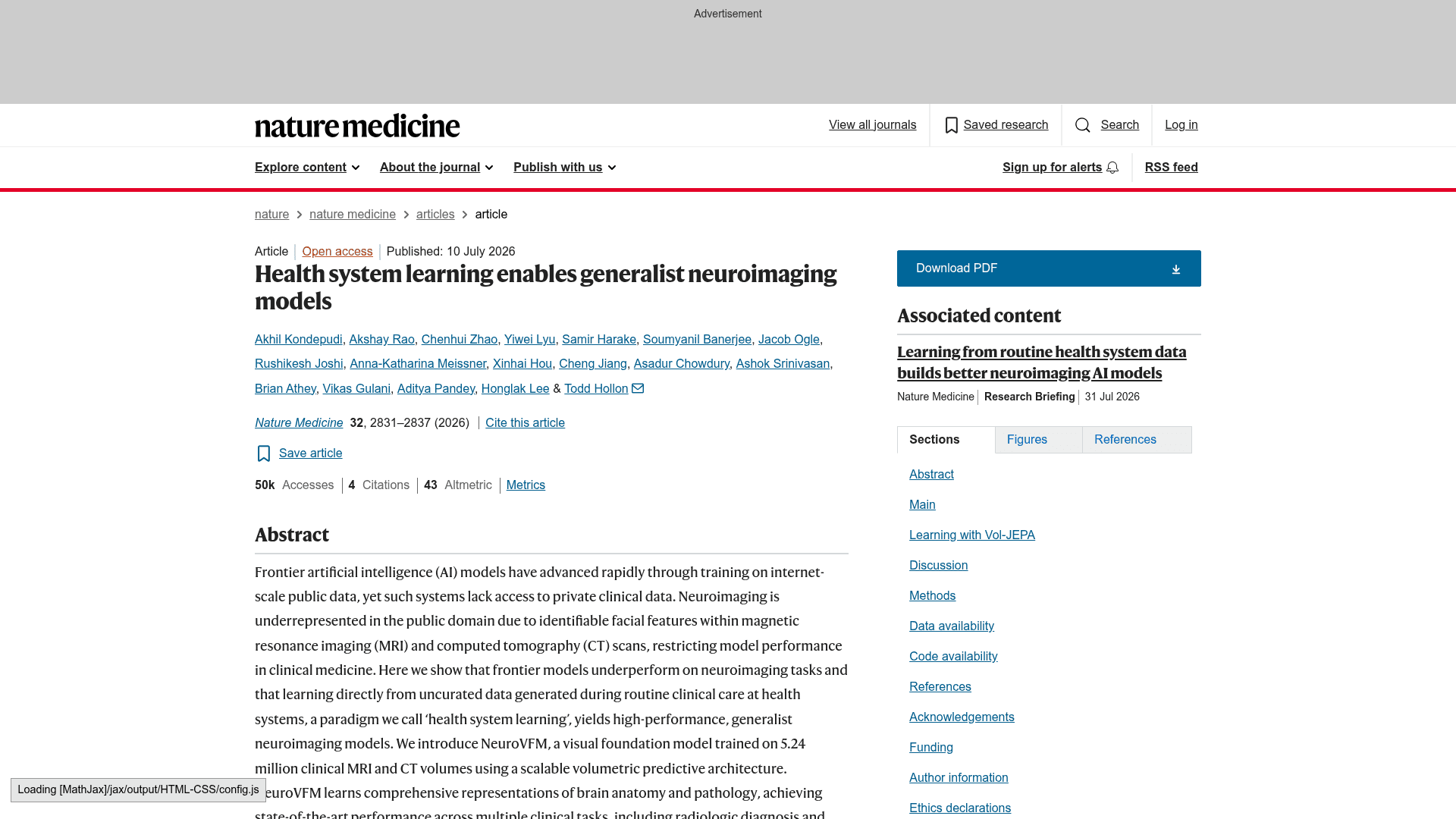
NeuroVFM is a volumetric visual foundation model for clinical neuroimaging developed by the MLiNS Lab at the University of Michigan and described in a Nature Medicine paper. It was trained with self-supervision on 5.24 million MRI and CT volumes from 566,915 studies collected over two decades of routine care at Michigan Medicine. The code is MIT-licensed on GitHub, and the pretrained weights are hosted on Hugging Face under CC-BY-NC-SA-4.0. The authors state it is a research tool only and not approved by the FDA.
What It Is
NeuroVFM is a stack of models for interpreting brain, head, neck, face and orbit MRI and CT studies. A 3D vision transformer encoder, pretrained with a method the authors call Vol-JEPA, turns each study into latent visual tokens. Those embeddings feed study-level diagnostic heads covering 74 MRI and 82 CT diagnoses, or a findings language model that generates preliminary findings from a study plus clinical context. The outputs can then be passed to an external reasoning model for tasks such as triage.
How the Workflow Runs
The Python pipeline loads an encoder, a diagnostic head and a vision-language model from Hugging Face. A study folder is preprocessed, embedded, and either classified into diagnoses with probabilities or used to generate findings text. The findings model pairs the frozen encoder with Qwen3-14B through a Perceiver-style connector. Repository scripts and configs cover Vol-JEPA pretraining, diagnostic head training with multiple instance learning, and findings model fine-tuning. FlashAttention-2 v2.6.3 is required for training and inference.
Reported Results
The paper reports a macro-averaged AUROC of about 92.7 on CT and 92.5 on MRI across 156 diagnostic tasks on a temporally held-out cohort, outperforming the baselines it compared against. In a blinded expert review, the authors report that NeuroVFM-generated findings had about half the key-finding error rate of GPT-5 (10% versus 20%). In a one-week prospective silent feasibility study of 1,155 studies, the NeuroVFM-based triage arm reached 92.6% balanced accuracy versus 71.2% for GPT-5, with 86.5% sensitivity for critical findings. The authors note it is not suited as an autonomous screening tool.
Access and Limits
Some weights require access approval with an institutional email. Raw patient imaging data is not public. The authors say the model is susceptible to bias from its training data and must not be used for clinical decision-making.
Community Discussions
Be the first to start a conversation about NeuroVFM
Share your experience with NeuroVFM, ask questions, or help others learn from your insights.
Pricing
Open Source (MIT code)
NeuroVFM code is released under the MIT License. Model weights are separately licensed under CC-BY-NC-SA 4.0 and some require access approval with an institutional email. Research use only.
- Code under MIT License
- Model weights under CC-BY-NC-SA 4.0 (non-commercial, not OSI-approved)
- Some weights require access approval with an institutional email
- Research use only; not a medical device
- Optional external reasoning API requires user's own API key (external cost)
Capabilities
Key Features
- 3D ViT encoder producing embeddings for MRI and CT neuroimages
- Vol-JEPA self-supervised pretraining
- Study-level diagnostic heads for 74 MRI and 82 CT diagnoses
- Findings LLM generating preliminary findings from studies and clinical context
- Attention-based grounding of diagnoses to image regions
- Optional external reasoning API for triage
- Training scripts for pretraining, diagnostic heads and SFT
- Pretrained weights on Hugging Face