
Niteshift
A full-stack cloud platform for running coding agents like Claude Code, Codex, and OpenCode in isolated, fully configured environments with live previews and verified PRs.
At a Glance
About Niteshift
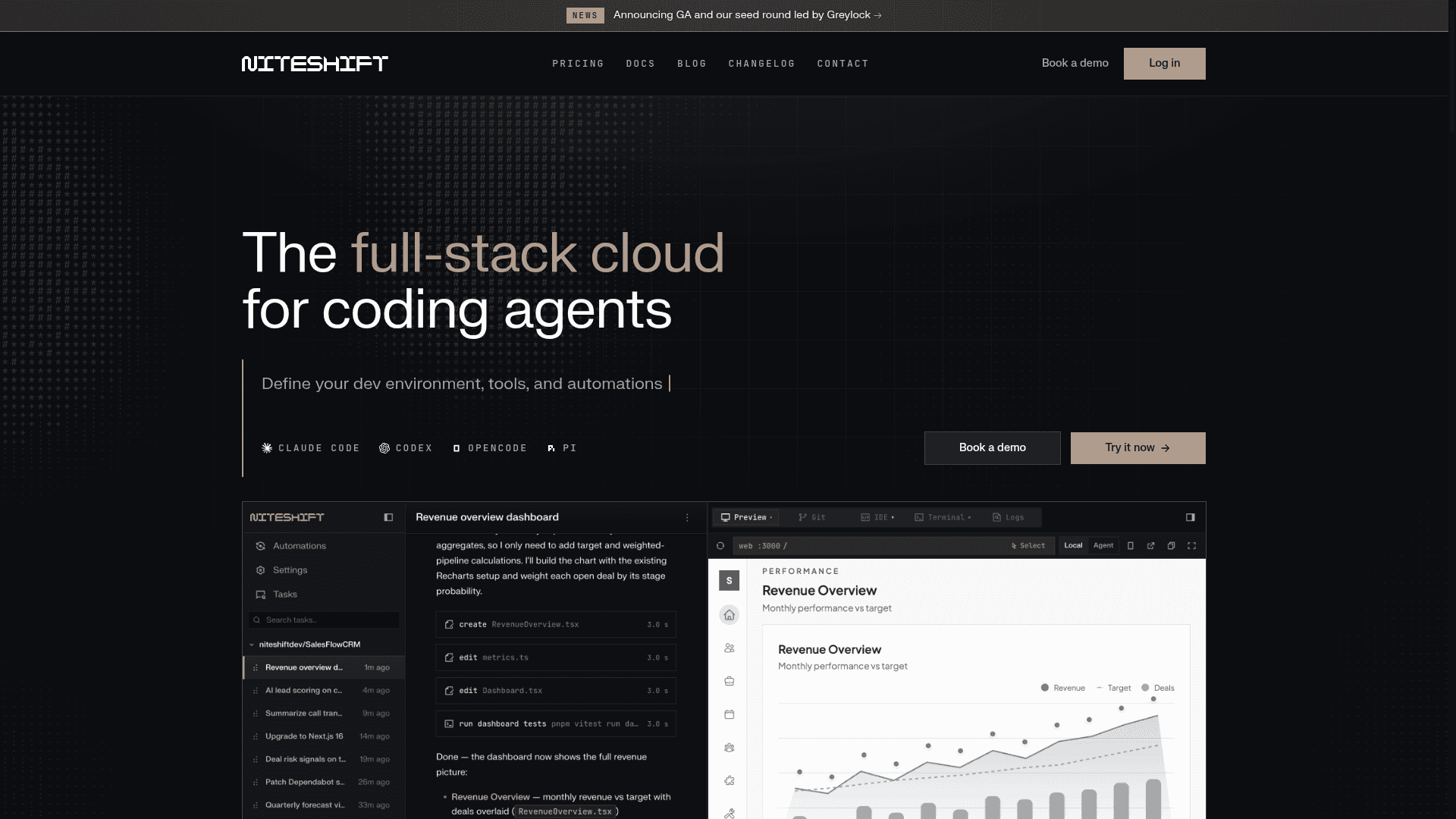
Niteshift is a cloud platform built specifically for running AI coding agents at scale. It handles full-stack environment setup — services, databases, auth, workers, and seeded data — so agents like Claude Code, Codex, and OpenCode can run, test, and verify changes end to end without local machine constraints. The company announced general availability alongside a seed round led by Greylock.
What It Is
Niteshift sits in the emerging category of "background agent platforms" — cloud infrastructure purpose-built for autonomous coding agents rather than human developers. Instead of running agents on a developer's laptop with RAM limits and worktree juggling, Niteshift spins up isolated, full-stack cloud environments on demand. Each environment is configured from the repo's own docs, scripts, CI, and Docker files, and the platform iterates until the entire app stack is running end to end before the agent begins work.
How the Verification Loop Works
A core design principle of Niteshift is that agents must prove their changes work before shipping. After making code changes, agents run tests, browser checks, log analysis, CI pipelines, and custom evals, then attach the evidence directly to the pull request. The platform provides live preview URLs for each task environment, enabling browser-level verification alongside API and database checks.
Agent Flexibility and Team-Defined Policies
Niteshift is designed to be agent-agnostic. Teams configure their environment, MCP servers, skills, network egress allowlists, and OAuth credentials once, and any supported agent — Claude Code, Codex, OpenCode, or others — runs inside those team-defined policies. This separation means teams can swap frontier models as they improve without reconfiguring their stack.
Integrations and Dispatch Model
Niteshift integrates with the tools engineering teams already use for task dispatch and observability:
- Dispatch sources: GitHub (PRs and issues via slash commands), Linear (assign issues to @niteshift), Slack (mention @niteshift in any channel)
- Connected services: Sentry, Datadog, AWS, Vercel, Notion, Stripe, LaunchDarkly, Supabase, Cloudflare, Google Cloud, Neon, MongoDB
- MCP support: Hundreds of additional tools can be connected via the Model Context Protocol
Audience and Use Cases
The platform targets engineering teams that want to run multiple parallel agent tasks — optimizing eval loops, wiring up issue autofixes, adding features — without local setup overhead. The vendor publishes testimonials from founders and engineering leads describing use cases including robot simulation environments, codebase optimization runs lasting hours, and enabling non-engineers (designers, PMs) to ship PRs directly.
Update: General Availability Launch
Niteshift announced GA alongside its seed round led by Greylock, as noted in the site's top banner linking to the blog post "Introducing Niteshift." The changelog is actively maintained at niteshift.dev/changelog, signaling ongoing product development.
Community Discussions
Be the first to start a conversation about Niteshift
Share your experience with Niteshift, ask questions, or help others learn from your insights.
Pricing
Free
1 seat with $10 of credits per month.
- 1 seat
- $10 of credits / month
Individual
1 seat with $50 of credits per month and pay-as-you-go beyond credits.
- 1 seat
- $50 of credits / month
- Pay-as-you-go beyond your credits
Team
Unlimited seats with $250 of credits per month and pay-as-you-go beyond credits.
- Unlimited seats
- $250 of credits / month
- Pay-as-you-go beyond your credits
Capabilities
Key Features
- Full-stack cloud environment setup from repo docs, CI, and Docker
- Isolated per-task sandboxes with live preview URLs
- Agent-agnostic: supports Claude Code, Codex, OpenCode, and more
- Automated verification: tests, browser checks, logs, CI, and evals attached to PRs
- Team-defined MCP servers, skills, and network egress policies
- Dispatch via GitHub, Linear, or Slack
- Elastic parallel task execution without local RAM or worktree limits
- Onboarding agent that configures the full stack automatically
- Pay-as-you-go credits beyond plan allocation
- OAuth managed credentials for connected services