
Observal
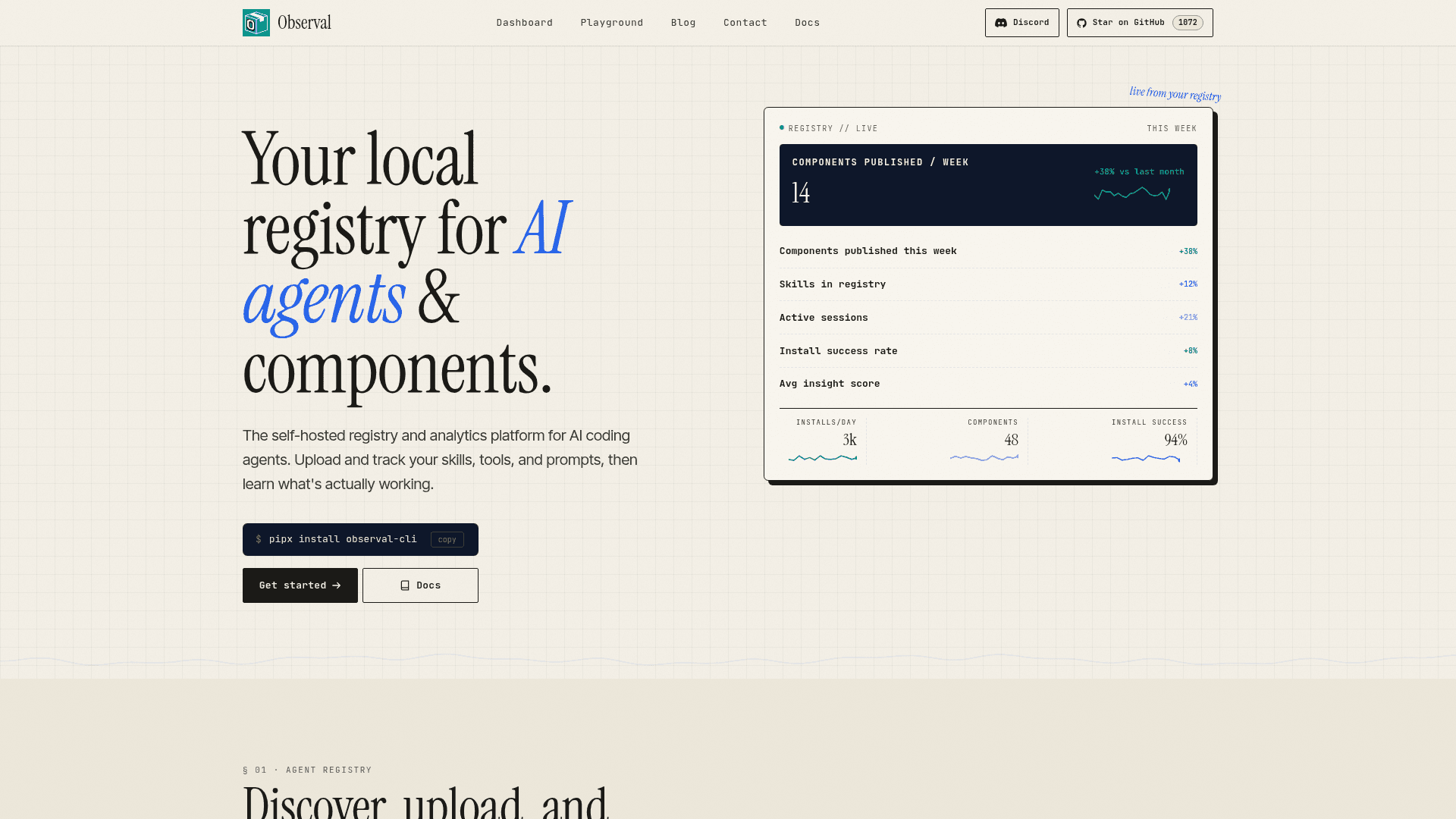
Self-hosted, open-source registry and analytics platform for AI coding agents — upload, version, and track skills, MCP servers, hooks, and prompts, then learn what's actually working.
At a Glance
About Observal
Observal is the control plane and system of record for internal AI components, built by BlazeUp AI and released under the Apache License 2.0. It runs entirely on your own infrastructure via Docker Compose and gives engineering teams a single place to publish, discover, install, and measure AI agents, skills, MCP servers, hooks, prompts, and sandboxes. The project is actively maintained on GitHub and reached v1.10.3 as of July 2026.
What It Is
Observal addresses two structural problems the README identifies in how organizations manage internal AI components: a lack of a discoverability layer (components scattered across siloed repositories) and a missing feedback loop (developers publish agents with no visibility into how they're actually used). The platform provides a centralized registry with admin review and version diffing, a CLI that installs agents into any supported harness with one command, full session telemetry, and AI-powered insight reports that turn usage data into specific system-prompt recommendations.
Self-Hosted Architecture
Observal deploys as a Docker Compose stack of ten services: a FastAPI/Strawberry GraphQL backend, a React 19 + Vite 6 web UI, PostgreSQL 16 for registry data, ClickHouse for telemetry, Redis + arq for queuing, a worker, a load balancer, Prometheus, and Grafana. A Kubernetes Helm chart is also available for production topologies. The CLI is distributed as a standalone binary or via pipx/uv for Python 3.11+ environments. Because everything runs on your own infrastructure, components, sessions, and data never leave your network.
Supported Harnesses and Component Types
One agent definition renders the correct config for every supported coding harness automatically:
- Harnesses: Claude Code, Cursor, Kiro, Pi, Copilot (CLI & VS Code Extension), Codex, OpenCode, Antigravity CLI
- Component types: Skills, MCP servers, Hooks, Prompts, Sandboxes
Each component type is versioned, reviewed by admins before going live, and tracked for adoption. Version diffs show exactly what changed between releases so teams can safely evolve shared context.
Session Observability and Insights
Every session from supported harnesses is captured as a structured trace — token usage, tool calls, thinking blocks, and outcomes — with no sampling. Traces are searchable and sortable in the web UI and can be replayed turn by turn for debugging or auditing. On top of raw traces, Observal's insight engine (powered by LiteLLM, compatible with Anthropic, OpenAI, Bedrock, Gemini, Azure, and Ollama) produces named action reports: what's going wrong, which metric proves it, and the exact system-prompt change that fixes it.
Update: v1.10.3
The latest release, v1.10.3, was published on July 21, 2026. The repository was created in March 2026 and has seen continuous pushes through July 2026, indicating active early development. The GitHub README lists audit logs, SAML SSO, SCIM provisioning, and an executive dashboard as included in the Apache-2.0 distribution. The project's GitHub page reports 2,227 stars and 462 forks as of the data snapshot.
Community Discussions
Be the first to start a conversation about Observal
Share your experience with Observal, ask questions, or help others learn from your insights.
Pricing
Open Source
Fully open-source self-hosted platform under Apache License 2.0. Free to use, modify, and distribute.
- Self-hosted registry and analytics
- Agent and component registry with admin review
- Session telemetry and trace capture
- AI-powered insight reports
- Cross-harness config generation
Capabilities
Key Features
- Self-hosted agent and component registry
- One-command agent install across multiple harnesses
- Session telemetry with full trace capture (no sampling)
- AI-powered insight reports with specific system-prompt recommendations
- Admin review queue with approve/reject and version diffs
- Five component types: Skills, MCP servers, Hooks, Prompts, Sandboxes
- Cross-harness config generation (Claude Code, Cursor, Kiro, Copilot, Codex, etc.)
- Session replay with turn-by-turn timeline
- Audit logs, SAML SSO, SCIM provisioning
- Docker Compose and Kubernetes Helm deployment
- CLI installable via pipx or standalone binary
- LiteLLM-powered insights compatible with multiple LLM providers
- Leaderboard tracking top agents and components by downloads
- Prometheus and Grafana monitoring included