
ToolHub
Self-hosted, open-source platform that turns any console script into an AI agent tool with hierarchical navigation, MCP support, and infinite federation.
At a Glance
Free for personal use and open-source modifications under AGPL-3.0.
Engagement
Available On
Listed Oct 2026
About ToolHub
ToolHub is a high-performance, self-hosted, open-source platform for creating, orchestrating, federating, and securely executing tools for AI agents. Built on the Bun runtime and licensed under AGPL-3.0, it provides a structured, distributed skill file system with on-the-fly tree navigation and a unified interaction contract — eliminating the need to hardcode functions into system prompts or overload model context windows with hundreds of API schemas.
What It Is
ToolHub is an execution engine for AI agent skills. Rather than acting as a proxy registry for pre-built MCP servers (as tools like MCPJungle or MCPHub do), ToolHub turns any script — written in Bun, Node.js, Python, Go, Bash, PHP, Deno, or C++ — into an agent-callable tool on the fly. Tools are organized in a hierarchical folder tree that agents navigate using listTools() and execute with callTool(), keeping model context lean by only loading relevant schemas on demand.
Architecture and Execution Model
ToolHub's core system routes agent HTTP requests through a Fastify router with dual authentication tiers (agent password and admin password). A unified router engine dispatches calls to one of three category types:
- LOCAL: Scripts executed in isolated OS temp workspaces (
/tmp/hub_run_<timestamp>_<hash>), with full dependency installation, environment variable injection, and workspace purge after each run. - REMOTE: Recursive proxy tunnels to other ToolHub nodes via HubSDK, enabling infinitely nested federation trees with cycle protection and transparent path normalization.
- MCP: External Model Context Protocol servers, supported in both stateless Stdio spawn mode and a stateful persistent pool for memory-heavy sessions (Puppeteer, SSH, databases) with hot call latency of 10–30ms and a 5-minute idle TTL.
The platform also includes an MCP Promote feature that converts remote MCP tool definitions into editable native database tools in one click.
Infinite Federation
One of ToolHub's distinguishing architectural features is its support for infinitely nested REMOTE nodes. Server A can connect to Server B, which links to Server C, exposing a unified path like /office/home/lights/turn_on. HubSDK handles path normalization, credential forwarding, and graph-based cycle detection automatically. This contrasts with typical MCP gateways, which operate on a single client → gateway → servers layer with no recursive nesting.
IDE Bridge and Skill Portability
ToolHub includes a Sublime Text Bridge that enables AI agents to make atomic AST-level code edits (replace-literal) in approximately 2ms, with real-time diff preview via Sublime Merge integration and native Ctrl+Z undo stack support. Skills can be exported and imported as .toolpack bundles containing folder structures, schemas, and runners. Every edit automatically creates a revision snapshot with one-click rollback via the ToolVersion system.
Deployment and Setup
ToolHub requires no Docker — it runs directly on bare-metal servers, lightweight VPS instances, or even Raspberry Pi hardware using the Bun runtime. Setup involves cloning the repository, running bun install, pushing the Prisma schema to a SQLite database, and running an interactive seed script that configures language (EN/RU/ZH) and passwords. A JS/TS SDK (HubSDK) is included for integrating ToolHub into agent loops. The web admin console and Swagger API docs are available in development mode; production builds serve from port 3000.
Update: v1.0.0 Initial Release
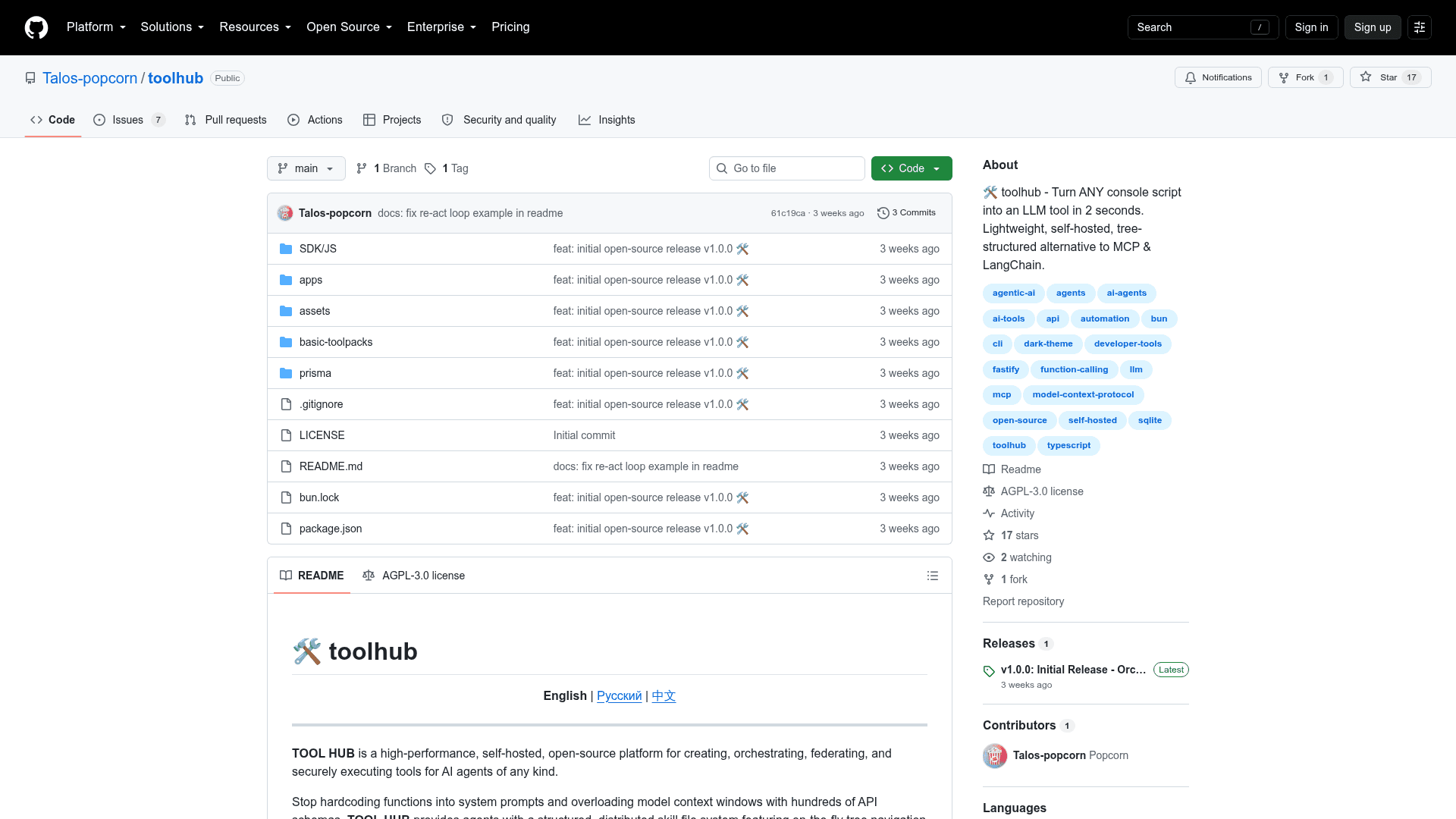
The project's first public release (v1.0.0) was published on September 6, 2026, under the name "Orchestrate Any Script into an LLM Tool in few Seconds." The repository is written primarily in TypeScript, uses Bun as its runtime, and SQLite via Prisma as its database. As of the latest available data, the repository had 17 stars and 7 open issues. Commercial use within closed corporate environments or proprietary products requires a separate commercial license; contact is available at collab@labstudio.tech.
Community Discussions
Be the first to start a conversation about ToolHub
Share your experience with ToolHub, ask questions, or help others learn from your insights.
Pricing
Open Source
Free for personal use and open-source modifications under AGPL-3.0.
- Full platform source code
- Self-hosted deployment
- Hierarchical tool navigation
- Infinite federation
- MCP support
Commercial License
Required for use within closed corporate environments or proprietary products without AGPL-3.0 copyleft restrictions.
- All open-source features
- Commercial use rights
- No AGPL-3.0 copyleft restrictions
Capabilities
Key Features
- Turn any script (Bun, Python, Go, Bash, PHP, Deno, C++) into an AI agent tool
- Hierarchical folder tree navigation with listTools() and callTool()
- Infinite federation of ToolHub nodes with cycle protection
- Dual-mode MCP engine: Stateless Stdio and Stateful Persistent Pool
- MCP Promote: convert MCP tools to native editable database tools
- Isolated workspace execution with automatic purge
- Sublime Text Bridge with atomic replace-literal edits
- Sublime Merge real-time diff preview and native Ctrl+Z undo
- .toolpack export/import for skill portability
- Automatic revision snapshots with one-click rollback
- Dual authentication tiers: agent password and admin password
- JS/TS HubSDK for agent loop integration
- Swagger API documentation in development mode
- Admin web console
- Audit logs and execution telemetry
- No Docker required — runs on Raspberry Pi, VPS, or bare-metal
- SQLite database via Prisma
- Interactive installer with EN/RU/ZH language support