Oh My Subagents
A local open-source runtime for persistent, supervised parent–subagent delegation that turns ad-hoc AI agent coordination into durable, accountable AI teams with Codex and Claude.
At a Glance
Fully free and open-source under the MIT License. Self-hosted local runtime with all features included.
Engagement
Available On
Alternatives
Listed Aug 2026
About Oh My Subagents
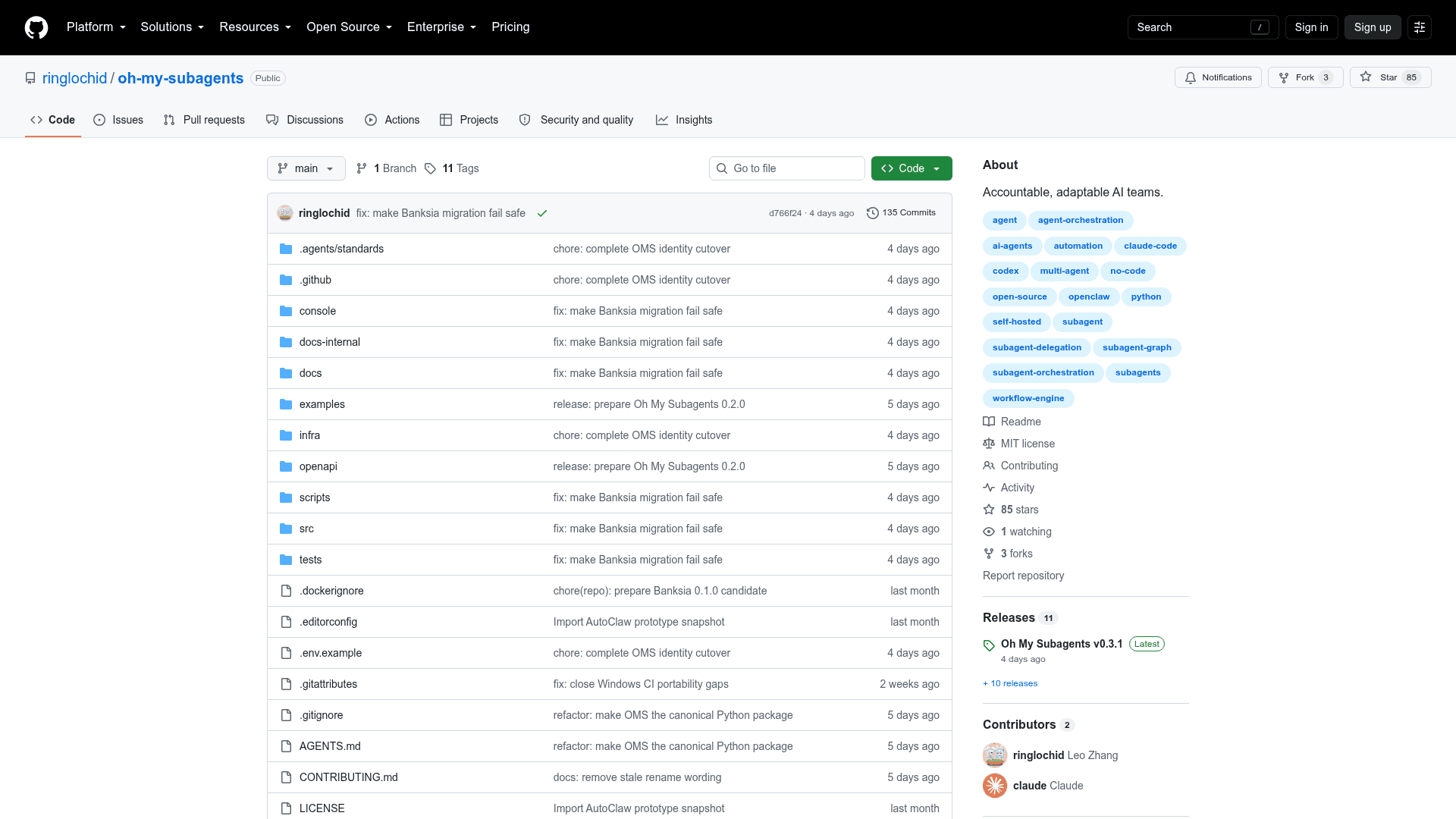
Oh My Subagents (OMS) is an open-source Python runtime created by Yunan Zhang (GitHub: ringlochid) that brings durable, accountable coordination to multi-agent AI workflows. It targets developers and teams using OpenAI Codex or Anthropic Claude who need more than ad-hoc subagent delegation—specifically, persistent state, clear ownership, and honest recovery after interruptions. The project is available on PyPI under the MIT License (with the visual Console component under the Sustainable Use License).
What It Is
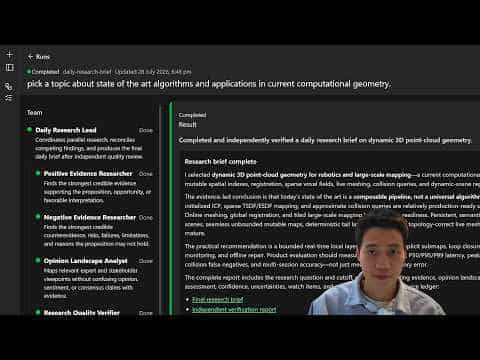
Oh My Subagents is a local runtime that manages parent–subagent delegation as committed controller state rather than ephemeral chat transcripts. When a Manager agent delegates a "Wave" of work, OMS commits the child Assignments, persists the parent wait, supervises every return, and continues the parent with complete Checkpoints—even after a terminal is closed or a provider session is interrupted. The result is a coordination layer that enforces one owner per Assignment, one stable Workflow revision per Task, and one accountable Result per run.
How the Delegation Model Works
The core abstraction is a Workflow definition—a published, versioned tree of named responsibilities. At runtime, Managers choose the execution pattern that fits the actual task and current evidence:
- Sequential execution for dependent work
- Parallel fan-out for independent work
- Iterate through implement, review, and repair cycles
- Divide bounded batches among reusable owners
- Replan one responsibility subtree when the current team no longer fits
Waves and their child Assignments commit together with the parent wait. Children return terminal Checkpoints independently; the controller collects the complete Wave and continues the parent. Managers can delegate recursively without a hidden global polling loop.
Visual Console and Operator
The primary user experience is a visual Console served locally at http://127.0.0.1:18125/. It includes:
- Workflow Library — keeps reusable teams, drafts, and published revisions together
- Workflow Studio — a horizontal canvas for shaping the full responsibility hierarchy, validating it, and publishing deliberately
- Run Studio — shows the live team, current plans, meaningful Activity, Human Requests, managed Actions, referenced files, and the exact completed or blocked Result
- Steering — delivers bounded new context to one exact active Member without fabricating earlier history
A separate conversational Operator can draft and revise Workflows, publish on request, start and control Runs, answer Human Requests, and inspect managed Actions. Both the Console and Operator call the same controller-owned operations.
Setup Path and Platform Support
OMS requires Python 3.12 or newer and supports Linux, macOS 13+, and Windows 11 x64. Installation via pipx is recommended:
pipx install oh-my-subagents
oms init
oms service install
SQLite is the default database, so no external database server is needed. An optional PostgreSQL driver is available for teams that need it. The background service uses native OS mechanisms: systemd user service on Linux, a current-user LaunchAgent on macOS, and a current-user Scheduled Task on Windows. Users migrating from the predecessor project Banksia have a dedicated oms migrate-from-banksia command.
Starter Workflows
oms init publishes eight provider-neutral Starter Workflows covering common high-stakes missions:
production-feature-delivery— features crossing contracts, implementation, and release readinessincident-investigation-and-recovery— competing hypotheses, recovery, and preventionmigration-and-modernisation— inventory, dependency-aware batches, and cutoverdeep-research-and-decision-brief— independent evidence, claim verification, and one accountable recommendationdecision-through-competing-prototypes— alternatives tested under a fair rubricidea-to-validated-demo— product idea to evidence-backed pitchexperiment-and-replication-program— explicit methods, durable execution, and claim auditsecurity-audit-and-hardening— attack-surface mapping, audits, and adversarial re-verification
Update: v0.3.1
The latest release is v0.3.1, published on 2026-08-22. The project was created in July 2026 and has been actively updated, with the last push on 2026-08-22. The repository notes a migration path from a predecessor project called Banksia, indicating a rename/relaunch lineage. GitHub topics include openclaw, signaling alignment with the OpenClaw ecosystem. The project had 94 stars and 3 forks as of the last recorded update.
Community Discussions
Be the first to start a conversation about Oh My Subagents
Share your experience with Oh My Subagents, ask questions, or help others learn from your insights.
Pricing
Open Source
Fully free and open-source under the MIT License. Self-hosted local runtime with all features included.
- Full local runtime for parent–subagent delegation
- Visual Console (Workflow Library, Workflow Studio, Run Studio)
- Conversational Operator
- Eight Starter Workflows
- SQLite and optional PostgreSQL support
Capabilities
Key Features
- Persistent parent–subagent delegation with durable runtime state
- Visual Workflow Studio for designing responsibility hierarchies
- Run Studio with live team view, Activity, Human Requests, and Results
- Conversational Operator for drafting, publishing, and controlling Runs
- Eight provider-neutral Starter Workflows included out of the box
- Recursive Manager delegation without a global polling loop
- Durable fan-out and fan-in via committed Wave and Assignment state
- Honest recovery after terminal closure or provider interruption
- Steering: deliver bounded context to one active Member mid-run
- SQLite default with optional PostgreSQL support
- Native background service on Linux (systemd), macOS (LaunchAgent), and Windows (Scheduled Task)
- Migration path from predecessor Banksia project
- Capabilities deny by default and never inherit from parent
- Ordinary workspace files stay in place; OMS records navigation references only
Integrations
Demo Video