Olares
An open-source personal cloud operating system built on Kubernetes that lets you self-host AI models, apps, and data on your own hardware with enterprise-grade security.
At a Glance
Full Olares OS available free under AGPL-3.0. Install on your own hardware with all features included.
Engagement
Available On
Alternatives
Listed Jul 2026
About Olares
Olares is an open-source personal cloud operating system developed by BEC Lab, designed to let individuals host their data, AI models, and applications locally on their own hardware. Licensed under AGPL-3.0, it provides a Kubernetes-powered foundation that mirrors the IaaS/PaaS/SaaS layering of public clouds — but entirely under the user's control. The project has accumulated over 5,000 GitHub stars and reached version 1.12.6 as of July 2026.
What It Is
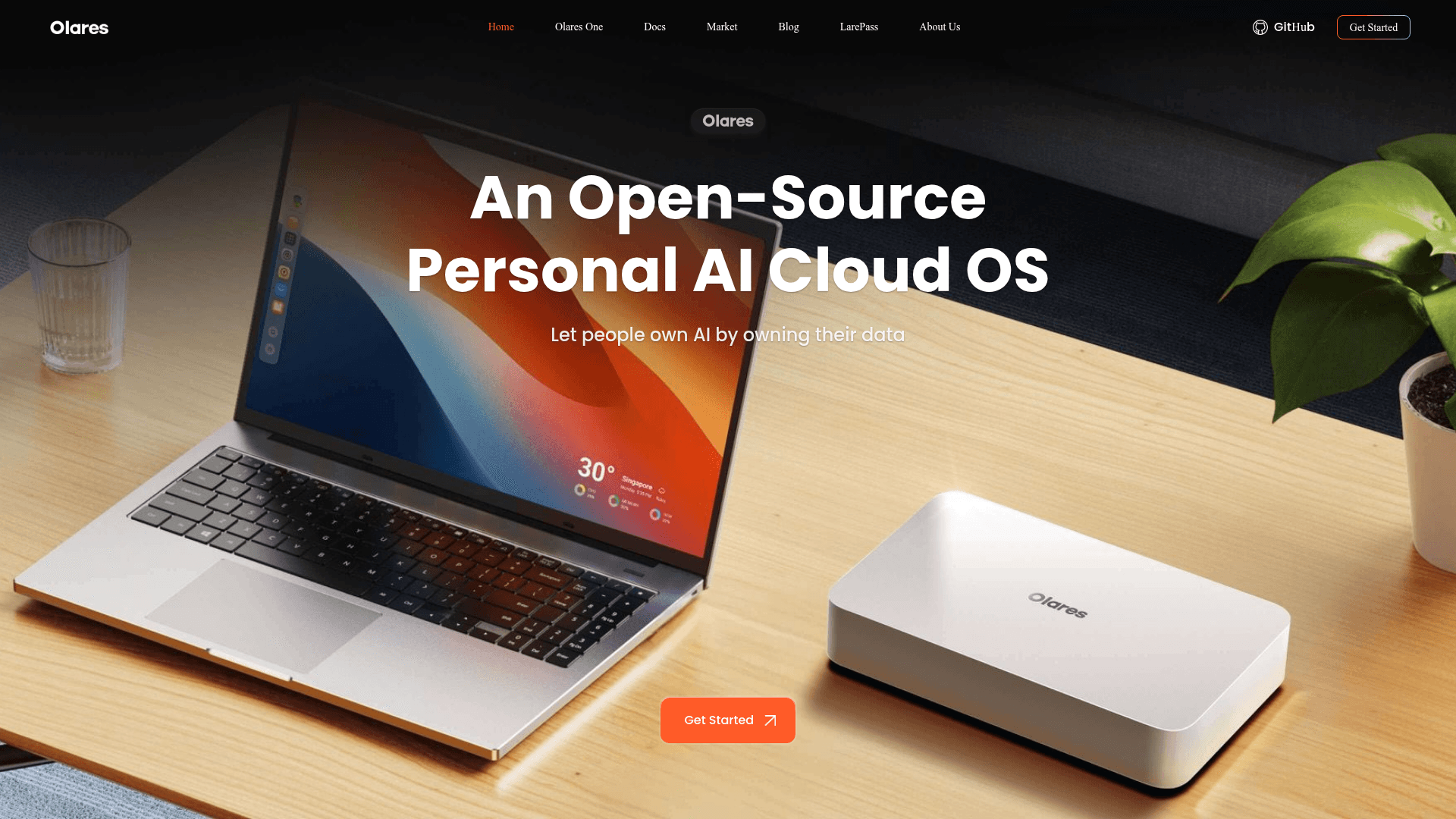
Olares is a self-hosted OS that runs on commodity Linux hardware (Ubuntu 24.04+ or Debian 11+) and delivers a smartphone-intuitive desktop experience on top of a cloud-native infrastructure stack. Rather than replacing a single cloud service, it positions itself as a full personal cloud platform: users can run local LLMs via Ollama, generate images with ComfyUI, perform private AI-driven search with Vane (formerly Perplexica), manage files, store passwords, and install community apps — all from a unified interface. The architecture mirrors public cloud layers: infrastructure (Kubernetes/K3S), platform (databases, message queues), framework (sandboxed app runtime), built-in apps, and a community app market.
Architecture and Open-Source Stack
Olares is built on a deep stack of well-known open-source projects rather than proprietary components:
- Infrastructure: Kubernetes, K3S, JuiceFS, MinIO, containerd
- Networking: Tailscale, Headscale, Cloudflare Tunnel, FRP, Envoy
- Security: Authelia, Infisical, Open Policy Agent, lldap
- Storage and backup: Seafile, Restic, Velero, Rclone
- Databases: PostgreSQL, MongoDB, Citus, KVRocks
- Observability: Prometheus, Jaeger, OpenTelemetry
- App lifecycle: Helm, Argo, NATS
The primary implementation language is Go, and the repository is organized into apps, cli, daemon, framework, infrastructure, and platform directories.
Built-In Apps and Desktop Experience
Olares ships a full suite of built-in applications accessible from a desktop-like interface:
- Files – unified file manager with cross-device sync
- Vault – self-hosted password manager with end-to-end encryption, 2FA, and shared vaults (described as a 1Password alternative)
- Wise – local-first reader and knowledge base with AI-powered recommendations
- Market – sandboxed app ecosystem with one-click install
- Control Hub – no-CLI Kubernetes console for monitoring and managing all services
- Studio (Devbox) – integrated development environment for building and publishing Olares apps
- Settings – centralized configuration for users, security, networking, and integrations
Single sign-on spans all installed applications through a shared authentication service.
Key Use Cases
The README identifies several primary deployment scenarios:
- Edge AI: running local LLMs, computer vision, and speech recognition models with GPU management
- Personal data repository: secure file sync and management across devices
- Self-hosted workspace: open-source SaaS alternatives for team collaboration
- Private media server: personal streaming with user-owned media
- Smart home hub: IoT and home automation control
- Decentralized social media: self-hosted Mastodon, Ghost, or WordPress instances
- Learning platform: hands-on Kubernetes and container orchestration practice
Deployment Paths
Users can run Olares in three ways, according to the website:
- Bring Your Own Hardware – install the open-source OS on any compatible Linux machine
- Olares One – a purpose-built hardware appliance from the Olares team, preloaded with the OS and AI-ready specs; the Kickstarter launch is scheduled for December 2025
- OEM/Manufacturing – white-label hardware program using Olares reference designs and official images
The companion mobile and desktop app, LarePass, provides remote access to the Olares instance from any device or browser.
Update: v1.12.6 and Olares One Milestone
The latest GitHub release is v1.12.6, published July 16, 2026. The About page notes that Olares OS 1.12.0 was released in August 2025 and described as "our most robust major release yet." On the hardware side, Olares One completed its Engineering Validation Test (EVT) in May 2025 and its Design Validation Test (DVT) in October 2025, with a Kickstarter launch scheduled for December 2025. Development began in April 2022, with the first major 1.x release in April 2024.
Community Discussions
Be the first to start a conversation about Olares
Share your experience with Olares, ask questions, or help others learn from your insights.
Pricing
Open Source
Full Olares OS available free under AGPL-3.0. Install on your own hardware with all features included.
- Full personal cloud OS on your own hardware
- Built-in apps: Files, Vault, Wise, Market, Control Hub, Studio
- Local AI model hosting and GPU management
- Community app market
- Single sign-on
Capabilities
Key Features
- Open-source personal cloud OS (AGPL-3.0)
- Kubernetes-powered infrastructure
- Built-in desktop with file manager, vault, reader, and app market
- Self-hosted password manager with end-to-end encryption and 2FA
- Local AI model hosting (LLMs, computer vision, speech recognition)
- GPU management for edge AI workloads
- Single sign-on across all installed applications
- Sandboxed application ecosystem with one-click install
- Unified file system with automated scaling and backups
- Cross-device access via LarePass mobile and desktop clients
- No-CLI Kubernetes console (Control Hub)
- Integrated development environment (Studio/Devbox)
- Private knowledge base with local recommendation algorithms
- Tailscale/Headscale-based secure networking
- Community app market
- Smart home and IoT hub support
- Decentralized social media app support (Mastodon, Ghost, WordPress)