
GrowthBook
Warehouse-native open-source platform for feature flags, A/B experimentation, and product analytics, available as cloud or self-hosted.
At a Glance
About GrowthBook
GrowthBook is an open-core platform built by Graham McNicoll and Jeremy Dorn, co-founded in 2020, that combines feature flag management, A/B experimentation, and product analytics in a single warehouse-native product. The core codebase is available on GitHub under the MIT license (with enterprise features under a separate commercial license), and the platform can be deployed on GrowthBook Cloud or self-hosted via Docker. The GitHub repository has accumulated over 8,000 stars as of mid-2026.
What It Is
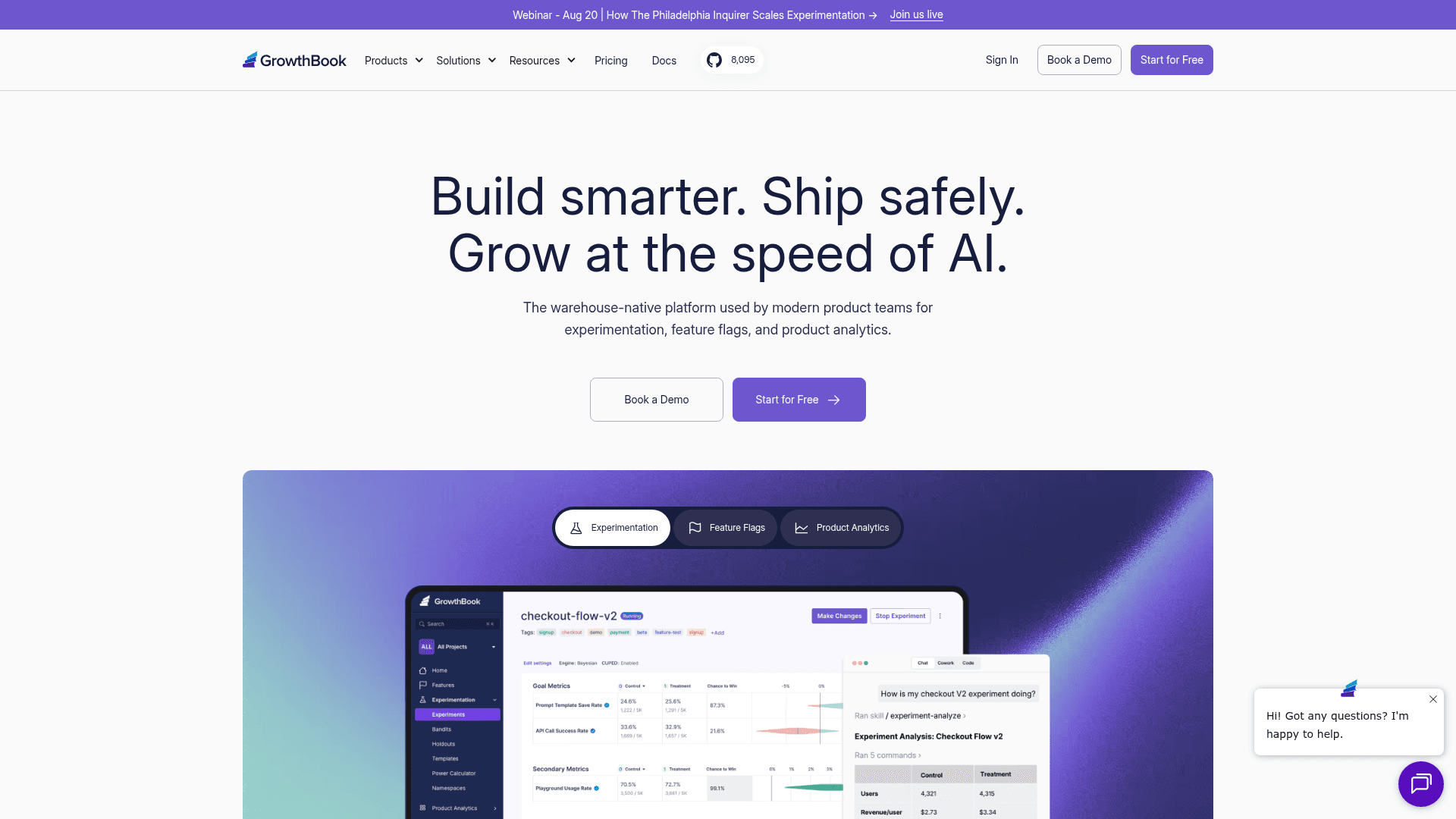
GrowthBook sits at the intersection of feature management and experimentation infrastructure. Rather than storing event data in a proprietary database, it queries data directly from a team's existing data warehouse—Snowflake, BigQuery, Redshift, Databricks, ClickHouse, and others—making it "warehouse-native." Teams define metrics in SQL, run A/B tests and feature flag experiments, and analyze results without duplicating data into a vendor-controlled store. A built-in product analytics suite lets teams build dashboards and explore user behavior alongside experiment results.
Warehouse-Native Architecture
The warehouse-native design is a core architectural differentiator. GrowthBook connects to 11+ data sources and runs statistical queries directly against a team's existing warehouse rather than requiring event forwarding to a proprietary store. This means experiment analysis uses the same data pipelines and governance controls already in place. Enterprise plans add fact-table optimization and incremental data refresh to reduce query costs and latency at scale. A managed warehouse option is also available for teams that want to get started without connecting their own data infrastructure.
Experimentation and Statistical Engine
GrowthBook's stats engine supports both Bayesian and Frequentist approaches, with advanced methods including CUPED/variance reduction, sequential testing, multi-arm bandits, sticky bucketing, sample ratio mismatch (SRM) detection, post-stratification, and multiple testing corrections. The platform includes a power calculator, decision framework, holdouts, and customizable pre-launch checklists. Experiment results can be shared via shareable reports and presentation views, and an insights dashboard aggregates learnings across the program.
Feature Flag Management
Feature flags in GrowthBook support percentage rollouts, advanced targeting, instant kill switches, scheduled flags, safe rollouts with auto-rollback, and ramp schedules. Flags are evaluated locally in the SDK (zero network calls at evaluation time), with optional remote evaluation for server-side use cases. The platform ships 24+ SDKs covering JavaScript, React, Python, Go, Ruby, PHP, Java, Kotlin (Android), Swift (iOS), Flutter, React Native, Rust, Elixir, C#/.NET, and edge runtimes including Cloudflare Workers, Fastly Compute, and Lambda@Edge. OpenFeature providers are available for Python, Go, .NET, and Java.
AI-Native Development and MCP Server
GrowthBook 5.0, released July 2026, introduced agent-ready capabilities including an MCP (Model Context Protocol) server that lets AI coding agents create feature flags, start experiments, and clean up stale flags directly through tool calls. An AI Visual Editor and an AI Data Analyst (beta) are included across plans. The platform also supports bringing your own LLM provider at the enterprise tier, and exposes agent skills alongside a full REST API and webhooks for custom integrations.
Update: GrowthBook 5.0
Version 5.0.0 was published on July 20, 2026. The release is described on the GrowthBook blog as "Build, ship, and improve at scale," with the headline additions being agents in the workflow, warehouse-native analytics, and expanded experimentation tooling for company-wide programs. The GitHub repository shows active development with the last push on August 5, 2026. The project's open-source lineage dates to 2021, with the commercial cloud offering running alongside the self-hosted option throughout.
Deployment and Security
GrowthBook offers two deployment paths: GrowthBook Cloud (managed SaaS) and self-hosted (Docker Compose, on-premises or private cloud). Both paths share the same feature set. The platform is SOC 2 Type II certified and compliant with GDPR, COPPA, and CCPA. Enterprise plans add HIPAA BAA availability, exportable audit logs, custom OIDC SSO, SCIM provisioning, custom roles, team permissioning, and approval workflows for flag and experiment changes.
Community Discussions
Be the first to start a conversation about GrowthBook
Share your experience with GrowthBook, ask questions, or help others learn from your insights.
Pricing
Starter
For individuals or small teams to launch features and experiment quickly on GrowthBook Cloud.
- Up to 3 users
- 1 project
- Unlimited feature flags
- Unlimited experiments
- Unlimited traffic
Open Source
Self-hosted GrowthBook for teams who want full control. Free with unlimited users.
- 1 project
- Unlimited feature flags
- Unlimited experiments
- Unlimited traffic
- Unlimited users
Pro
For small and mid-sized teams with advanced statistics and analytics on GrowthBook Cloud.
- Up to 50 users
- 3 projects
- Unlimited feature flags
- Unlimited experiments
- Unlimited traffic
- Visual editor
- Multi-arm bandits
- Safe rollouts
- Customizable dashboards
- Advanced permissioning
- Power calculator
- Sequential testing
- CUPED / Variance Reduction
- Sticky bucketing
- Funnel builder
- Premium support
- 2M CDN requests/mo
- 20GB CDN bandwidth/mo
Enterprise
For teams running experimentation and releasing features at scale on GrowthBook Cloud.
- Custom environments
- Ramp schedules
- Approval workflows
- Advanced access control
- SSO & SCIM provisioning
- Exportable audit logs
- 99.99% uptime SLAs
- Optimizations for large datasets
- Dedicated support & training
- Holdouts
- Custom experiment dashboards
- Post-stratification
- Bring your own LLM provider
Enterprise (Self-Hosted)
Enterprise features on your own infrastructure with dedicated support and advanced governance.
- Custom environments
- Advanced access control
- SSO & SCIM provisioning
- Advanced permissioning workflows
- Visual editor
- Multi-arm bandits
- Safe rollouts
- Ramp schedules
- Approval workflows
- Sticky bucketing
- Holdouts
- Dedicated support & training
- Bring your own LLM provider
- Multi-tenant mode
Capabilities
Key Features
- Feature flags with advanced targeting and gradual rollouts
- A/B testing and multivariate experimentation
- Warehouse-native analytics (Snowflake, BigQuery, Redshift, Databricks, ClickHouse)
- 24+ SDKs for web, mobile, server, and edge runtimes
- Bayesian and Frequentist statistical engines
- CUPED/variance reduction and sequential testing
- Multi-arm bandits
- Sticky bucketing
- Sample ratio mismatch (SRM) detection
- Safe rollouts with auto-rollback
- Ramp schedules
- AI Visual Editor
- AI Data Analyst (beta)
- MCP server for AI agent integration
- Built-in product analytics suite
- Funnel builder
- Power calculator
- Shareable experiment reports
- Webhooks and REST API
- Self-hosted (Docker) and cloud deployment options
- SOC 2 Type II, GDPR, COPPA, CCPA compliance
- SSO and SCIM provisioning (Enterprise)
- Approval workflows and audit logs (Enterprise)
- OpenFeature provider support