
OpenBots
Open-source, self-hostable workspace for building AI agents with isolated cloud desktops, persistent memory, background schedules, and 200+ SaaS integrations.
At a Glance
Open-source, self-hostable core product licensed under the MIT License. External costs for LLM provider keys, database and Daytona sandboxes apply separately.
Engagement
Available On
Listed Nov 2026
About OpenBots
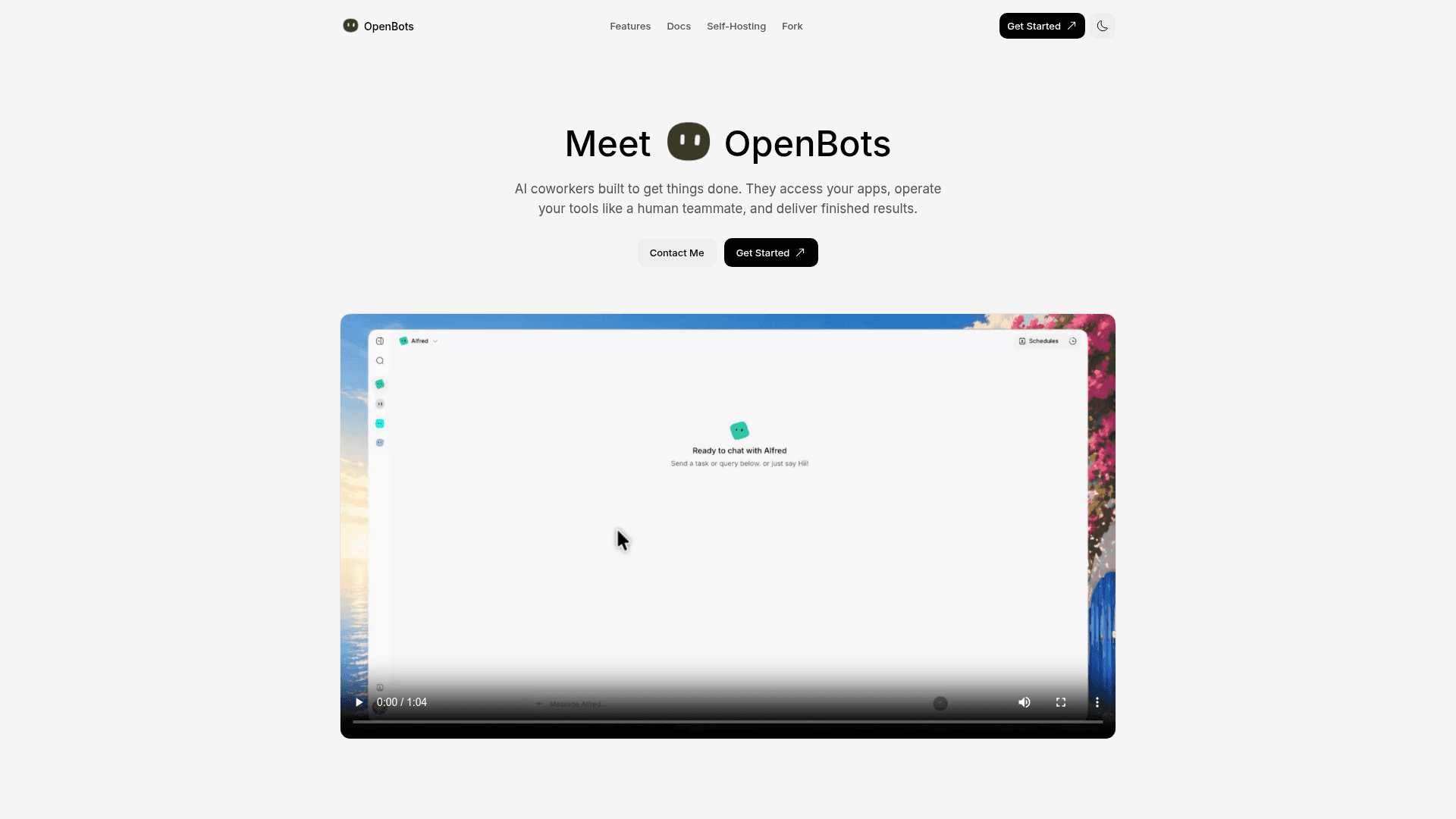
OpenBots is an open-source workspace for creating a team of AI agents that research, write and execute code, use connected apps, and run tasks in the background. Each agent has its own personality, persistent memory, and an isolated virtual machine. The project is published on GitHub by r2hu1 and is self-hostable.
What It Is
OpenBots is an autonomous agent platform with a chat-based workspace. Users create agents with their own system instructions, a choice of model provider (Gemini, Claude, OpenAI, or OpenRouter), and a configurable set of allowed tools. Agents respond in a streaming chat that shows high-level activity such as researching, recalling memory, or creating a report, with sanitized technical details available on request.
Cloud Desktops and Human Takeover
Each agent is provisioned with its own Daytona cloud sandbox. The sandbox exposes a Linux desktop and browser that the user can watch live via noVNC, and agents control it through mouse, keyboard, window, and screenshot actions. When an agent meets a Captcha, 2FA prompt, or payment confirmation, it pauses so the user can take over in the desktop and then hand control back. Deleting an agent removes its sandbox, schedules, memories, and cached state.
Artifacts, Memory, and Schedules
Agents produce interactive artifacts rendered in the timeline: HTML/CSS prototypes, Mermaid diagrams, SVGs, PDFs, Word documents, spreadsheets (XLSX, CSV), and Markdown, with export options. Memory tools (search_memory, save_memory, delete_memory, get_chat_history) let agents retain context across sessions, and a Memory sheet lets users review and delete entries. Delayed and recurring tasks run through Trigger.dev, survive server restarts, and can send Web Push notifications when they finish.
Integrations and Setup
Connections run through Composio and the Model Context Protocol, covering services such as Gmail, Google Calendar, Notion, GitHub, Linear, Jira, Slack, Discord, and others, plus custom MCP servers. Local setup uses Bun, a PostgreSQL database, an LLM provider key, and optionally a Daytona API key for the cloud desktop. A self-hosting guide and technical documentation are provided in the repository. The README states the project is MIT licensed, though the GitHub metadata lists no license.
Community Discussions
Be the first to start a conversation about OpenBots
Share your experience with OpenBots, ask questions, or help others learn from your insights.
Pricing
Self-Hosted (MIT)
Open-source, self-hostable core product licensed under the MIT License. External costs for LLM provider keys, database and Daytona sandboxes apply separately.
- 100% open-source and self-hostable
- MIT License per README (GitHub metadata shows no license detected)
- Requires own PostgreSQL database and LLM provider key
- Optional DAYTONA_API_KEY for Cloud Isolated Desktop
Capabilities
Key Features
- Dedicated agents with custom system instructions, models, and tool permissions
- Isolated Daytona cloud desktop per agent with noVNC live view
- Human-in-the-loop takeover for Captcha and 2FA
- Persistent cross-session agent memory with Memory sheet
- Interactive artifacts: HTML, Mermaid, SVG, PDF, DOCX, XLSX/CSV
- Durable scheduled background tasks via Trigger.dev
- Web Push notifications
- Human-readable activity stream
- Multi-image upload for visual analysis
- 200+ SaaS integrations via Composio and custom MCP servers
- Self-hostable