
OpenCode Memory
A persistent memory plugin for AI coding agents that enables long-term context retention across sessions using a local vector database (Turso/libSQL).
At a Glance
Fully free and open-source plugin available via npm. No cost to use, modify, or distribute.
Engagement
Available On
Alternatives
Listed Aug 2026
About OpenCode Memory
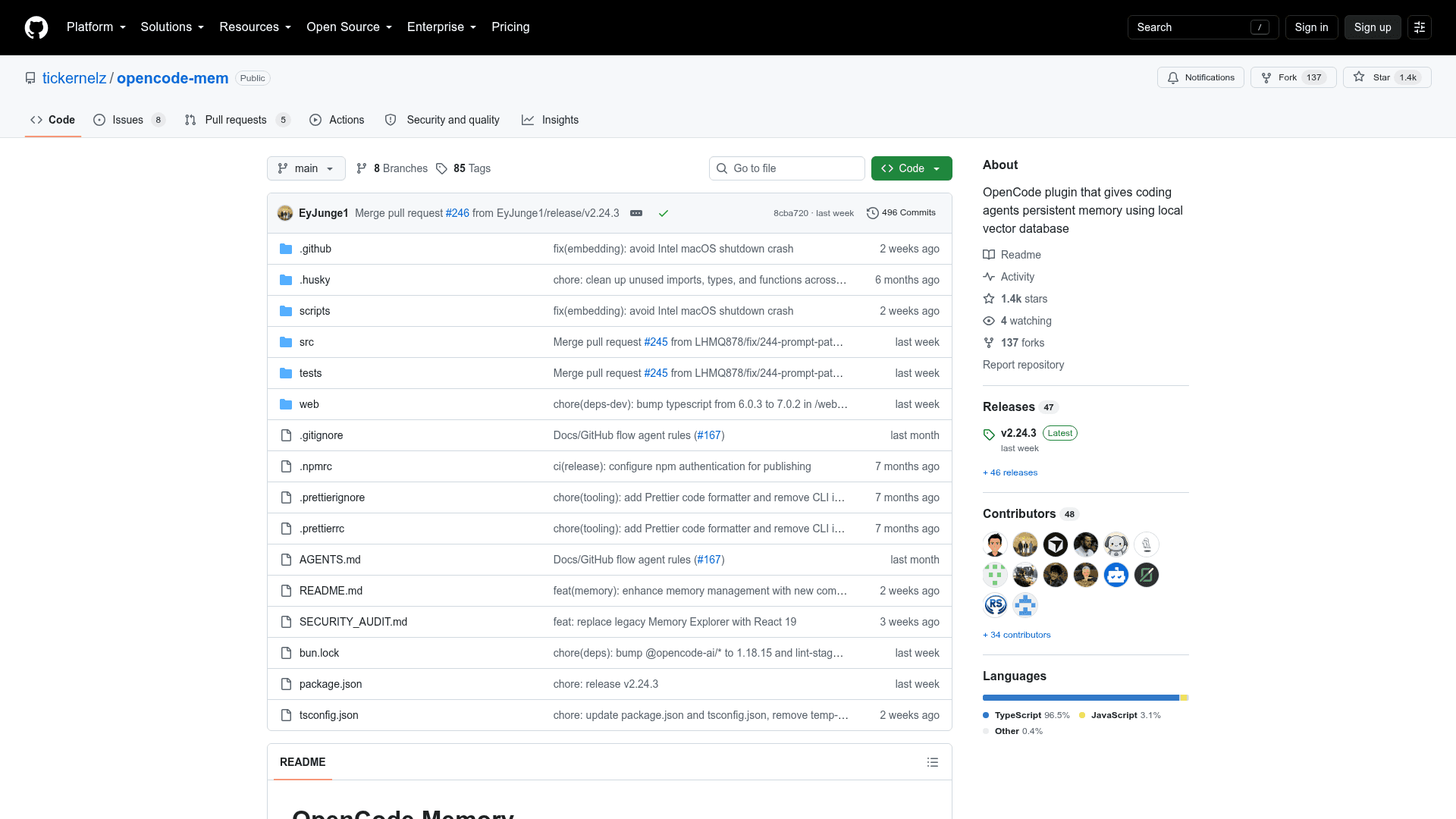
OpenCode Memory is an open-source plugin for the OpenCode AI coding platform that gives coding agents a persistent, searchable memory store backed by a local Turso/libSQL vector database. It runs entirely on-device by default, requiring no external vector database service, and supports both automatic background memory capture and manual memory management via a built-in tool API. The project has accumulated over 1,300 GitHub stars and 135 forks since its creation in early 2026.
What It Is
OpenCode Memory (published as opencode-mem on npm) is a plugin that attaches a long-term memory layer to OpenCode coding sessions. When a session goes idle, a background AI request extracts technically meaningful context—architecture decisions, bug patterns, user preferences—and stores it as vector embeddings in a local libSQL database. In later sessions, relevant memories are automatically injected into context, so the agent "remembers" prior work without the user needing to re-explain it.
How Memory Is Captured and Retrieved
The plugin operates in two modes that can run simultaneously:
- Auto-capture: After conversation turns, a background AI request summarizes technical work and saves it as a memory entry. Requires an AI provider that supports structured/tool-call output (e.g., Anthropic Claude, OpenAI GPT-4o-mini).
- Manual tool calls: The
memorytool supportsadd,search,list,profile,forget,list-shards,migrate,export, andimportoperations on demand.
Memories are scoped per project (keyed by git remote URL or project root path) or can be queried across all projects with scope: "all-projects". A separate User Profile accumulates cross-project preferences and habits, updated automatically on a configurable interval.
Embedding and Vector Search Architecture
Vector search is powered by libSQL's native F32_BLOB column type and vector_top_k approximate nearest-neighbor index (DiskANN). No separate vector database or custom SQLite build is required. Embeddings are generated locally by default using @huggingface/transformers with ONNX runtime, with the default model being Xenova/nomic-embed-text-v1 (768 dimensions, multilingual, 8192-token context). Over 12 local embedding models are supported, and a remote OpenAI-compatible embedding endpoint can be substituted via embeddingApiUrl and embeddingApiKey configuration keys.
Supported local models include:
Xenova/nomic-embed-text-v1— default, multilingual, 768 dimsXenova/jina-embeddings-v2-base-en— English-only, 768 dimsXenova/all-MiniLM-L6-v2— very fast, 384 dimsXenova/all-mpnet-base-v2— high quality, 768 dims
Web UI and Management
A full-featured web interface is served locally at http://127.0.0.1:4747 and provides a memory–prompt timeline, capture inspection, and user profile management. When the server is exposed beyond loopback (e.g., 0.0.0.0), HTTP Basic Auth or a Bearer token (webServerApiToken) can be required for all /api/* requests. The UI supports re-embed migrations, shard browsing, and export/import workflows.
Multi-Provider AI Support
Auto-capture and user profile learning work with any provider listed by opencode providers list, including Anthropic, OpenAI, GitHub Copilot, and others. The recommended configuration uses opencodeProvider + opencodeModel so OpenCode owns authentication and token refresh. A manual fallback (memoryProvider) supports direct API calls to OpenAI Chat Completions, OpenAI Responses API, Anthropic Messages API, and MiniMax endpoints.
Update: v2.24.3
The latest release is v2.24.3, published on 2026-08-08. Recent development has focused on migrating from legacy SQLite shards to native Turso/libSQL vector format (with automatic migration on first startup, lock files to prevent concurrent migration, and backup preservation), fixing Intel Mac (darwin/x64) ONNX runtime teardown crashes by pinning onnxruntime-node@1.20.1, and adding the opencode-mem/tags public subpath export for third-party plugin interoperability. The project is actively maintained with CI testing across Linux, Windows, macOS 15, and macOS 26 on both Intel and Apple Silicon.
Community Discussions
Be the first to start a conversation about OpenCode Memory
Share your experience with OpenCode Memory, ask questions, or help others learn from your insights.
Pricing
Open Source
Fully free and open-source plugin available via npm. No cost to use, modify, or distribute.
- Persistent local vector memory store
- Auto-capture background memory extraction
- 12+ local embedding models
- Web UI for memory management
- Multi-provider AI support
Capabilities
Key Features
- Persistent memory across AI coding sessions
- Local Turso/libSQL vector database with native vector search
- Auto-capture: background AI extraction of technical context
- Manual memory tool (add, search, list, forget, migrate, export, import)
- User profile learning across projects
- Full-featured web UI at localhost:4747
- 12+ local embedding models via HuggingFace Transformers/ONNX
- Remote OpenAI-compatible embedding endpoint support
- Smart deduplication
- Multi-provider AI support (OpenAI, Anthropic, GitHub Copilot, MiniMax)
- Project-scoped and cross-project memory search
- Export/import for cross-machine backup and restore
- Shard migration with dry-run and backup preservation
- HTTP Basic Auth and Bearer token for web UI security
- Workspace marker file for multi-repo project memory sharing
- Public subpath exports for third-party plugin interoperability