
OpenDray
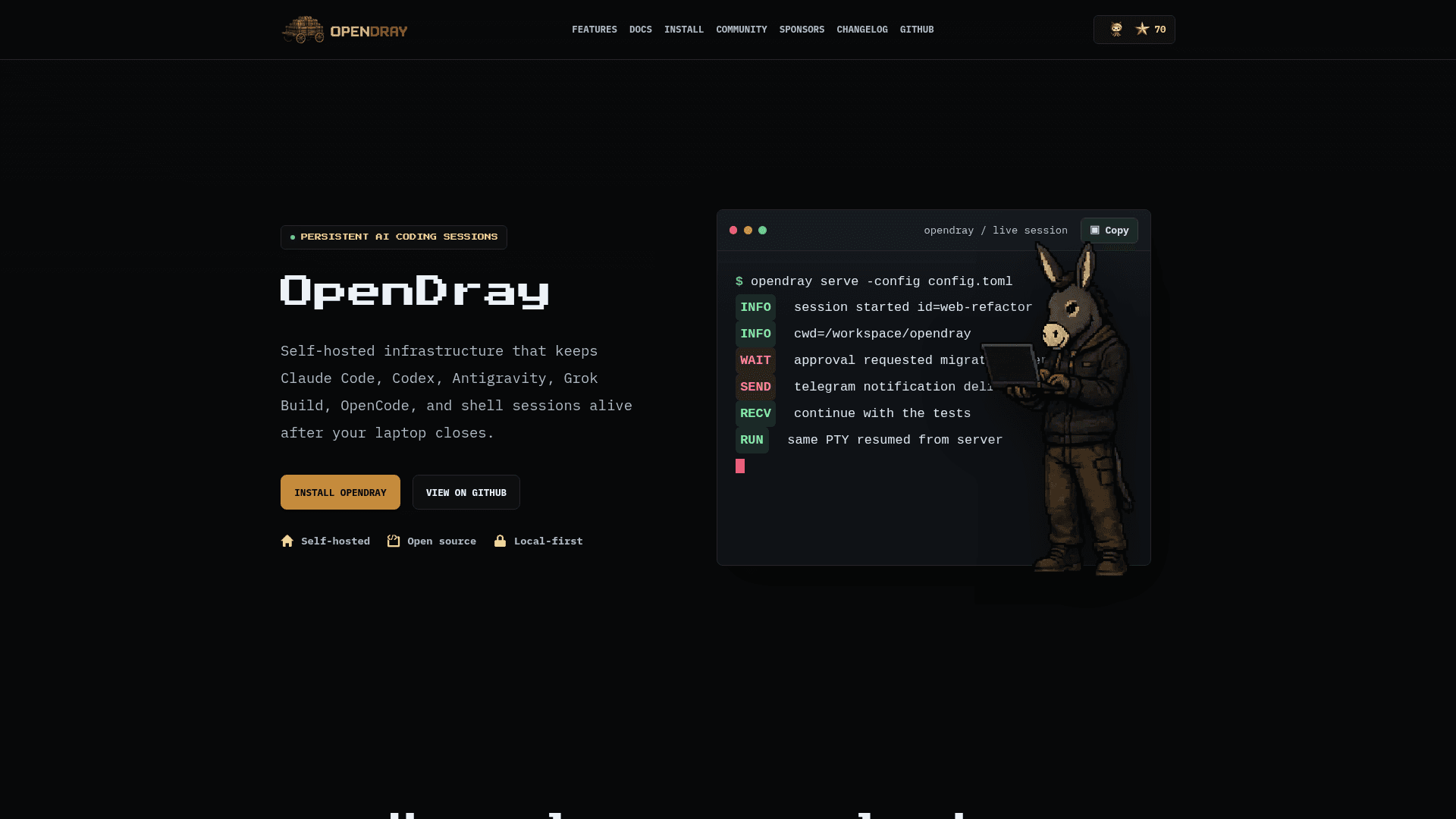
Self-hosted gateway that keeps Claude Code, Codex, Antigravity, Grok Build, OpenCode, and shell sessions running in reattachable PTY sessions.
At a Glance
Apache 2.0-licensed self-hosted OpenDray, free to self-host with no telemetry and no required cloud account.
Engagement
Available On
Listed Nov 2026
About OpenDray
OpenDray is an open-source, self-hosted gateway that runs AI coding CLIs such as Claude Code, Codex, Antigravity, Grok Build, OpenCode, and plain shell as PTY-backed sessions on a host you control. Sessions survive client disconnects, laptop sleep, and host reboot, and can be reattached from a web admin, a mobile app, or chat channels. It ships as a single Go binary under the Apache 2.0 license, with no telemetry and no required cloud account.
What It Is
OpenDray treats long-running AI coding sessions as server infrastructure rather than local terminal windows. It runs the actual agent CLIs on a host that stays awake, such as a Mac mini, NAS, or VPS, and keeps scrollback, working directory, and waiting prompts attached to the process. Developers and small teams can answer an approval prompt from another device and resume the same running task.
Memory, Accounts, and Channels
Memory is organized into user, project, and session scopes, with embeddings from ONNX, Ollama, or LM Studio and retrieval backed by Postgres with pgvector. A multi-account pool can balance new sessions and switch a live session between logged-in accounts. Bidirectional chat channels cover Telegram, Slack, Discord, Feishu, DingTalk, and WeCom, plus a Bridge adapter for custom transports; replies are routed back into the correct live session. A database inspector supports PostgreSQL, MySQL, MariaDB, and SQLite.
Building on the Gateway
A REST and WebSocket API with scoped keys and a per-call audit log lets teams build approval flows, dashboards, and automation around the same session model. A session environment config can inject credentials into every session; the docs show this with the Jev (TypeSafe) decision CLI, which returns JSON probabilities and a verdict for classify, verify, route, and screen tasks.
Deployment Model
OpenDray is host-resident by design and Docker is not a supported deploy path, because it spawns real PTY subprocesses and shares host state such as project files, SSH agent, and CLI credentials. A one-line installer supports Linux, macOS, and WSL2, with systemd and launchd service options; Windows setup goes through WSL2.
Community Discussions
Be the first to start a conversation about OpenDray
Share your experience with OpenDray, ask questions, or help others learn from your insights.
Pricing
Open Source (Self-hosted)
Apache 2.0-licensed self-hosted OpenDray, free to self-host with no telemetry and no required cloud account.
- Apache 2.0 license
- Single Go binary
- Persistent PTY sessions
- Multi-account pools with live switching
- Three-scope local-first memory
Capabilities
Key Features
- Persistent PTY sessions that survive client disconnect and host reboot
- Support for Claude Code, Codex, Antigravity, Grok Build, OpenCode, and shell
- Multi-account pool with live account switching
- Three-scope memory (user, project, session) with local-first embeddings
- Database inspector for PostgreSQL, MySQL, MariaDB, and SQLite
- Bidirectional chat channels: Telegram, Slack, Discord, Feishu, DingTalk, WeCom, and Bridge
- REST and WebSocket API with scoped keys and audit log
- Web admin and Flutter mobile app
- Session env injection for host-tool credentials such as Jev
- Round Table multi-provider threads (experimental)
- Single Go binary with cosign-signed releases