
Opengeni
Open-source agent infrastructure that provides durable sessions, sandboxes, credentials, tools, memory and multi-tenancy for embedding AI agents in products.
At a Glance
The full source. Yours to run. Self-host on your infrastructure under Apache 2.0.
Engagement
Available On
Alternatives
Listed Oct 2026
About Opengeni
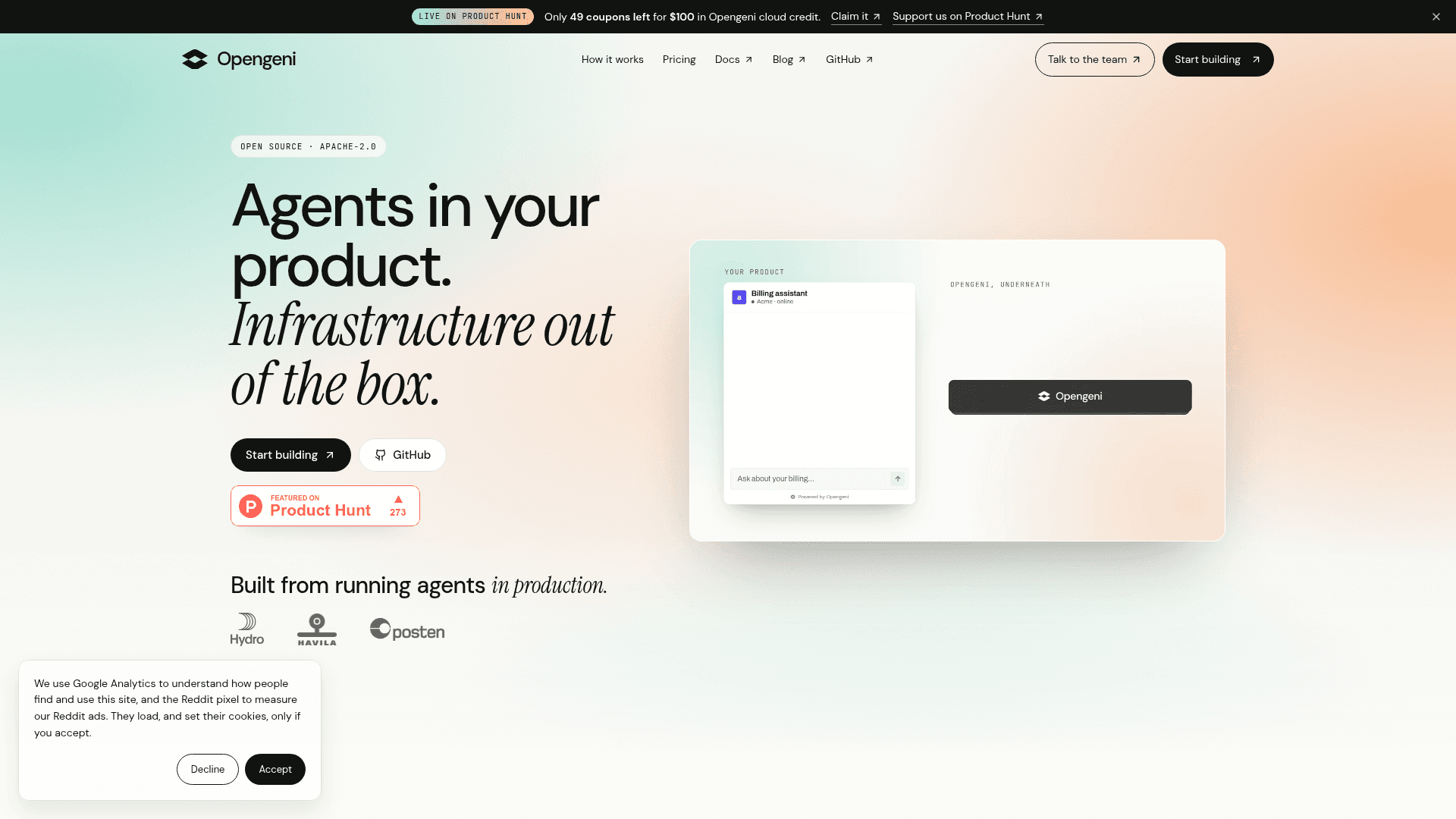
Opengeni is an Apache-2.0 open-source platform for putting AI agents inside a product without building the underlying infrastructure. Developers create sessions, send input and stream events through one API, using a TypeScript SDK, React components or plain HTTP. It is available as a managed cloud and as a self-hosted deployment.
What It Is
Opengeni is an agent execution layer. Your product supplies the interface, and Opengeni runs sessions, tools and sandboxes underneath. Sessions started by your product also appear in the Opengeni app, where teammates can follow and review them.
What the Platform Handles
The homepage lists the pieces it says you don't have to build:
- Durable sessions that resume after a worker restart or a closed tab.
- Isolated sandboxes for running agent code away from secrets.
- Per-user credential handling, including OAuth tokens and scoped short-lived tokens.
- Tools and MCP, including installing tools from an OpenAPI spec.
- Memory learned from past sessions.
- Multi-tenancy with row-level security.
- Model swapping across OpenAI, Azure OpenAI, OpenRouter or any OpenAI-compatible endpoint.
Embedding in Your Product
@opengeni/sdk/chat provides a server-side chat handler that maps product, tenant, user and conversation. @opengeni/sdk is a TypeScript client for sessions, workspaces, tools, files and event streams. @opengeni/react offers session hooks, a composer and timeline components, which can be restyled through CSS variables for accent, corners, font and light or dark theme. The backend holds the API key and proxies session routes.
Deployment Options
For local development, install Bun and Docker, add a model key to .env and run bun run dev to start the full stack, including the web app. For production, Opengeni provides a Helm chart for any Kubernetes cluster, with Terraform for AWS, Azure and GCP. Compute targets include sandbox execution and Connected Machines, where you enroll a machine you control and run work where your files and tools already live.
Community Discussions
Be the first to start a conversation about Opengeni
Share your experience with Opengeni, ask questions, or help others learn from your insights.
Pricing
Open source
The full source. Yours to run. Self-host on your infrastructure under Apache 2.0.
- Full Apache 2.0 source
- Self-host on your infrastructure
- Bring your model credentials
- Durable sessions and sandboxes
- Community support
Opengeni Cloud
Fully hosted. Ready for work. Metered model usage with no platform fee or minimum commitment.
- Model cost + 5%
- Managed infrastructure and updates
- Supported models, billed through Opengeni
- Sandboxed agent execution
- Audit and usage controls
- Invite your whole team. No seat fees
- No platform fee or minimum commitment
Enterprise
Deployment scoped together with your team.
- Private infrastructure requirements
- Deployment and integration help
- Security and access requirements
- SSO requirements and configuration
- Commercial support options
Capabilities
Key Features
- Durable sessions that resume after failures
- Isolated sandbox execution
- Per-user credential and OAuth token handling
- Tools and MCP support, including OpenAPI-based tool install
- Persistent memory across sessions
- Multi-tenancy with row-level security
- Model provider swapping
- TypeScript SDK and server-side chat handler
- Themeable React components
- Connected Machines
- Self-hosting via Helm and Terraform