Trinity
Self-hosted, open-source production runtime for autonomous AI agents — governed, auditable, and deployable on your own infrastructure under Apache 2.0.
At a Glance
About Trinity
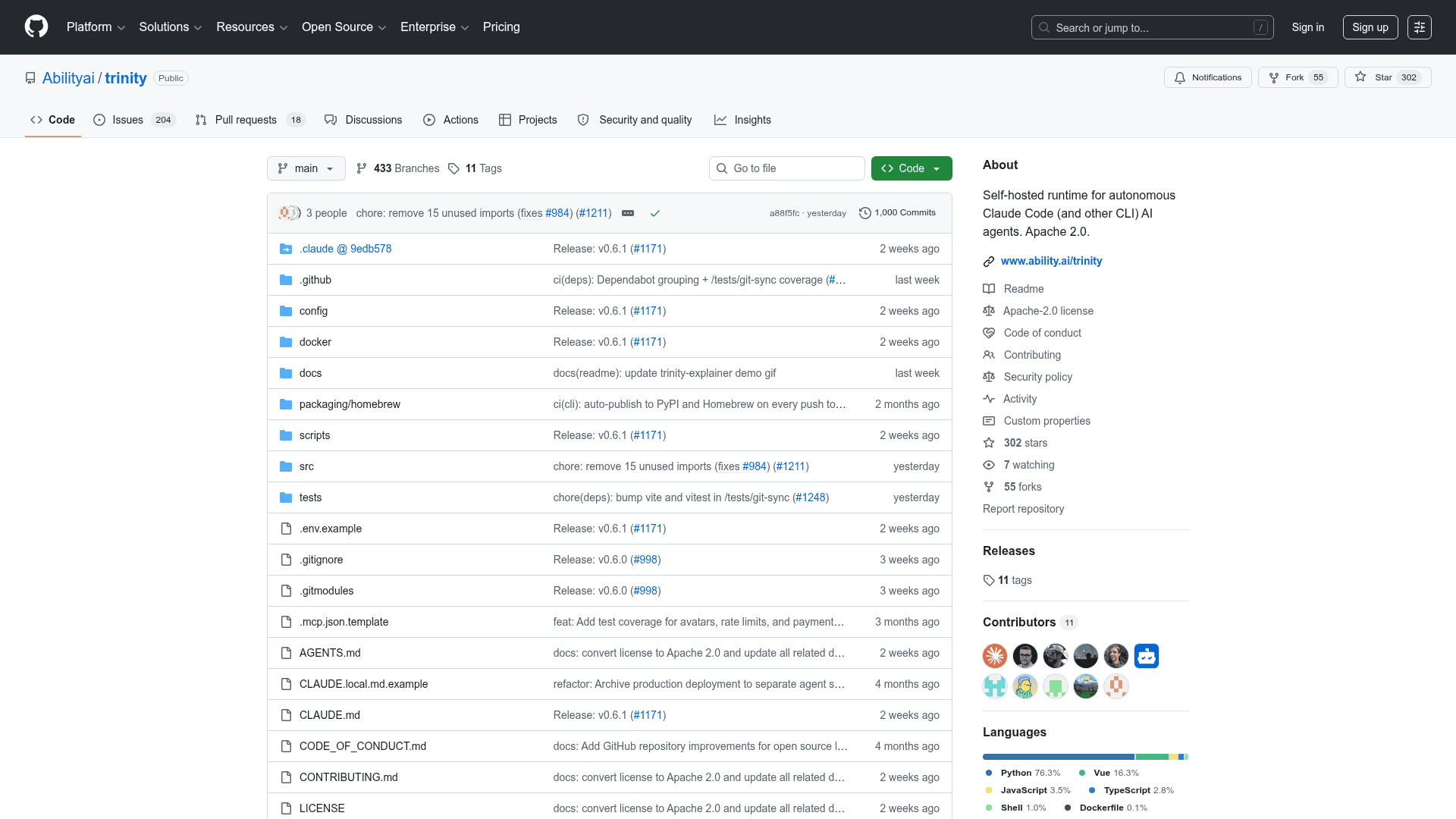
Trinity is the open-source production runtime for autonomous AI agents built by Ability.ai. Licensed under Apache 2.0, it lets teams self-host a full agent orchestration platform on their own infrastructure — or have Ability.ai run it as managed operations. The repository was created in December 2025 and has accumulated over 300 GitHub stars as of mid-2026.
What It Is
Trinity is an agent orchestration platform that takes AI agents from a developer's laptop into production. Each agent runs in its own isolated Docker container with real-time observability, fleet-wide scheduling, agent-to-agent delegation, and a tamper-evident audit trail. The README positions it against three alternatives: SaaS platforms (where data leaves your perimeter), custom builds (6–12 months of engineering), and bare frameworks (no observability or fleet management). Trinity is designed to address all three gaps in a single self-hosted package.
Architecture and Stack
Trinity is built on a multi-service architecture:
- Frontend — Vue.js 3 + Tailwind CSS, served on port 80
- Backend — FastAPI, port 8000
- MCP Server — 74 tools for external orchestration, port 8080
- Scheduler Service — Cron-based automation with Redis distributed locks, port 8001
- Vector — Log aggregation, port 8686
- Agent Containers — Each agent runs in its own isolated Docker container
The platform supports two agent runtimes: Claude Code (Anthropic) and Gemini CLI (Google), selectable per agent. Persistent state is stored in SQLite with Git-backed versioning for agent memory.
Fleet Observability and Governance
Trinity's control plane provides a graph view of the entire agent fleet with live status, success rates, cost tracking, and resource usage per agent. A Gantt-style timeline shows execution history color-coded by trigger type (manual, scheduled, MCP, agent-triggered, public, paid). The platform exports OpenTelemetry metrics and distributed traces to external tools like Grafana or Datadog.
Governance features include:
- Platform Audit Log — Append-only, cross-cutting audit trail for lifecycle, auth, and MCP events (admin-only API)
- Role Hierarchy — 4-tier RBAC (
user<operator<creator<admin) - Deterministic Guardrails — Configurable per-agent safety enforcement
- Chain-of-thought logging — Full transparency into why an agent made a decision
The README states Trinity received a Grade A (Excellent) in an independent web application penetration test by UnderDefense (April 2026), with all critical and high findings remediated.
Deployment Model and Self-Hosting
Trinity deploys with a single curl command that clones the repository, configures the environment, builds the base image, and starts all services via Docker Compose. A quickstart.sh script provides an interactive guided setup. The Trinity CLI (pip install trinity-cli or brew install abilityai/tap/trinity-cli) offers a terminal-first alternative for deploying and managing agents.
The platform also integrates with Claude Code via the Abilities plugin marketplace (github.com/abilityai/abilities), which covers the full agent lifecycle: scaffold, develop, deploy, and iterate. Plugins like /create-agent:create, /trinity:onboard, and /trinity:sync define the canonical workflow for building and managing agents from within Claude Code.
Multi-agent systems can be defined in a single YAML manifest and deployed via MCP or the REST API, enabling coordinated fleets with shared folders, hierarchical delegation, and cron-based scheduling.
Channel Integrations and Access Control
Agents are reachable through pluggable channel adapters: Slack (Socket Mode + webhooks, per-channel agent binding), Telegram (DMs, groups, voice transcription, file uploads), and WhatsApp via Twilio. A unified verified-email allow-list governs access across web, Slack, and Telegram with per-agent require_email / open_access policies. Agents can also initiate proactive conversations with users via send_message and send_group_message MCP tools.
Update: Active Development as of June 2026
The repository was last pushed on June 22, 2026, with 222 open issues and 55 forks, indicating active community engagement. The README references recent feature additions including per-agent GitHub PAT support, unified access control, proactive messaging, and a mobile admin PWA. Optional enterprise modules — SSO, user management, and SIEM export — are available under a separate commercial license. Ability.ai states it runs Trinity in production internally, claiming over 1 million agent runs per week and 99.94% scheduler uptime over a trailing 90-day window.
Community Discussions
Be the first to start a conversation about Trinity
Share your experience with Trinity, ask questions, or help others learn from your insights.
Pricing
Open Source
Full Trinity platform under Apache 2.0 — free for any use, commercial included. Self-host on your own infrastructure.
- Full platform source code under Apache 2.0
- Self-host on any infrastructure
- Isolated Docker containers per agent
- Fleet observability and audit log
- 74-tool MCP server
Enterprise
Optional enterprise modules including SSO, user management, and SIEM export under a separate commercial license.
- SSO integration
- Advanced user management
- SIEM export
- Commercial license
Capabilities
Key Features
- Isolated Docker container per agent
- Fleet graph view with live status and cost tracking
- Gantt-style execution timeline
- Cron-based scheduling with Redis distributed locks
- Agent-to-agent delegation and orchestration
- 74-tool MCP server for external orchestration
- Multi-agent system deployment from YAML manifest
- OpenTelemetry metrics and distributed tracing export
- Append-only platform audit log
- 4-tier RBAC role hierarchy
- Deterministic guardrails per agent
- Persistent memory (file-based and database-backed)
- Slack, Telegram, and WhatsApp channel adapters
- Verified-email unified access control
- Ephemeral SSH access to agent containers
- File manager for agent workspace
- Mobile admin PWA
- Public agent shareable links
- Paid agent access via Nevermined x402
- Trinity CLI (pip/brew installable)
- Claude Code plugin marketplace integration
- Multi-runtime support (Claude Code and Gemini CLI)
- Git-backed agent state versioning
- Real-time execution log streaming
- Execution retry and configurable timeouts
- Persistent async task backlog (SQLite FIFO)
- Custom agent dashboards via dashboard.yaml
- Agent notifications and Events page
- Template-based agent deployment from GitHub repos
- Independent pentest Grade A by UnderDefense (April 2026)
Integrations
Demo Video