
OpenRig
Open-source multi-agent harness that lets Claude Code, Codex, and Pi work together as a persistent, coordinated team on long-running software projects.
At a Glance
Fully free and open source under Apache 2.0. Self-hosted on your own infrastructure.
Engagement
Available On
Alternatives
Listed Oct 2026
About OpenRig
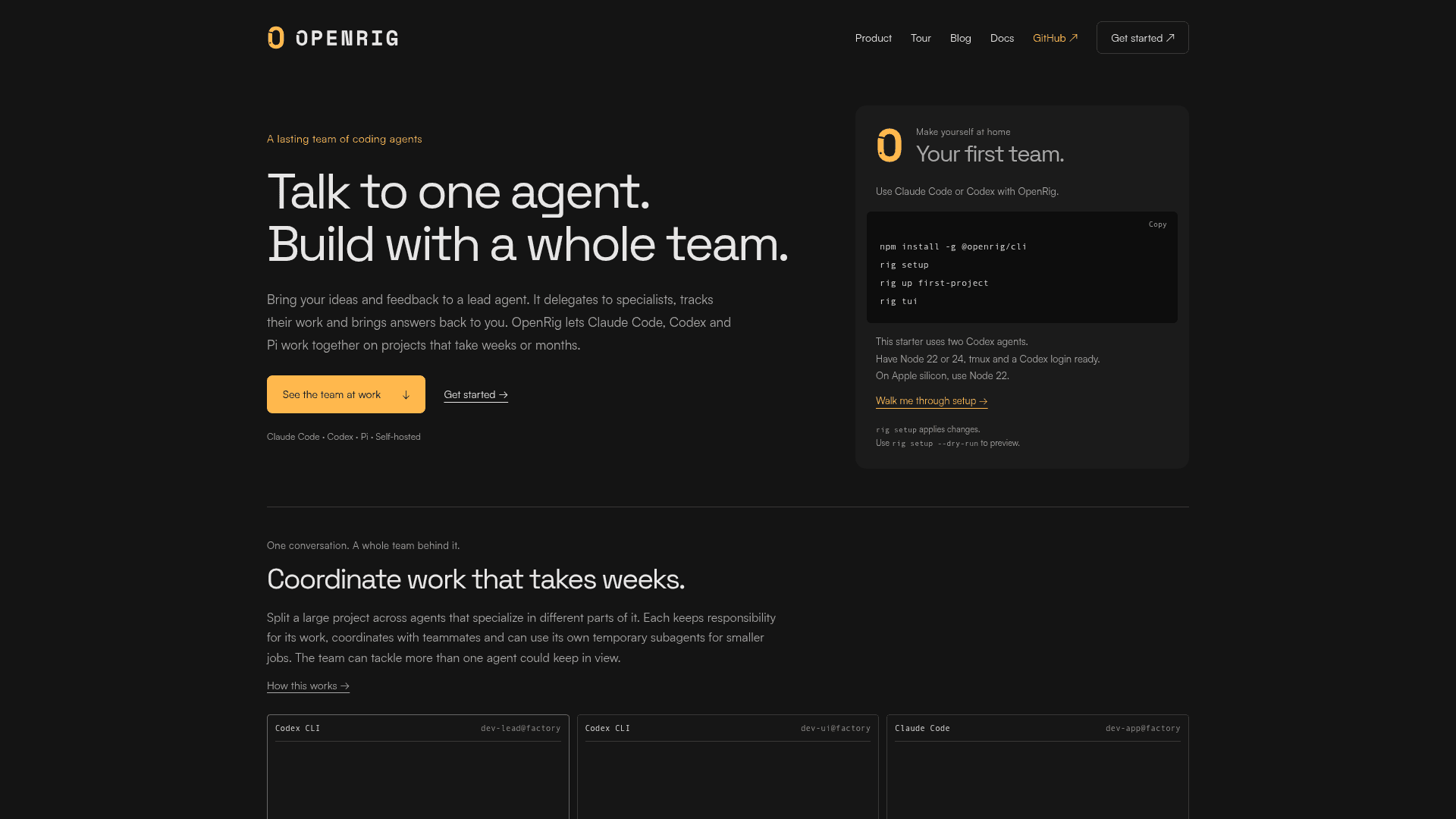
OpenRig is an open-source, self-hosted multi-agent harness built by Esoteric Labs and released under the Apache 2.0 license. It manages the system that coding agents form when run together — not the agents themselves, but the team they create: which sessions are running, how they relate, how to recover after a reboot, and how to prevent terminal sprawl. The project is written in TypeScript, installable via npm as @openrig/cli, and requires Node.js 22 or 24 and tmux on macOS or Linux.
What It Is
OpenRig sits one layer above individual AI coding agent harnesses like Claude Code and Codex. Where a harness wraps a single model, a rig wraps your harnesses — letting you define a multi-agent team in YAML, boot it with one command, and interact with it through a single lead agent that delegates to specialists. The core architecture is a local daemon, CLI, terminal UI (TUI), and MCP server, all built on tmux. Agents run in tmux sessions you can attach to directly; the TUI provides a topology explorer, table and graph views, seat details, project tracking, and a system feed.
Architecture and Key Concepts
OpenRig introduces a declarative layer (RigSpec) for defining multi-agent topologies:
- RigSpec: YAML definition of pods, members, edges, continuity policies, and a culture file
- AgentSpec: Reusable agent blueprint with skills, guidance, hooks, profiles, and startup contracts
- Seat: A stable role and address (e.g.,
dev-owner@first-project) that persists across conversation changes - Pod: A group of related seats with shared guidance; each agent still has its own context window
- Queue: Owned work items that keep their assignee and progress visible across conversations
- RigBundle: Portable archive with vendored AgentSpecs and SHA-256 integrity for sharing topologies across machines
The daemon runs a Hono HTTP server backed by SQLite and tmux runtime adapters. The MCP server exposes tools (rig_up, rig_ps, rig_send, rig_chatroom_send, etc.) so agents can manage their own topology.
How the Team Coordination Works
The central workflow involves a lead agent that receives goals from the user and delegates to durable specialist agents. Each specialist maintains ownership of its work, can spawn temporary native subagents for bounded tasks, and communicates with teammates via rig send (direct messages) or rig queue (tracked assignments). Key coordination primitives include:
rig send— direct message to a named seat, useful for quick specialist queries without creating a tracked taskrig queue— assigns owned work to a named agent; the task keeps its owner and progress for later follow-uprig broadcastandrig chatroom— team-wide communication- Snapshot/restore:
rig down --snapshotcaptures full state;rig up <name>restores from the latest snapshot
Starter Rigs and Deployment Model
OpenRig ships several ready-made rig configurations: first-project (two-seat Codex starter), conveyor (four-seat Claude Code + Codex handoff chain), product-team (larger squad with orchestrators, QA, design, and reviewers), implementation-pair, adversarial-review, research-team, and secrets-manager (HashiCorp Vault managed by a specialist agent, requires Docker). Users operate OpenRig on their own infrastructure; model usage costs from the selected providers (Anthropic, OpenAI) apply separately.
Update: OpenRig v0.6.1
The latest release is v0.6.1, published on 2026-09-29, titled "first-use repairs and one help path." The current documentation version is 0.5.14. OpenRig 0.6.0 dropped support for Node.js 20, requiring Node 22 or 24 due to the better-sqlite3 13 binding. The GitHub repository shows 2,189 stars and 161 forks as of late September 2026, with active issue and PR acknowledgment targets of one day per the contributing guide. The older React web UI remains in maintenance mode with best-effort support, with the TUI as the primary interface going forward.
Community Discussions
Be the first to start a conversation about OpenRig
Share your experience with OpenRig, ask questions, or help others learn from your insights.
Pricing
Open Source
Fully free and open source under Apache 2.0. Self-hosted on your own infrastructure.
- Full CLI, TUI, daemon, and MCP server
- Claude Code and Codex multi-agent coordination
- All starter rig templates
- Snapshot and restore
- Community support via GitHub Discussions
Capabilities
Key Features
- Define multi-agent teams in YAML (RigSpec)
- Boot entire agent teams with a single command (rig up)
- Terminal UI (TUI) with topology explorer, table, graph, and seat detail views
- Cross-harness coordination: Claude Code and Codex in the same rig
- Persistent seat addresses that survive conversation changes
- Owned work queue with assignee tracking (rig queue)
- Direct agent messaging (rig send, rig broadcast, rig chatroom)
- Snapshot and restore full rig state
- Discover and adopt existing tmux sessions into a managed rig
- MCP server for agent-driven topology management
- Starter rig library (first-project, conveyor, product-team, etc.)
- Service-backed rigs with Docker (e.g., secrets-manager with HashiCorp Vault)
- Typing guard to protect human-operated seats from automatic messages
- Slack integration via user-created app
- RigBundle portable archive for sharing topologies
- Culture files for setting coordination norms per rig type
- rig doctor for system health diagnostics
- rig setup with dry-run preview