
ZOB Harness
A governed Agent Factory for Pi that launches communicating agent teams, runs tmux-backed factories, validates artifacts, and packages repeatable workflows into reusable factories.
At a Glance
Fully free and open-source under the MIT license. Install via npm or clone from GitHub.
Engagement
Available On
Alternatives
Listed Jun 2026
About ZOB Harness
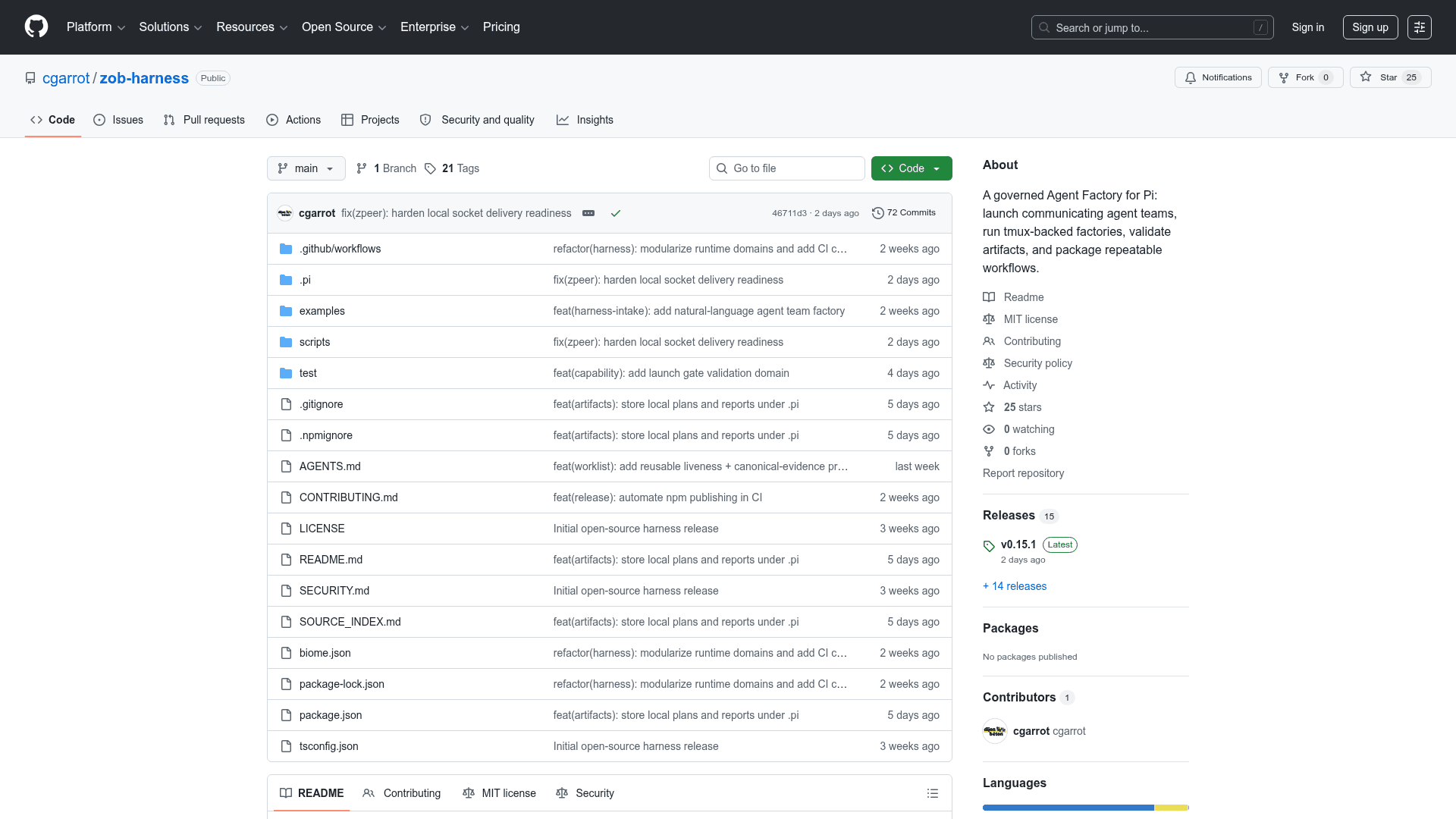
ZOB Harness is an open-source, MIT-licensed governed agent harness built on top of Pi, the coding-agent platform. It transforms Pi from a single-session assistant into a supervised multi-agent factory system where teams of specialized agents communicate visibly, produce durable artifacts, and package successful workflows for reuse. The project is maintained by cgarrot on GitHub and reached v0.15.1 as of June 2026.
What It Is
ZOB Harness is an agent harness and factory framework for Pi. Where most agent tools optimize a single assistant session, ZOB optimizes the full agent factory loop: define a team topology, launch a run, observe agent communication, review artifacts, and convert a working workflow into a reusable factory that can drive the next class of work. The core abstraction is the ZAgent/ZTeam model — roles such as chief, scout, builder, and oracle coordinate through structured, parent-visible messages rather than hidden worker chat, keeping multi-agent work debuggable and auditable.
How the Agent Factory Loop Works
A ZOB run follows a deliberate lifecycle:
- Define a ZTeam manifest with role aliases, communication policy, and parent-visible rooms.
- Prepare startup kickoff files so each agent begins with bounded, scoped instructions.
- Launch one Pi session per ZAgent, optionally backed by persistent tmux windows.
- Coordinate with structured
CONTEXT / ASK / EVIDENCE / URGENCY / BLOCKERmessages between roles. - Validate with checkpoints, sentinel gates, and oracle/no-ship review before any work is marked done.
- Package the successful workflow as a reusable manifest, launcher, kickoff set, workgraph, and validation ladder.
Artifacts under reports/<run_id>/ — manifests, kickoff files, workgraphs, status files, validation output, and oracle reports — are the source of truth, not the chat transcript.
Safety Model and Governance
ZOB is deliberately conservative. The safety posture is enforced by AGENTS.md, damage-control rules, a git policy file, a child-safety extension, and smoke scripts:
- No
.env, private key, SSH, AWS, or credential reads. - No destructive shell or git operations without explicit approval.
- No direct commits, pushes, tags, or force pushes by default; governed commits go through
/zcommitorzob_zcommit_runonly when explicitly authorized. - Completion requires concrete artifacts, validation evidence, and oracle/no-ship review when required.
- Automated npm releases are handled by GitHub Actions via semantic-release, not by local agents.
Surface and Tooling
The harness exposes approximately 77 tools, 25 commands, 39 specialist agents, 24 skills, and 75 npm scripts. The core workflow for new users centers on a small set: /zmode to pick an operating mode (explore, plan, implement, oracle, factory, orchestrator), /goal and /todo for goal-linked work breakdown, /contract for six-part delegation handoffs, and /zcommit for governed commits. Advanced surfaces — live peer communications, worker pools, goal rooms, merge queues, mission control, ProjectDNA, and ZTeam/ZAgent factory scaffolds — are opt-in and experimental.
The Harness Intake factory allows ZOB to analyze another agent harness (Claude Code, Codex, Cursor, Aider, or a custom setup) and propose reusable ZOB teams and factory scaffolds from its docs, agents, skills, commands, and prompts, writing outputs to a quarantined generated-proposals/ directory without auto-activating them.
Update: v0.15.1
The latest release is v0.15.1, published on June 17, 2026. Notable recent additions include the Goal TODO ZPeer/ZTeam handoff runtime (introduced in 0.4.0), active context discovery via zob_context_search with optional ColGREP integration, an optional intent classifier supporting regex and model-backed routing, and the zob:context:doctor / zob:context:init / zob:context:query npm script family. The project self-describes as an early, conservative, governed harness and explicitly states it should not be described as unrestricted autonomy or a production deployment system.
Community Discussions
Be the first to start a conversation about ZOB Harness
Share your experience with ZOB Harness, ask questions, or help others learn from your insights.
Pricing
Open Source
Fully free and open-source under the MIT license. Install via npm or clone from GitHub.
- Full agent factory orchestration
- All specialist agents and skills
- tmux-backed multi-agent sessions
- Governed commit workflows
- All npm scripts and smoke validators
Capabilities
Key Features
- Multi-agent team orchestration with chief, scout, builder, and oracle roles
- Visible structured agent communication (CONTEXT/ASK/EVIDENCE/URGENCY/BLOCKER)
- tmux-backed persistent agent sessions
- Durable run artifacts under reports/<run_id>/
- Reusable factory packaging from successful workflows
- Governed commits via /zcommit and zob_zcommit_run
- Goal-linked TODO trees with parent-owned workgraphs
- Oracle/no-ship review gates
- Harness Intake factory for analyzing and converting other agent setups
- Active context discovery with zob_context_search and optional ColGREP
- Optional intent classifier with regex and model-backed routing
- Automated npm releases via GitHub Actions and semantic-release
- Specialist agent delegation with /contract six-part handoff
- Smoke validation scripts for safety and surface checks
- ProjectDNA context workflows