
Openship
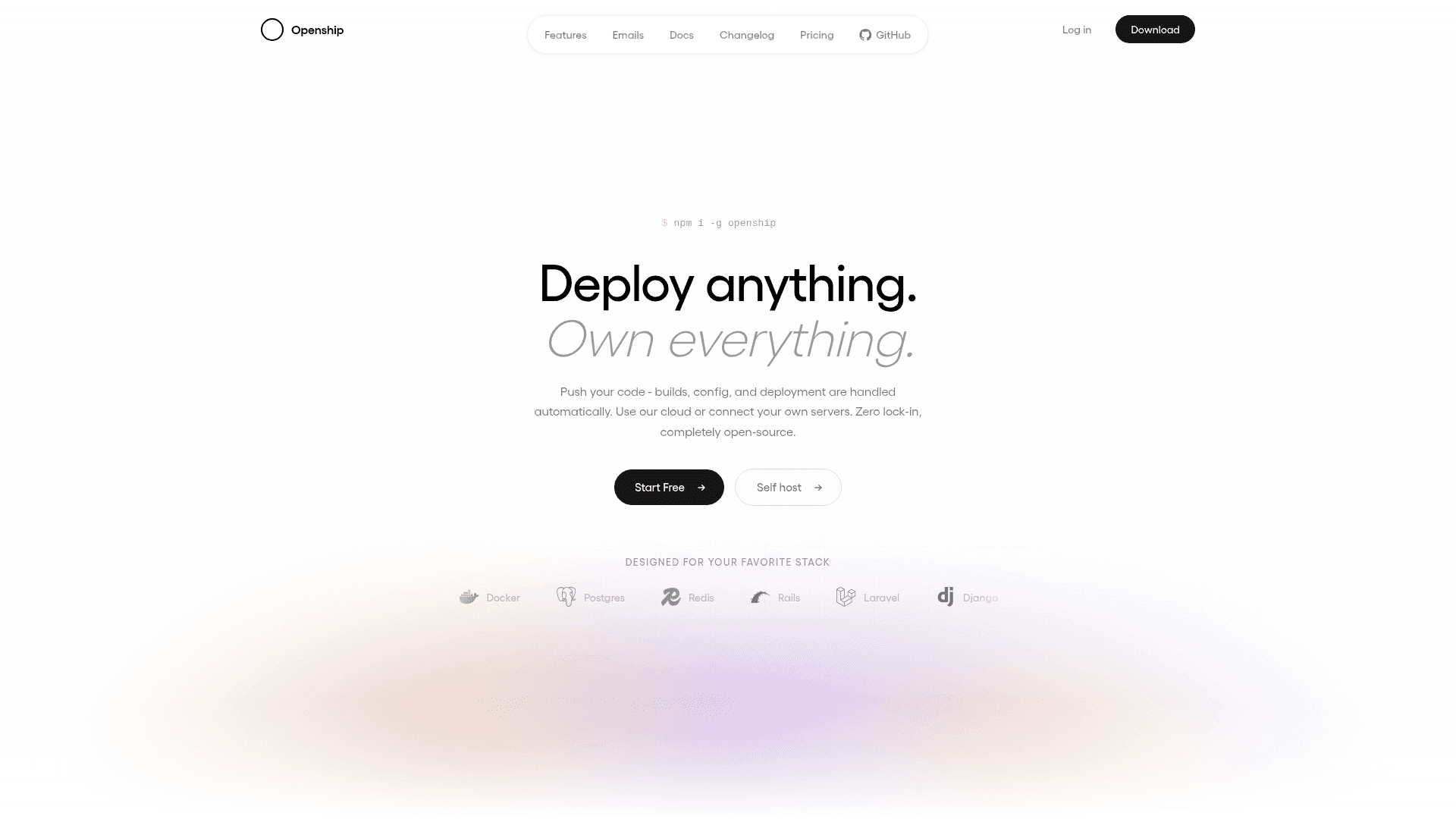
Open-source, self-hostable deployment platform with built-in CI/CD — push code, ship containers, and manage infrastructure from a desktop app, web dashboard, or CLI.
At a Glance
About Openship
Openship is an open-source deployment platform built by Oblien LLC that lets developers push code and have builds, configuration, and deployment handled automatically. It runs on Openship Cloud (managed) or any Linux server you own, and is licensed under Apache 2.0 with no vendor lock-in. The GitHub repository reached v0.1.11 as of July 2026 and is actively developed.
What It Is
Openship is a self-hostable CI/CD and infrastructure platform that covers the full path from a git push to a running container in production. It auto-detects your framework and stack, builds an immutable image, provisions managed services, wires up domains and SSL, and ships — without requiring YAML pipelines or manual configuration. It positions itself as an alternative to managed platforms like Vercel or Netlify and self-hosting tools like Coolify or Dokku, with the stated differentiator that builds run on your machine rather than on production servers.
How the Deployment Workflow Works
The platform follows a five-step path the homepage describes explicitly:
- Connect — link a Git repo and pick a target (Openship Cloud or your own server over SSH); nothing is installed on the target box
- Build — on every push, the image builds locally or in the cloud, runs tests, and is tagged as an immutable versioned artifact
- Ship — the built image streams to the target over SSH and starts as a fresh container on an isolated private network
- Route — domains are wired through OpenResty with automatic Let's Encrypt SSL and zero-downtime traffic swap
- Operate — stream logs, watch metrics, and roll back to any previous version from the CLI, web dashboard, desktop app, or an AI agent over MCP
Every deployment is an immutable snapshot, enabling one-click rollbacks without downtime.
Platform Coverage and Stack Support
The homepage lists 42 capabilities across seven categories: Deploy, Run, Connect, Services, Manage, Secure, and Collaborate. Supported languages and runtimes include Node, Python, Go, Rust, PHP, Ruby, Java, .NET, Elixir, and Docker/monorepos — auto-detected with no manual configuration. Managed services include PostgreSQL (versions 14–17), Redis, MongoDB, MySQL, S3-compatible object storage, a built-in transactional mail server (SPF/DKIM/DMARC auto-configured), and a CDN. Custom domains are unlimited with wildcard Let's Encrypt certificates and automatic renewal.
Three Interfaces and MCP Integration
Openship ships three first-class interfaces backed by the same API:
- Desktop app — native Mac and Windows, real-time logs, one-click deploys from local
- Web dashboard — team-oriented browser UI for deploys, metrics, billing, and access control
- CLI — a single binary covering deploy, logs, secrets, domains, and rollbacks; installable via
npm i -g openshipor a curl script
A REST API and an MCP server allow AI agents (Claude, Cursor, or any MCP client) to drive deployments using standard authenticated tools.
Deployment Model: Cloud, Self-Hosted, or Hybrid
The platform supports three shapes that can be switched at any time:
- Openship Cloud — managed multi-region (US, EU, APAC), auto-scaling, backups included, no infrastructure decisions
- Self-hosted — run the full platform on any Linux VPS, bare metal, or homelab; no agent or dashboard installed on target boxes; free forever under Apache 2.0
- Hybrid — cloud for burst workloads, your servers for sensitive data; one control plane, one billing, one dashboard
The homepage states that workloads move between cloud and self-hosted as plain containers with no rebuild required.
Update: v0.1.11
The latest GitHub release is v0.1.11, published July 18, 2026. The repository was created in March 2026 and has been updated continuously since. The README notes the project is "production-ready core, actively developed," with multi-node clusters, a load-balancing UI, private networking, advanced monitoring, and visual CI/CD pipelines listed as coming next. Documentation is described as still a work in progress.
Community Discussions
Be the first to start a conversation about Openship
Share your experience with Openship, ask questions, or help others learn from your insights.
Pricing
Hobby
Run the full platform on a server you own. No metering, no caps, no telemetry.
- Full platform, open source (Apache 2.0)
- Unlimited deploys, domains, projects
- All managed services - Postgres, Redis, mail
- CLI, web, desktop - same backend
- Community support
Cloud
Openship Cloud - managed multi-region, auto-scaling, backups included.
- Everything in Hobby
- Managed multi-region edge
- Auto-scaling and zero-downtime deploys
- Daily backups, point-in-time recovery
- Built-in mail server, unlimited domains
- Live monitoring and alerts
- Email support
Business
Cloud + your servers, audit logs, SSO, contractual SLA. For teams shipping production.
- Everything in Cloud
- Run apps on your VPS, services on the cloud
- SSO (SAML, OIDC) and SCIM provisioning
- Audit log retention and export
- 99.9% uptime SLA
- Priority support, dedicated channel
- Compliance-ready (SOC 2 / ISO 27001)
Capabilities
Key Features
- Push-to-deploy CI/CD
- Preview deployments per pull request
- Instant rollbacks to any immutable snapshot
- Auto-detected stack configuration (Node, Python, Go, Rust, PHP, Ruby, Java, .NET, Docker)
- Managed PostgreSQL (v14–17) with PITR
- Managed Redis, MongoDB, MySQL
- S3-compatible object storage
- Built-in transactional mail server (SPF/DKIM/DMARC)
- Unlimited custom domains with wildcard Let's Encrypt SSL
- CDN with HTTP/3 and Brotli compression
- Auto-scaling and zero-downtime rolling deploys
- Live streaming logs and real-time metrics
- Scheduled jobs with per-run logs
- Private networking (no exposed ports)
- WebSocket support
- CLI, web dashboard, and desktop app (Mac/Windows)
- MCP server for AI agent integration
- Encrypted secrets vault
- Audit log with export
- Team roles and per-resource access control
- SSO (SAML/OIDC) and SCIM provisioning (Business)
- Firewall, rate limiting, DDoS protection
- Docker Compose support
- Multi-server fan-out across regions
- Cloud ⇄ self-hosted migration in one click