
OpenVINO
Open-source toolkit by Intel for optimizing and deploying deep learning models across CPU, GPU, and NPU hardware targets.
At a Glance
About OpenVINO
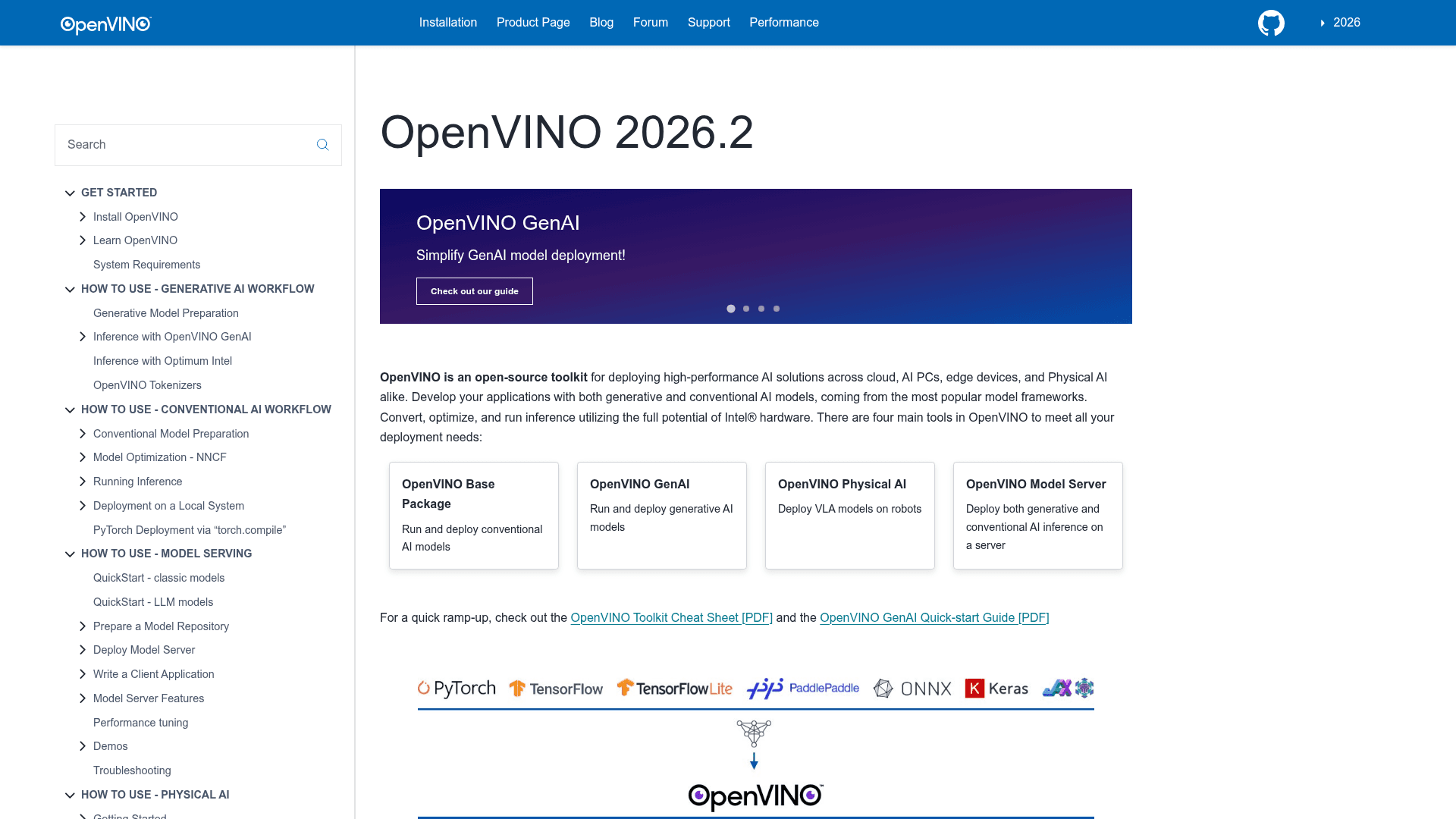
OpenVINO™ is an open-source software toolkit developed by Intel under the Apache License 2.0, designed to optimize and deploy deep learning models for inference across a wide range of hardware. The project is hosted at github.com/openvinotoolkit/openvino and has accumulated over 10,000 GitHub stars since its creation in 2018. It targets developers building AI applications who need to move trained models from popular frameworks into production efficiently.
What It Is
OpenVINO (Open Visual Inference and Neural network Optimization) is an inference optimization and deployment toolkit that sits between model training frameworks and production hardware. Its core job is to take a trained model — from PyTorch, TensorFlow, ONNX, Keras, PaddlePaddle, or JAX/Flax — convert it into an optimized intermediate representation, and run it efficiently on Intel CPUs (x86 and ARM), Intel integrated and discrete GPUs, and Intel NPUs. The toolkit provides APIs in C++, Python, C, and NodeJS, and includes a dedicated GenAI API for generative AI pipelines.
Framework and Hardware Coverage
OpenVINO supports a broad set of source frameworks and target devices:
- Frameworks: PyTorch, TensorFlow, ONNX, TensorFlow Lite, PaddlePaddle, JAX/Flax, Keras 3
- Devices: CPU (x86, ARM), Intel integrated GPU, Intel discrete GPU, Intel NPU
- Deployment modes: local system, Docker container, Kubernetes, baremetal, Ubuntu Snap, and via the OpenVINO Model Server (OVMS)
- Inference modes: synchronous, asynchronous, automatic batching, heterogeneous execution, automatic device selection
Optimization Capabilities
The toolkit includes the Neural Network Compression Framework (NNCF) for advanced model optimization:
- Post-training quantization (INT8, 4-bit weight quantization, microscaling/MX quantization)
- Quantization-aware training (QAT)
- LLM weight compression for large language models
- Model caching to reduce first-inference latency
- Preprocessing integration directly into the model IR
Generative AI and LLM Support
OpenVINO has expanded significantly into generative AI workloads. The OpenVINO GenAI sub-project provides optimized pipelines for LLM inference, including continuous batching, speculative decoding, structured output, and long-context optimizations. The OpenVINO Model Server (OVMS) exposes OpenAI-compatible APIs for chat completions, embeddings, reranking, image generation, speech-to-text, and text-to-speech. Demos in the documentation cover LLM chatbots, VLM models, RAG pipelines, and agentic AI workflows.
Ecosystem Integrations
OpenVINO connects into a wide ecosystem of AI frameworks and tools:
- Hugging Face Optimum Intel: direct model import from the Hugging Face Hub
- torch.compile: JIT-compile PyTorch code using OpenVINO as a backend
- vLLM: OpenVINO backend for fast LLM serving
- ONNX Runtime: OpenVINO Execution Provider
- LangChain and LlamaIndex: runtime performance enhancement for GenAI apps
- ExecuTorch: PyTorch edge deployment with OpenVINO backend
- MediaPipe: graph-based pipeline integration in OVMS
Update: Release 2026.2.0
The latest release is version 2026.2.0, published on May 28, 2026, according to the GitHub repository. The project follows a year-based versioning scheme (2024, 2025, 2026) with multiple point releases per year. The documentation site maintains versioned archives going back to 2023.3. Active development continues with nightly builds available alongside stable releases. The 2026 series adds Physical AI support — a new workflow section covering robot policy inference, runtime callbacks, and camera/robot API references — signaling expansion beyond traditional computer vision and NLP into embodied AI use cases.
Community Discussions
Be the first to start a conversation about OpenVINO
Share your experience with OpenVINO, ask questions, or help others learn from your insights.
Pricing
Open Source
Fully free and open-source under Apache License 2.0. No cost to use, modify, or distribute.
- Full OpenVINO Runtime
- Model conversion from all supported frameworks
- NNCF model optimization
- OpenVINO GenAI API
- OpenVINO Model Server (OVMS)
Capabilities
Key Features
- Model conversion from PyTorch, TensorFlow, ONNX, Keras, PaddlePaddle, JAX/Flax
- Inference on CPU (x86, ARM), Intel GPU, and Intel NPU
- Post-training quantization (INT8, 4-bit weight quantization)
- LLM weight compression and microscaling (MX) quantization
- Quantization-aware training (QAT) via NNCF
- OpenVINO GenAI API for generative AI pipelines
- OpenVINO Model Server (OVMS) with OpenAI-compatible REST/gRPC APIs
- Automatic device selection and heterogeneous execution
- Automatic batching and async inference
- Model caching for reduced first-inference latency
- Dynamic shapes and input reshaping
- Preprocessing API integration into model IR
- torch.compile backend support
- Python, C++, C, and NodeJS APIs
- Physical AI / robot policy inference support
- Continuous batching and speculative decoding for LLMs
- Docker, Kubernetes, and baremetal deployment
- Interactive Jupyter notebook tutorials