
OpenWebUiCode
Open WebUI reimplemented in .NET 10 and Blazor WebAssembly, extended into a coding-agent platform with per-chat git worktrees, sub-agents, memory and a VS Code-style IDE.
At a Glance
Self-hosted source is available under the custom Open WebUI License, which permits use and redistribution subject to its conditions. It includes branding-preservation restrictions and is not an OSI open-source license. Hosting and model usage cost extra where applicable.
Engagement
Available On
Listed Nov 2026
About OpenWebUiCode
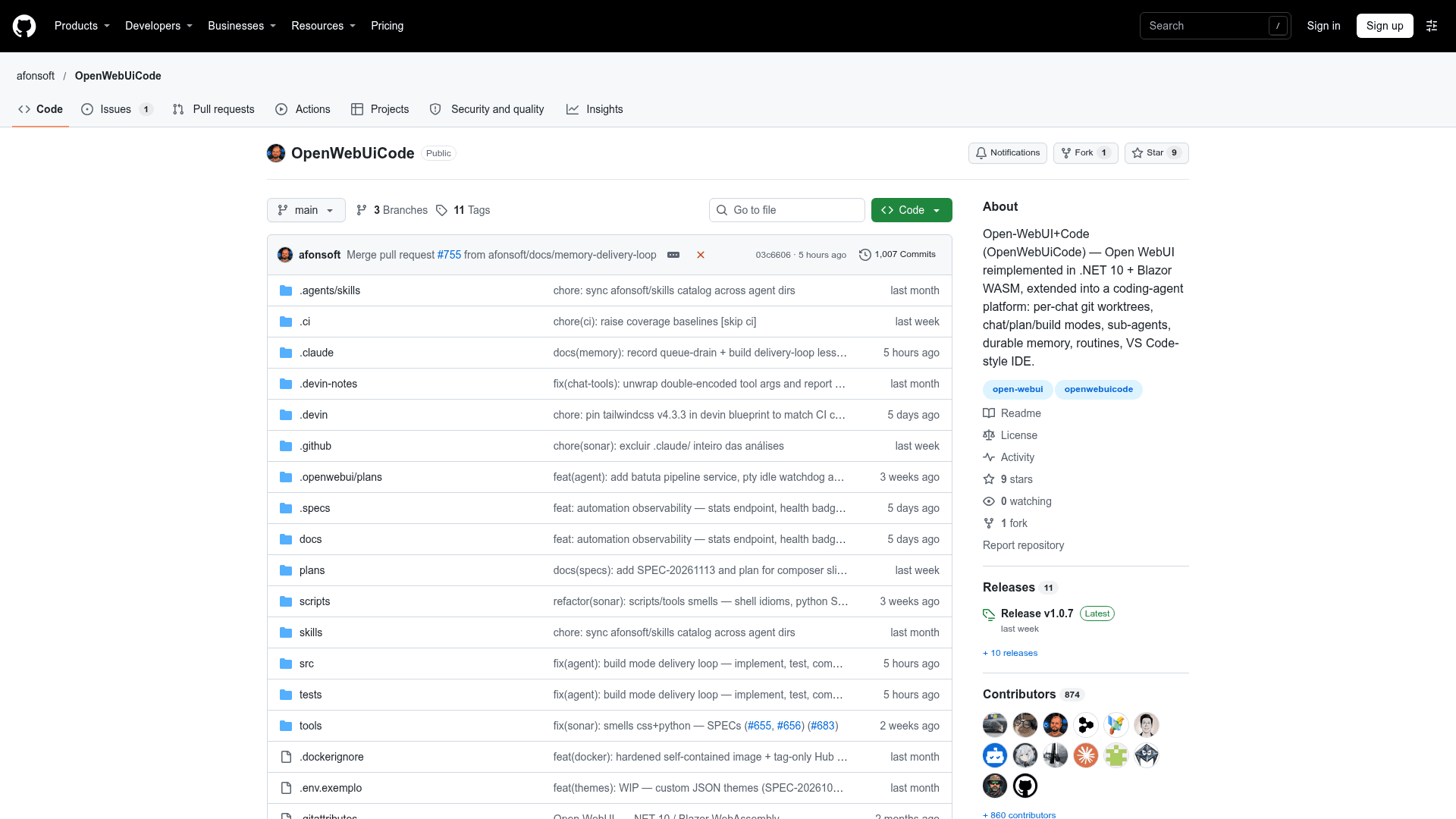
OpenWebUiCode (Open-WebUI+Code) is a GitHub project by afonsoft that migrates Open WebUI from SvelteKit and FastAPI to ASP.NET Core and Blazor WebAssembly on .NET 10 and C# 14. It extends the chat interface into a coding-agent platform in the spirit of opencode. The latest listed release is v1.0.7.
What It Is
A self-hosted, multi-user web chat and coding-agent platform. It keeps the original Open WebUI layout and configuration while adding repo-bound chats that run on dedicated git worktrees, parallel sub-agents, mid-run steering, durable memory, scheduled routines, a VS Code-style IDE and a worktree review pipeline.
How the Agent Workflow Works
Binding a chat to an owner/repo creates an exclusive git worktree and branch for that chat. Chats run in chat, plan or build modes. Plan mode analyses a requirement read-only and emits a structured SPEC markdown saved under .openwebui/plans/. The delegate_task tool spawns child sub-agents, each in its own worktree, and results can be reviewed with worktree_diff and merged with worktree_merge. Runs execute server-side, survive closing the browser, and can be steered or queued mid-run. Tools carry Read, Write or Exec approval tiers, with optional sandboxed execution via bubblewrap.
Models, Memory and Automation
The README describes a Leader and Sidekick model pair, model combos with failover strategies, model roles with fallback chains, and a read-only advisor model. Agent memory (memory_save and memory_search) and context compaction keep long sessions manageable. Routines and reminders, webhook-triggered runs, declarative *.agent.md agents, MCP servers, lifecycle hooks, Playwright browser tools and a headless mode, JSON-RPC endpoint and ACP stdio host are also documented.
Setup Path
It can be built with the dotnet CLI and run from src/OpenWebUI.Api on port 8080, or run from a multi-arch Docker image published on Docker Hub and GHCR. The README also covers docker compose files for the published image and for building from source.
Community Discussions
Be the first to start a conversation about OpenWebUiCode
Share your experience with OpenWebUiCode, ask questions, or help others learn from your insights.
Pricing
Self-Hosted
Self-hosted source is available under the custom Open WebUI License, which permits use and redistribution subject to its conditions. It includes branding-preservation restrictions and is not an OSI open-source license. Hosting and model usage cost extra where applicable.
- Self-hosted .NET and Blazor application
- Custom Open WebUI License
- Branding restrictions apply
- Bring your own model providers
- Docker or source deployment
Capabilities
Key Features
- Per-chat git worktrees bound to repositories
- Chat, plan and build agent modes
- delegate_task sub-agents running in parallel
- Worktree diff review and merge
- Mid-run steer and queue
- Durable agent memory and context compaction
- Routines and reminders
- Plan mode producing structured SPEC markdown
- Leader/Sidekick model pair and model combos with failover
- Tool approval tiers and sandboxed execution
- VS Code-style IDE and terminal
- Declarative *.agent.md agents
- Lifecycle hooks
- Headless mode, JSON-RPC and ACP stdio host
- Webhook-triggered runs
- Playwright browser tools
- RAG, Knowledge, channels and admin UI
- Multi-user RBAC with JWT and API keys