
Orb
Orb is a macOS and iOS client for orchestrating AI coding agent harnesses, providers, and machines from one place.
At a Glance
Orb is described by the GitHub repository About text as free and native. Model inference costs depend on the user's own provider subscriptions and API keys.
Engagement
Available On
Alternatives
Listed Oct 2026
About Orb
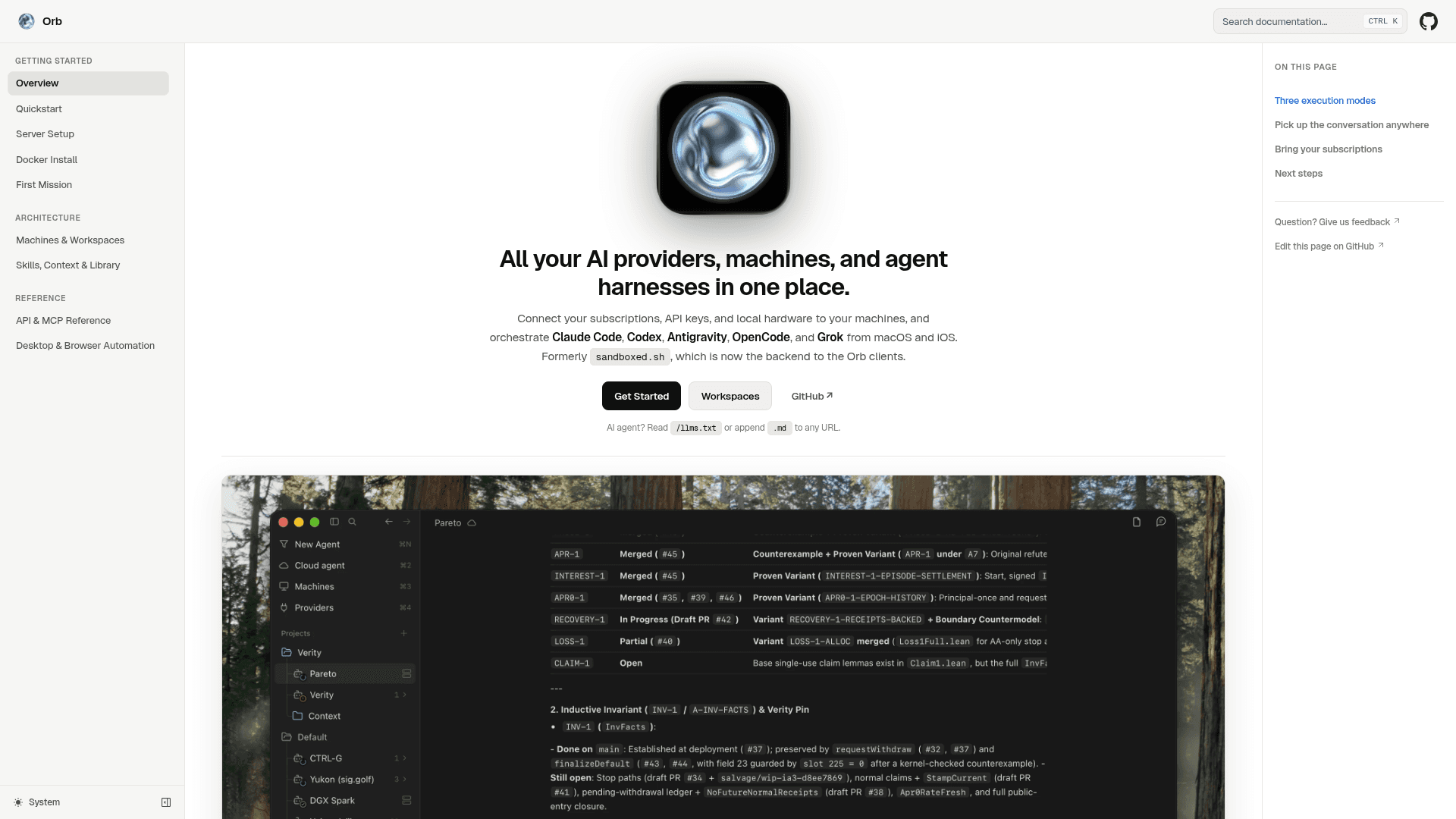
Orb, developed by Th0rgal, connects AI subscriptions, API keys, and local or remote hardware so users can run coding agents such as Claude Code, Codex, Antigravity, OpenCode, and Grok from macOS and iOS clients. It was formerly known as sandboxed.sh, which now serves as the backend (Core) for the Orb clients. The repository is public on GitHub, with documentation at orb.thomas.md.
What It Is
Orb is a client application for managing agent work across projects, missions, and machines. Users pick where an agent executes and where they read and steer it. The Rust backend (Core) stores projects, missions, event history, and remote-node coordination, while the desktop client is built with Tauri and SolidJS and the iOS client with SwiftUI.
Execution Modes
Orb offers three ways to run an agent:
- Your computer: a local CLI harness runs on the Mac through Orb's Tauri runner, using local files, tools, and existing CLI logins while syncing records to the server.
- Your private cloud: agents run on the Core server or leased remote nodes, in host directories or isolated systemd-nspawn containers with cgroup resource caps.
- Cloud agents: Hermes, Grok Bot, or Cursor Cloud sessions can be continued from Orb.
Working With Missions
Projects organize missions, colors, native skills (skills//SKILL.md), and a synchronized Context folder. In a conversation, users can follow live runs with collapsible tool and thought folds and nested subagents, use /plan and /goal modes, and queue follow-ups. A /btw side-agent panel lets users ask questions without interrupting the main turn. Missions can be woken on a schedule, recovered after interruption, and transferred across machines using SHA-256 verified file manifests and Git bundles. Output renders Markdown, code, tables, KaTeX math, quizzes, and images.
Providers and Integration
Subscription accounts can be signed in from the Providers screen or connected through CLIProxyAPI Plus, which can handle OAuth token refresh and routing, while Orb shows plan and quota status. The same control plane is exposed over a REST API, an SSE stream, and an MCP server for coordinators such as Hermes. Core also includes a Lean 4 decision kernel for orchestration and mission lifecycle; the README states these guarantees cover that kernel, not the whole application.
Community Discussions
Be the first to start a conversation about Orb
Share your experience with Orb, ask questions, or help others learn from your insights.
Pricing
Free
Orb is described by the GitHub repository About text as free and native. Model inference costs depend on the user's own provider subscriptions and API keys.
- Orchestrate Claude Code, Codex, Antigravity, OpenCode and Grok from macOS and iOS
- Run agents on your computer, a private cloud, or cloud agents
- Bring your own provider subscriptions and API keys (external costs)
Capabilities
Key Features
- Three execution modes: local computer, private cloud, cloud agents
- Orchestrates Claude Code, Codex, Antigravity, OpenCode, and Grok
- Live mission following with tool folds and nested subagents
- /plan and /goal modes
- /btw side-agent panel
- Scheduled mission wake-ups and automatic recovery
- Mission transfer across machines with verified file manifests and Git bundles
- Isolated systemd-nspawn container workspaces with cgroup caps
- Synced Context folder and native project skills
- Provider sign-in with quota status inspection
- REST API, SSE stream, and MCP server
- iOS companion app