
Orkestra
Local-first orchestration runtime that coordinates multiple coding agents in isolated Git worktrees with cross-agent review and verification gates.
At a Glance
Orkestra runtime, a local-first orchestration runtime for multiple coding agents, licensed under Apache-2.0 and free to use, modify and distribute.
Engagement
Available On
Alternatives
Listed Nov 2026
About Orkestra
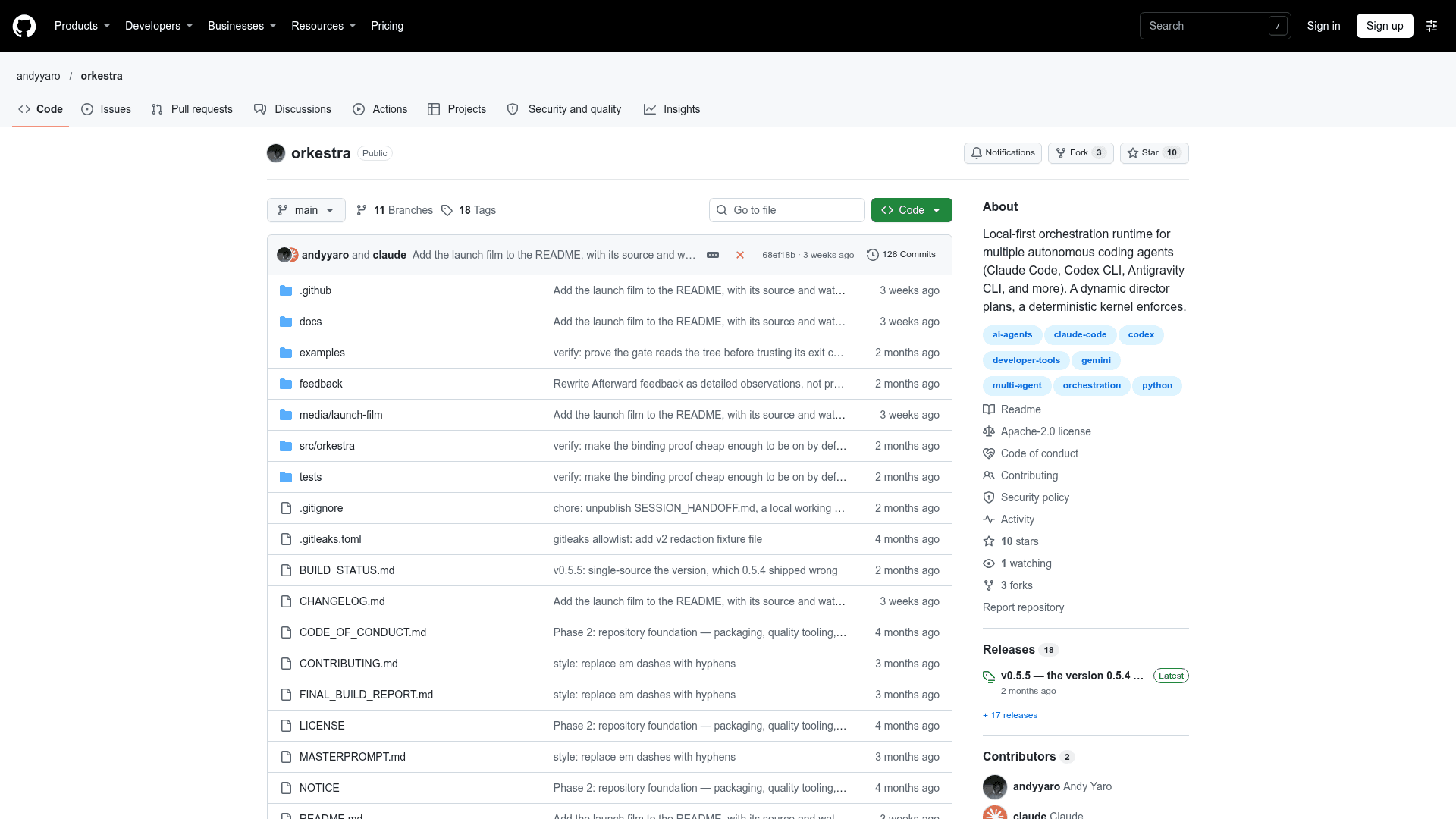
Orkestra is an open-source, Apache-2.0 Python runtime published by andyyaro on GitHub. It lets two or more coding agents such as Claude Code, OpenAI Codex CLI and Google Antigravity CLI work on the same project in parallel. Each task runs in its own Git worktree, the user's own test commands act as the gate, and a different agent must review work before it lands. The latest release listed is v0.5.5.
What It Is
Orkestra is a command-line orchestration layer for coding agents you already use. A director agent (Claude Code by default) analyzes a spec, probes the available agents, breaks the work into a dependency graph and proposes assignments as schema-validated JSON. A deterministic kernel written in plain Python, with no LLM, validates those proposals against policy, owns state in SQLite, dispatches tasks, runs verification and integrates results.
Workflow and Outputs
The orkestra start command guides setup: agent selection, a quality preset (Faster, Balanced, Maximum quality or Custom), models and effort, the verification gate and the spec. orkestra run --watch executes the plan, and watch, status, pause, resume and cancel control it. State survives crashes and reboots. When a run finishes, orkestra review shows what was built and the check results, and orkestra accept brings the work into your branch after asking. Finished work waits on a side branch, and the project's branches are not modified before acceptance. When a decision is needed, orkestra decisions and orkestra approve explain and resolve it. orkestra demo runs the real engine with scripted fake agents, so no logins or tokens are needed.
Safety Model
The README states several guarantees: implementer and reviewer must be different agents, the kernel runs the user's [verify] commands and reads exit codes itself, per-agent token budgets bound cost, and credential-shaped strings are redacted from persisted logs. Agents sign in through their own official CLIs, and Orkestra does not read token stores. Elevated modes such as autonomy = "unsafe-full" are explicitly named and not default.
Supported Agents and Limits
Adapters cover Claude Code, Codex CLI, Antigravity CLI, Gemini CLI (API key, Vertex or Enterprise auth only), a JSONL-protocol external adapter for any other agent, and a scripted fake agent. Documented limits: Antigravity's JSON output flag is undocumented upstream, the Docker sandbox covers only external and fake agents, and Windows is untested.
Community Discussions
Be the first to start a conversation about Orkestra
Share your experience with Orkestra, ask questions, or help others learn from your insights.
Pricing
Open Source (Apache-2.0)
Orkestra runtime, a local-first orchestration runtime for multiple coding agents, licensed under Apache-2.0 and free to use, modify and distribute.
- Apache-2.0 licensed core runtime
- Install via uv tool install 'orkestra-runtime[tui]'
- Free offline demo with scripted fake agents (no tokens spent)
- Supports Claude Code, OpenAI Codex CLI, Google Antigravity CLI, Gemini CLI and external adapters
- Provider plan limits and agent subscriptions are external costs borne by the user
Capabilities
Key Features
- Parallel multi-agent execution in isolated Git worktrees
- Director agent plans task dependency graph
- Deterministic kernel with policy validation
- Enforced cross-agent review (implementer differs from reviewer)
- User-defined verification gates run by the kernel
- Bounded repair loops and fallback agents
- Per-agent token budgets and rate-limit-aware scheduling
- Crash-safe SQLite state with pause, resume and cancel
- Live watch dashboard and TUI
- Free demo mode with scripted fake agents
- Quality presets and per-agent model and effort configuration
- Credential redaction in logs
- External agent adapter via JSONL protocol