
Open-source audio-video generation model that creates synchronized video and audio from text or text plus image prompts.
At a Glance
Self-hosted Ovi audio-video generation model and inference code released under the Apache License 2.0.
Engagement
Available On
Listed Nov 2026
About Ovi
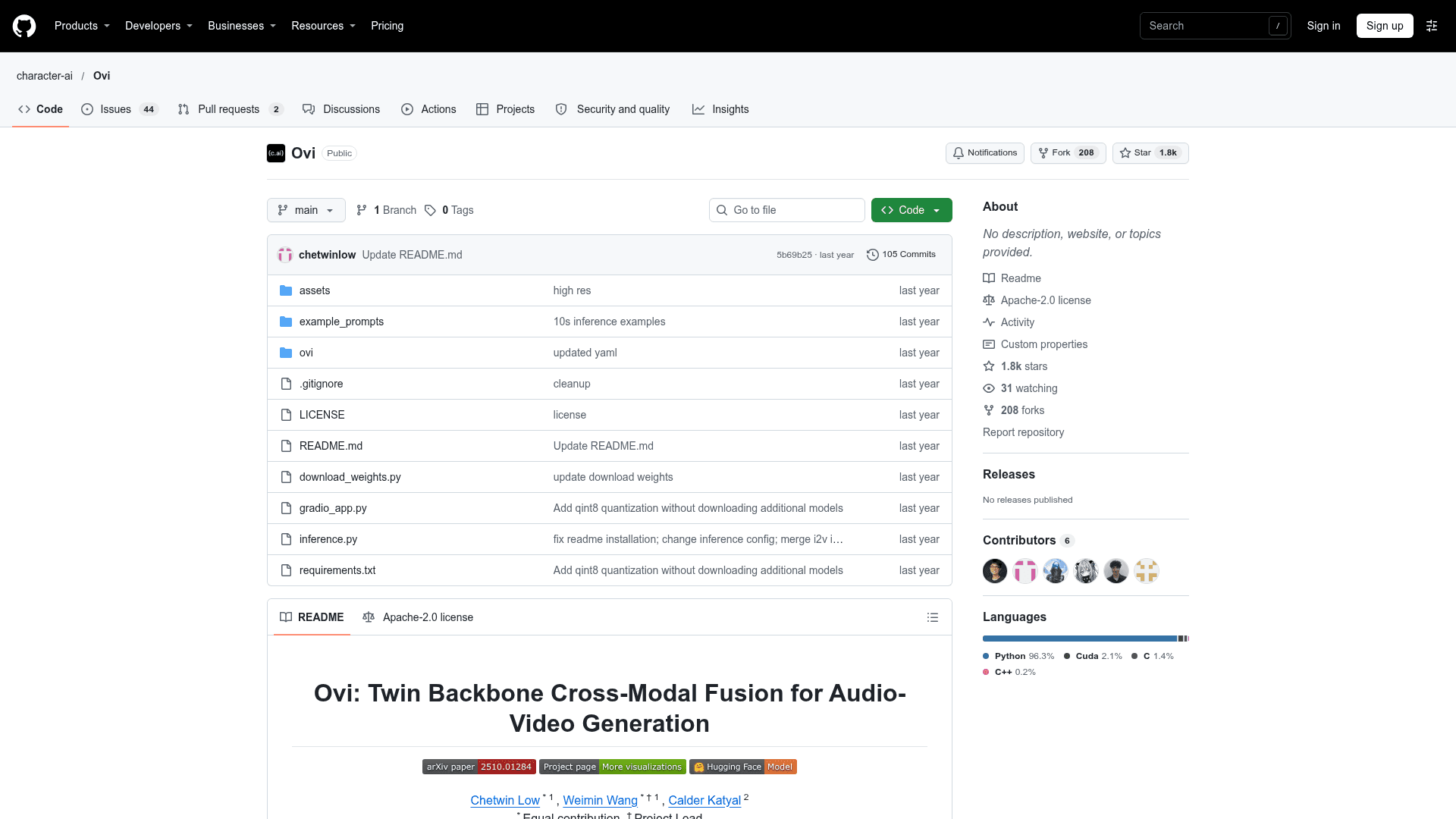
Ovi is an open-source video and audio generation model from Character AI, described in an accompanying arXiv paper as a twin-backbone cross-modal fusion approach. It generates synchronized video and audio together from text-only or text-plus-image input. The repository provides inference code, a Gradio app, and configuration for running the released checkpoints.
What It Is
Ovi is a research-derived generative model that produces video clips with matching speech and sound effects in a single pass. The README describes it as a veo-3-like model. Its video branch is initialized from Wan2.2, and its audio branch is a 5B-parameter branch pretrained from scratch, reusing MMAudio's audio VAE. Outputs are 24 FPS clips of 5 or 10 seconds at up to 960x960 resolution, in various aspect ratios such as 9:16, 16:9 and 1:1.
Prompting and Workflow
Users supply a text prompt, optionally with a starting image. Modes include text-to-video, image-to-video, and t2i2v, which first generates a starting image with Flux Krea. Speech is marked in the prompt with <S>...<E> tags, and audio or sound effects are described in an Audio: line at the end of the prompt. Example prompt CSVs are included. Settings in a YAML config control model variant, denoising steps, audio and video guidance scales, negative prompts, seed, and output directory. Inference runs from the command line on one or more GPUs or through a Gradio UI.
Update: Ovi 1.1
The 10 November 2025 update adds temporally consistent 10-second generation at 960x960. The model was trained natively at that resolution on a dataset with 100% more videos. The audio prompt format changed from <AUDCAP> tags to the Audio: prefix.
Hardware and Setup
Setup involves cloning the repo, installing PyTorch 2.6.0, the requirements, and Flash Attention, then downloading weights with a script. The README gives a minimum of 32GB GPU VRAM, with fp8 or qint8 plus CPU offload supported to run in about 24GB at some quality cost. Multi-GPU sequence parallelism is supported. Planned items include a reference voice condition, a distilled model, and training scripts. ComfyUI support is available through a third-party wrapper.
Community Discussions
Be the first to start a conversation about Ovi
Share your experience with Ovi, ask questions, or help others learn from your insights.
Pricing
Open Source (Apache-2.0)
Self-hosted Ovi audio-video generation model and inference code released under the Apache License 2.0.
- Apache License 2.0 (OSI-approved)
- Text or text+image to video+audio generation
- 10-second or 5-second videos at 960x960
- Gradio application code and multi-GPU inference
- fp8 and qint8 quantization support
Capabilities
Key Features
- Simultaneous synchronized video and audio generation
- Text-to-audio-video and image-to-audio-video modes
- 5-second and 10-second clips at 24 FPS up to 960x960
- Multiple aspect ratios (9:16, 16:9, 1:1)
- Speech and audio description prompt tags
- Gradio web UI
- Multi-GPU inference with sequence parallelism
- fp8 and qint8 quantization with CPU offload for lower VRAM
- Configurable guidance scales and negative prompts
- Example prompt CSV files