
Pando
Open-source, self-hosted platform that builds, scans, isolates and shares AI-built internal apps behind SSO.
At a Glance
Free forever self-hosted edition under AGPL-3.0, including running apps for your customers.
Engagement
Available On
Listed Nov 2026
About Pando
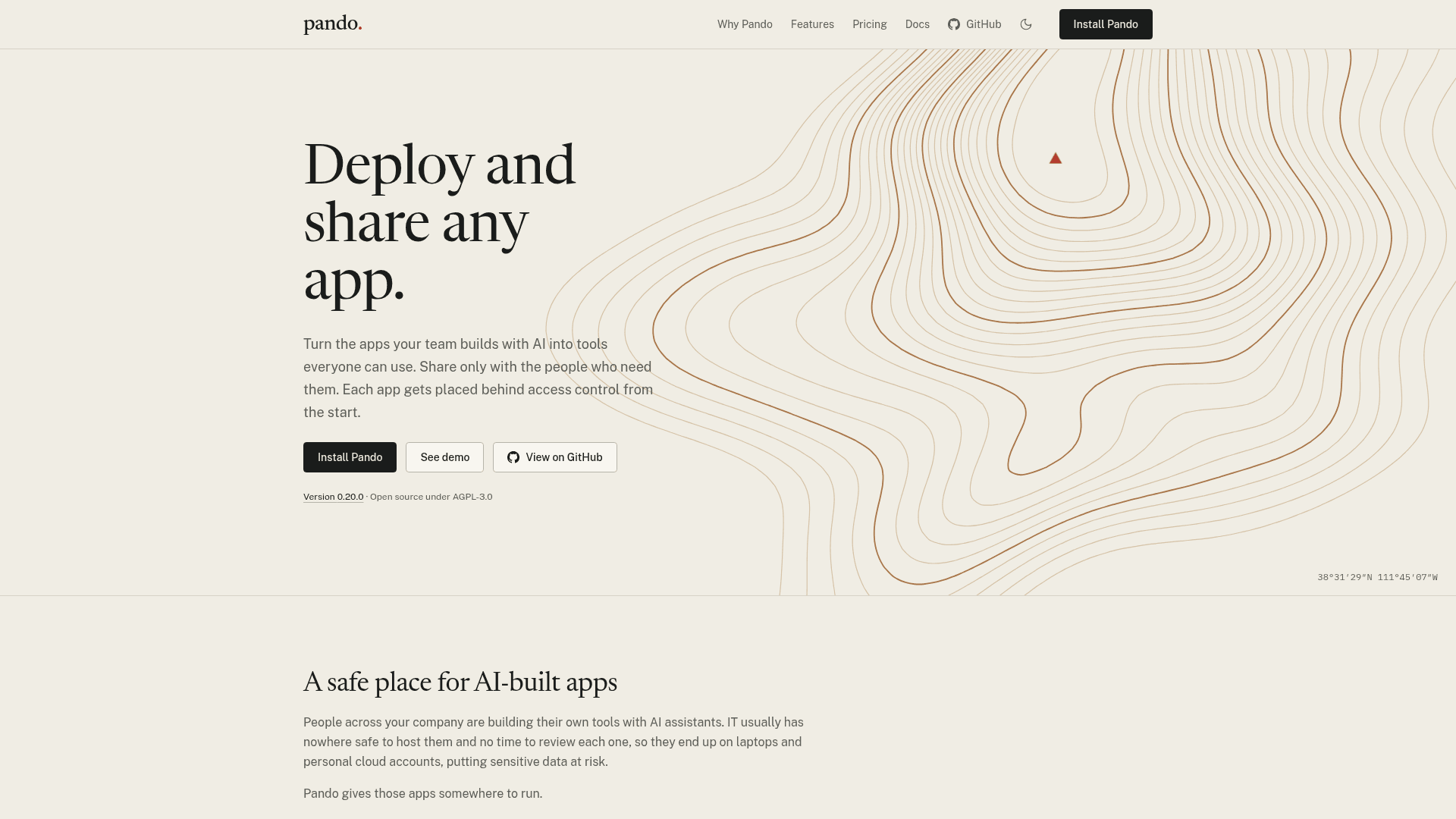
Pando is an open-source, self-hosted platform for running the apps a team builds, including ones written with AI assistants. Point it at a git repository, folder or image and it detects how to build the app, scans it, runs it on an isolated private network and shares it behind sign-in. It is maintained by Ben Meeker, is released under AGPL-3.0, and the project's README labels its status as alpha (current release v0.20.0).
What It Is
Pando is a deployment and sharing layer for small internal apps such as dashboards, internal tools and prototypes. The README says it is built for IT and platform teams who want employees to deploy internal tools without those tools living on laptops or personal cloud accounts. It runs on a machine with Docker or Podman, and apps can also run across several hosts or on Kubernetes. Pando has no hosted service behind it, per the FAQ.
How a Deploy Works
Pando detects the source type and decides how to build it: Compose file, published image, Dockerfile, static site, or a Railpack buildpack, and it asks questions when it cannot tell. Builds run in a rootless container with no access to the host's files. Each build is scanned for vulnerable dependencies, leaked secrets and misconfiguration and given a 0 to 100 score, and admins can set a minimum score required to deploy. The app then runs as a bundle on its own private network at its own address.
Access, Identity and Governance
Every request passes through an identity-aware proxy that signs the visitor in and checks permissions before the app sees anything, passing the user's identity to the app via signed headers. Sign-in works with any OIDC or SAML provider such as Okta, Entra ID or Google, with SCIM provisioning. Apps are private by default and can be shared with people or groups, made public, or made public behind a passcode. Host policy controls allowed sources, egress and public sharing, and an audit log records actions.
Interfaces and Optional AI
Pando offers an API, CLI, web console and an MCP server for coding agents, limited to a token's permissions. Optional AI adapters (Anthropic, OpenAI, Ollama) can help fix failed detection plans, draft roles and policy, and turn questions into audit log searches. The FAQ says Pando is not built for business-critical systems or services needing replication or autoscaling.
Community Discussions
Be the first to start a conversation about Pando
Share your experience with Pando, ask questions, or help others learn from your insights.
Pricing
Open source
Free forever self-hosted edition under AGPL-3.0, including running apps for your customers.
- All features
- SSO (OIDC and SAML) and SCIM included
- No limits on apps, users or hosts
- Community support on GitHub Discussions
- Security advisories
Commercial license
For offering Pando as a service or shipping it in a product without releasing your changes. Terms set per customer.
- Run Pando as a hosted service without publishing modifications
- Embed Pando in a proprietary product
- Ship Pando in an appliance or image
- Use Pando where policy rules out copyleft licenses
Dedicated support
Annual agreement for teams wanting direct access to maintainers.
- Private support channel
- Help with installation, upgrades and configuration
- Priority on bugs you report
- Response times defined in your agreement
Managed hosting
A dedicated single-tenant Pando installation, run and maintained for you.
- An installation used only by your organization
- Upgrades and backups handled for you
- The same release as the open-source version
- Export your apps at any time
Capabilities
Key Features
- Deploy from git repositories, uploads or published images
- Automatic build detection (Dockerfile, Compose, Railpack buildpack, static sites)
- Rootless builds
- Vulnerability, secret and misconfiguration scanning with 0-100 security score
- Minimum score deploy gate
- Per-app private network isolation
- Identity-aware proxy with signed identity headers
- SSO via OIDC and SAML with SCIM
- Host policy and egress controls
- Audit log with SIEM export and signed webhooks
- Backups, volumes and database provisioning
- Deploy approvals, plans and revisions with rollback
- API, CLI and MCP server
- Optional AI adapters for detection help and policy drafting