
pansy
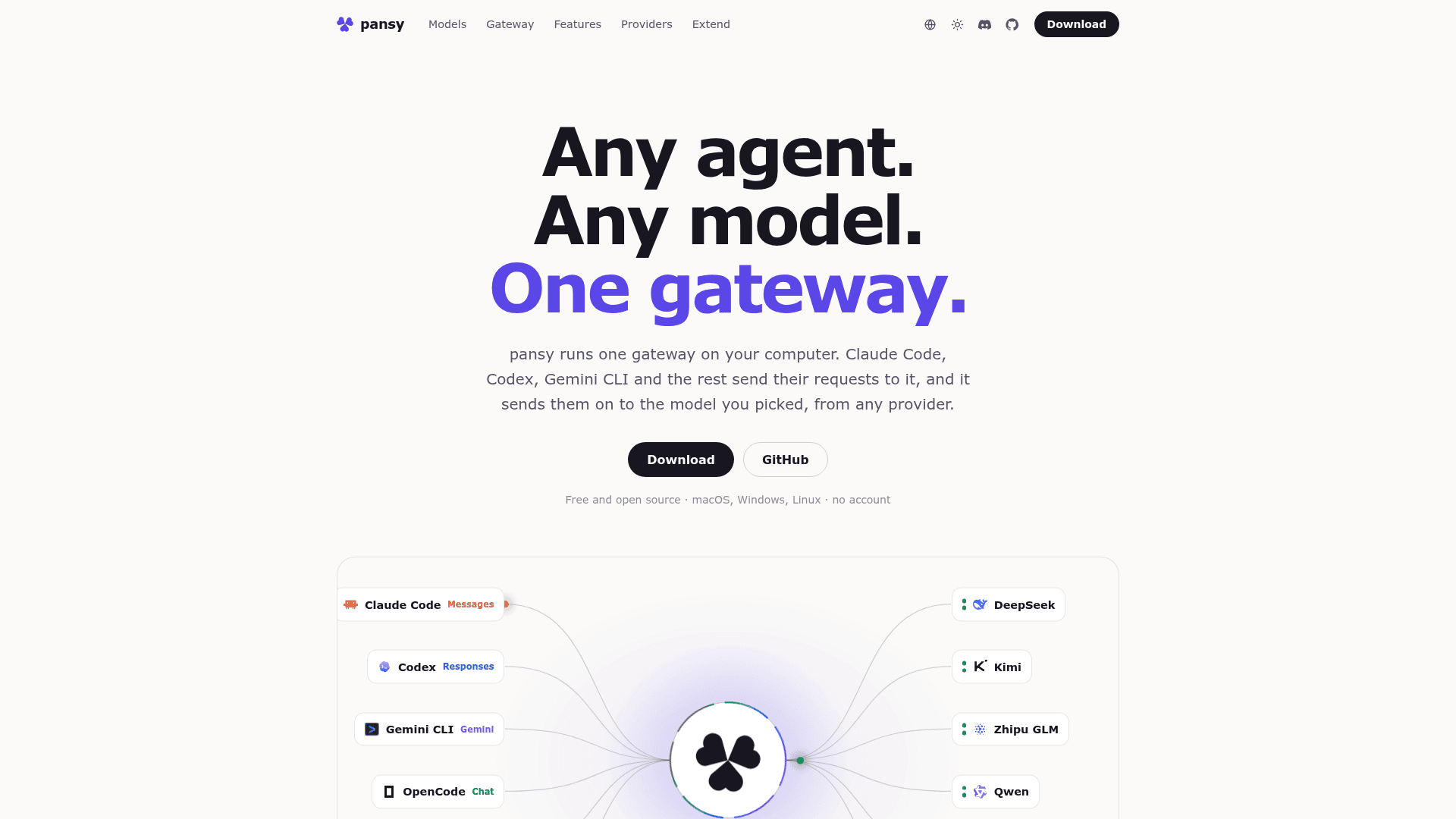
A local gateway and desktop app that lets coding agents like Claude Code, Codex and Gemini CLI use models from any provider.
At a Glance
Free, MIT-licensed local gateway and desktop app for macOS, Windows and Linux; no account required.
Engagement
Available On
Alternatives
Listed Nov 2026
About pansy
pansy is an open-source local gateway and desktop app from the pansy-ai organization, written in Rust. It runs on the user's computer and routes requests from coding agents such as Claude Code, Codex, Gemini CLI, OpenCode, Qwen Code and Crush to the model and provider the user picked. It is available for macOS, Windows and Linux, with a window, a tray icon and a command line.
What It Is
pansy is an AI gateway for coding agents. A local endpoint at 127.0.0.1:7267 accepts requests in Anthropic Messages, OpenAI Chat Completions, OpenAI Responses and Gemini formats and translates between them, including streaming, tool calls and reasoning. When an agent and a provider speak the same protocol, the request passes through untouched. Users add a provider key (60 presets are listed, plus any OpenAI-, Anthropic- or Gemini-compatible URL) and choose a model for each agent.
How Models Are Assigned
There are three ways to say which model an agent uses. Connecting an agent edits the relevant keys in its own config while keeping comments and formatting, and Disconnect restores what was there. A project-level .pansy.toml names models per folder, holds no keys, and a repository-supplied one only counts after the user approves it. The pansy run command starts one agent on one model for a single run without writing config.
Failover, Routing and Masking
A provider can hold several keys; one that is rate-limited, out of quota or refused rests for a while and the next answers. Routing groups such as group/daily combine several models, picked in order, in turn or least used first. Masking replaces API keys, tokens, passwords and personal data with placeholders before a request leaves the computer and restores them in the reply. The project states that prompts and replies are never kept and usage is counted locally.
Extending It
Subscriptions such as ChatGPT, GitHub Copilot and Gemini Code Assist plans can serve other agents by reading the existing sign-in. Other features include profiles, usage views, session browsing for Claude Code, Codex and OpenCode, a doctor command, agents defined as TOML manifests, and community plugins running on Bun. The project is MIT licensed and began as a Rust rewrite of magpie by yetone.
Community Discussions
Be the first to start a conversation about pansy
Share your experience with pansy, ask questions, or help others learn from your insights.
Pricing
Open Source
Free, MIT-licensed local gateway and desktop app for macOS, Windows and Linux; no account required.
- Local gateway on 127.0.0.1:7267 translating Anthropic Messages, OpenAI Chat, OpenAI Responses and Gemini protocols
- Key failover and routing groups
- Secret masking
- Usage tracking and sessions
- 60 provider presets
Capabilities
Key Features
- Local gateway at 127.0.0.1:7267 translating between Anthropic Messages, OpenAI Chat, OpenAI Responses and Gemini protocols
- Per-agent model selection that edits agent config in place and restores it on Disconnect
- Key and account failover across rate limits and quota exhaustion
- Routing groups (in order, in turn, least used)
- Masking of secrets and personal data with placeholders
- Per-project .pansy.toml and per-run model selection
- Subscription support for ChatGPT, GitHub Copilot and Gemini Code Assist plans
- Profiles for switching all agents' models at once
- Local usage tracking by day, model, agent, provider and project
- Session browsing and resume commands for Claude Code, Codex and OpenCode
- 60 provider presets plus custom compatible URLs
- Agents defined as TOML manifests
- Community plugins on Bun
- Doctor command for diagnosing gateway, providers and agents
- Desktop app, tray icon and CLI