
PolyStrata
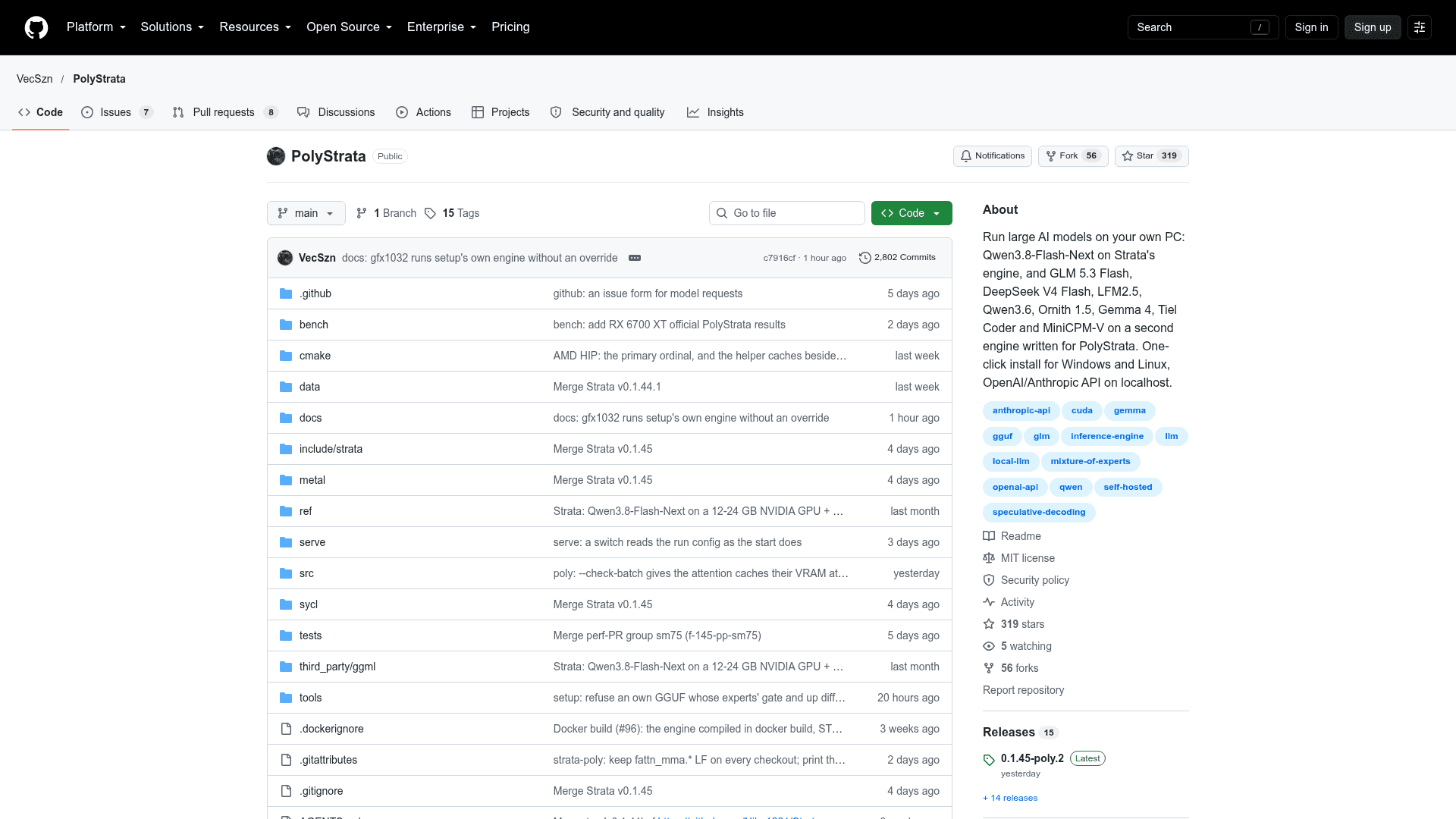
Open-source local inference tool that runs large mixture-of-experts AI models on a consumer PC with an OpenAI- and Anthropic-compatible local API.
At a Glance
PolyStrata is free and open source under the MIT License, self-hosted on your own PC. Models have their own licenses.
Engagement
Available On
Alternatives
Listed Oct 2026
About PolyStrata
PolyStrata is an open-source project from VecSzn, built on Niko1221's Strata, that runs large language models on an ordinary Windows or Linux PC with a consumer graphics card. It serves nine models through two inference engines and exposes a chat app and a local API on localhost. According to the README, nothing leaves the user's PC. The latest release listed is v0.1.45-poly.1.
What It Is
PolyStrata is a local LLM inference engine and installer for mixture-of-experts models that normally need a server. The installer detects the graphics card, RAM and disk, then asks which model, size and context length to use, and whether the model should read pictures. It downloads the model files and starts a server whose app opens in the browser at http://127.0.0.1:8080. The app has a Chat tab, a live Monitor of the model and GPU/CPU/RAM, and an About page with settings.
Supported Models and Engines
Qwen3.8-Flash-Next runs on Strata's own engine, on NVIDIA or AMD cards with 12 GB of VRAM or more. Eight further models run on an engine written for PolyStrata, which the README labels experimental: GLM 5.3 Flash, DeepSeek V4 Flash, LFM2.5-24B-A2B, Qwen3.6-35B-A3B, Ornith 1.5, Gemma 4 26B-A4B, Tiel Coder 35B-A3B and MiniCPM-V 4.7 35B-A3B. Several of these read pictures, while GLM 5.3 Flash, DeepSeek V4 Flash and LFM2.5 are text-only. The server can switch between installed models while running.
How It Fits Models on Small Cards
The README explains that the busiest experts stay in GPU memory, all experts live in RAM, the processor works on the rest, and the model file stays on the SSD. Several models also use speculative decoding, in which a draft block or draft model guesses upcoming tokens and the main model verifies them. Prompts are read in large chunks. The README publishes tokens-per-second figures measured on specific laptops and workstations, and a benchmark command lets users measure their own machine.
Connecting Apps and Agents
Apps connect through an OpenAI-compatible endpoint at /v1, an Anthropic-style /v1/messages endpoint (usable with Claude Code), and a /v1/responses endpoint for Codex CLI. Reasoning effort can be set to off, low, medium or high. An MCP server lets AI tools install, start and stop PolyStrata, and an AI-setup guide lets coding assistants perform the installation. Serving to other devices requires an explicit host setting and an API key.
Community Discussions
Be the first to start a conversation about PolyStrata
Share your experience with PolyStrata, ask questions, or help others learn from your insights.
Pricing
Open Source
PolyStrata is free and open source under the MIT License, self-hosted on your own PC. Models have their own licenses.
- MIT-licensed core software
- Runs large AI models locally on your own PC
- OpenAI/Anthropic-compatible API on localhost
- One-click install for Windows and Linux
- A few parts and every model have their own licenses (e.g., LFM2.5 allows commercial use only for companies with under $10M yearly revenue)
Capabilities
Key Features
- Runs nine large mixture-of-experts models locally on two engines
- One-click installer for Windows (START-HERE.bat) and Linux (setup.sh)
- Picks model size based on detected GPU, RAM and disk
- OpenAI-compatible, Anthropic Messages and Responses API endpoints on localhost
- Browser app with Chat and live GPU/CPU/RAM Monitor
- Picture input for supported models
- Speculative decoding for faster answers
- Thinking level control (off, low, medium, high)
- Switch between installed models while the server runs
- Built-in benchmark command and BENCH script
- MCP server for AI-driven install and control
- Multi-GPU support for some models