
Posthook
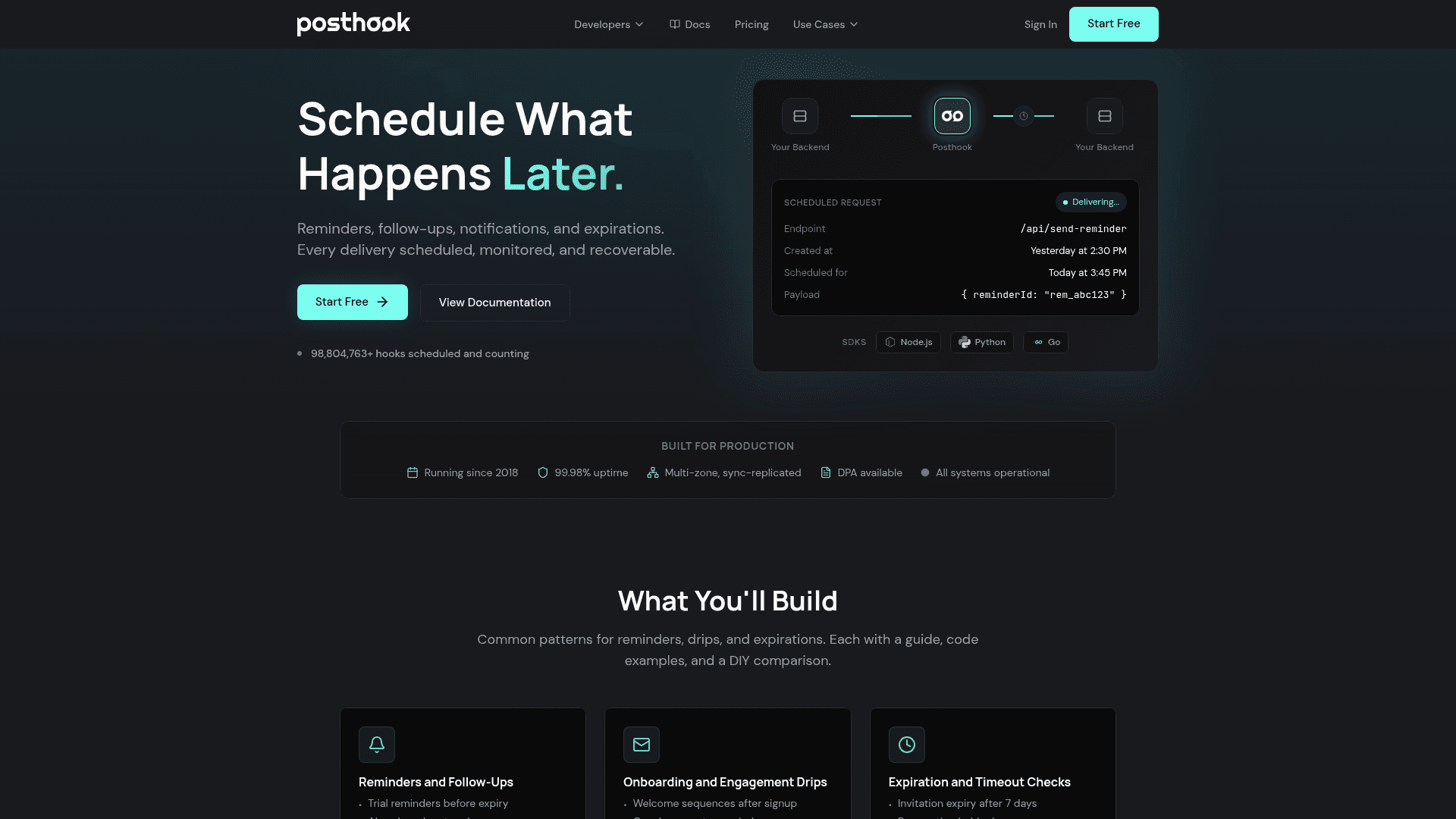
Posthook is a managed webhook scheduling API for developers to reliably schedule reminders, follow-ups, expirations, and notifications at precise future times.
At a Glance
About Posthook
Posthook is a managed webhook scheduling service built and run by Carlos Gomez, a backend engineer who started the product in 2018 after needing reliable per-event scheduling for a social events app. It has been in continuous production since then, with the site reporting 99.98% uptime and over 98 million hooks scheduled to date.
What It Is
Posthook is a scheduling-as-a-service API that lets developers schedule HTTP callbacks (webhooks) to fire at a specific future time — relative delays, absolute UTC timestamps, or local times with timezone awareness. Rather than building and maintaining cron pollers, timestamp columns, or queue-backed job systems, developers make a single API call to schedule a hook, and Posthook handles delivery, retries, observability, and alerting. It is intentionally narrow: it is not a full workflow orchestration engine or general background job platform, but a focused tool for the "do this later, reliably" problem.
How the Scheduling Model Works
Posthook accepts three scheduling modes per hook:
- Relative delay (
postIn): fire in30m,24h,7d, etc. - Absolute UTC (
postAt): RFC 3339 timestamp - Local time with timezone (
postAtLocal+timezone): DST-safe, handles spring-forward and fall-back automatically
When the scheduled time arrives, Posthook POSTs a signed (HMAC-SHA256) payload to the developer's configured endpoint. Handlers can return a 202 and call back with ack/nack up to 3 hours later for long-running async jobs. Retries use fixed or exponential backoff with jitter and do not count against the monthly quota.
Observability and Alerting
Every hook delivery is captured and queryable — scheduling, attempts, response bodies, and cancellations — with retention from 7 to 90 days depending on plan. The dashboard supports per-delivery drill-down, health aggregation by endpoint, and bulk retry or replay by endpoint and time range. Anomaly alerting uses per-endpoint baselines learned from actual traffic, with alert speeds ranging from 15 minutes down to 30 seconds, routed to email, Slack, or webhook.
Developer Tooling and Integrations
Posthook ships official SDKs for Node.js/TypeScript, Python, and Go. The Node SDK (MIT-licensed, v1.2.0 as of March 2026) handles auth, pagination, retries, signature verification, and WebSocket delivery. A CLI enables local development by receiving webhooks on localhost via WebSocket — the same transport works for endpoints behind VPCs or firewalls. Config-as-code via TOML (posthook.toml) lets teams manage recurring schedules in version control and deploy with npx posthook apply. Framework guides cover Next.js, Express, FastAPI/Flask/Django, Go, and Rails.
Update: Node SDK v1.2.0
The Node.js SDK reached v1.2.0 in March 2026, adding WebSocket listener support (listen and stream APIs), an Express handler helper (signatures.expressHandler), async hook support with ack/nack callbacks, bulk retry/replay/cancel operations, and full TypeScript generics for typed payloads. The SDK requires Node.js 18+ and has a single runtime dependency (ws).
Architecture and Reliability
Posthook runs on Kubernetes across multiple availability zones with PostgreSQL using synchronous replication and automatic failover, and Pub/Sub with no single-zone dependency. Every hook is committed to a durable message queue before the API returns. The service has maintained 99.98% uptime since 2018 per its public uptime monitor. Payments are processed via Stripe; a Data Processing Agreement (DPA) is available for compliance needs.
Community Discussions
Be the first to start a conversation about Posthook
Share your experience with Posthook, ask questions, or help others learn from your insights.
Pricing
Free
Validate a scheduling pattern end-to-end before production.
- 1,000 hooks/month
- 3 projects
- 7-day log retention
- 15-min alerts
- Email alerts
Launch
For early product teams. Onboarding drips, reminders, and expirations.
- 20,000 hooks/month
- 5 projects
- 30-day log retention
- 5-min alerts
- Email & Slack alerts
- Fixed and exponential retry strategies
- Max 5 retries
- Email support (24hr)
Growth
For growing SaaS teams with multiple workflows across onboarding, notifications, and recovery.
- 100,000 hooks/month
- 15 projects
- 60-day log retention
- 2-min alerts
- Email & Slack alerts
- Bulk actions
- Fixed and exponential retry strategies
- Max 10 retries
- Email support (24hr)
Scale
For mature platforms needing high-volume scheduling with faster alerts, longer retention, and bulk recovery.
- 500,000 hooks/month
- 50 projects
- 90-day log retention
- 30-sec alerts
- Email, Slack & Webhook alerts
- Bulk actions
- Fixed and exponential retry strategies
- Max 15 retries
- Priority support (Email + Chat, 12hr)
Capabilities
Key Features
- Webhook scheduling via API (relative delay, absolute UTC, local timezone)
- HMAC-SHA256 signed deliveries with replay protection
- Async hooks with ack/nack callbacks up to 3 hours
- Per-endpoint anomaly alerting with learned baselines
- Bulk retry, replay, and cancel by endpoint and time range
- 7–90 day delivery log retention with per-hook drill-down
- Timezone-aware scheduling with automatic DST handling
- Fixed and exponential backoff retries with jitter
- Config-as-code recurring schedules via TOML
- WebSocket delivery for endpoints behind VPCs or firewalls
- CLI for local development webhook testing
- Multi-project workspaces with separate keys and alerting
- Official SDKs for Node.js/TypeScript, Python, and Go
- Per-hook retry override
- Idempotent delivery with hook ID as idempotency key