
PromptQL
A multiplayer AI agent workspace that maintains shared context across teams, connecting to data sources and learning from corrections to improve accuracy for everyone.
At a Glance
Usage-based plan with free credits to get started. No credit card required.
Engagement
Available On
Listed Jul 2026
About PromptQL
PromptQL is a multiplayer AI agent workspace built by Hasura — the team behind the Hasura GraphQL Engine and Hasura Data Delivery Network. It positions itself as a shared-context AI layer for teams, functioning like Claude or ChatGPT but with shared threads, a shared wiki, and an agent whose accuracy compounds as the team works together. The product is actively available with a free-credit entry point and an enterprise tier.
What It Is
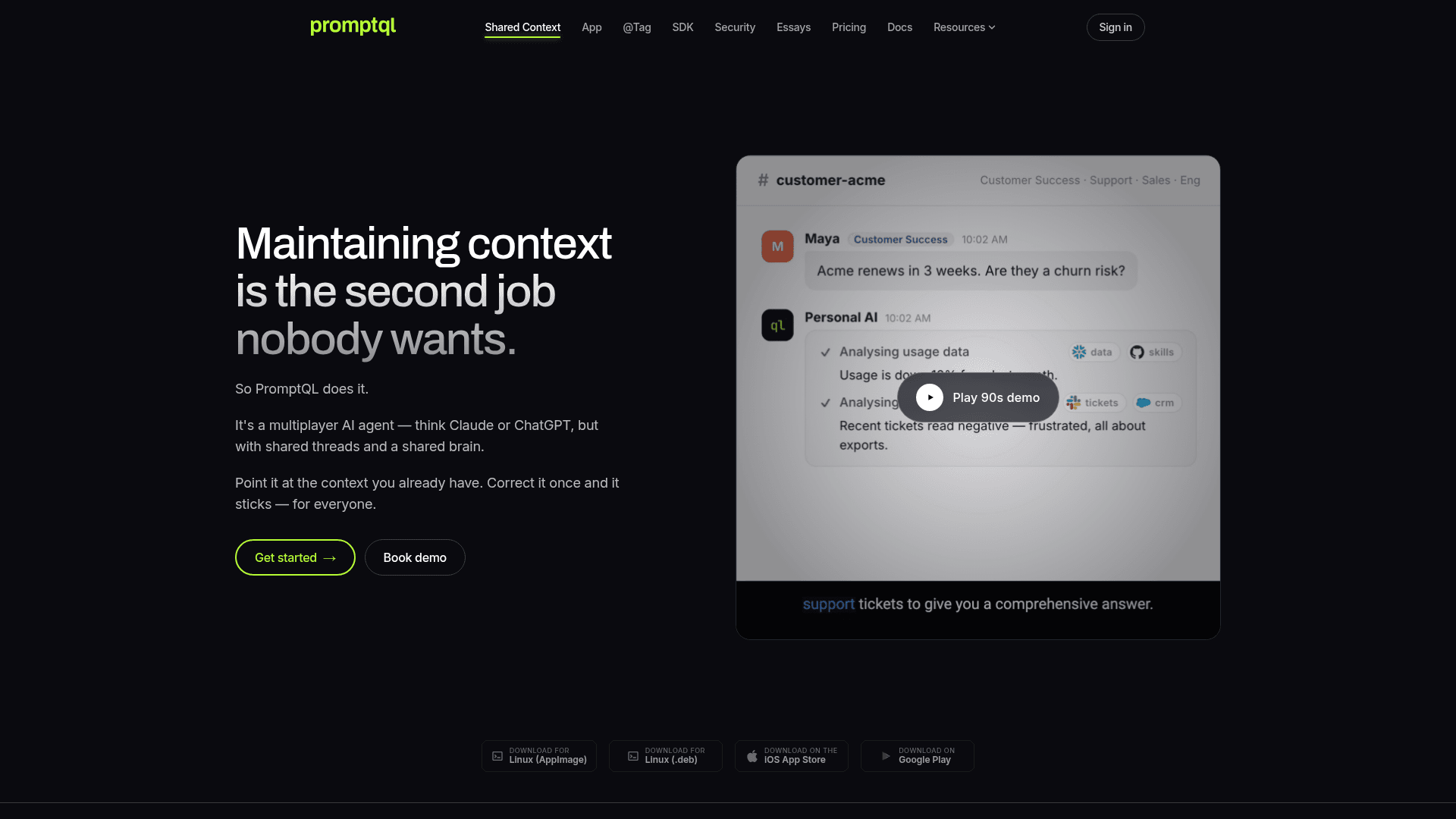
PromptQL is a team-oriented AI workspace that connects to data wherever it lives — warehouses, databases, SaaS apps, and APIs — and answers business questions by writing and executing code against those sources. Unlike single-user AI assistants, PromptQL is designed around shared context: corrections made by one team member propagate to everyone, and the system captures tribal knowledge from everyday conversations into a Wikipedia-style wiki rather than requiring upfront documentation. It targets data-heavy workflows in financial services, healthcare, retail, and GTM teams.
How the Multiplayer Context Loop Works
The core mechanic is a flywheel between human correction and AI accuracy. When the agent makes an assumption or pulls from a stale source, a team member can correct it inline — that correction becomes a cited, scoped wiki entry that every future session can use. The product page describes this as "teach it once, everyone gets the skill." Key mechanics include:
- Shared threads: Analysis conversations are open channels, not private sessions, so teammates can review, clarify, and build on prior thinking.
- In-flow wiki capture: When a user corrects a metric definition or flags an edge case, PromptQL surfaces a "wants to learn" prompt to add it to the shared wiki with revision history and audit trails.
- Semantic layer: A dynamic, collaboratively maintained context graph replaces traditional rigid semantic layers, seeded from Slack, Google Drive, GitHub, Snowflake, Salesforce, and other connected sources.
Data Connectivity and Architecture
PromptQL introspects schemas to build a unified data graph without moving or reshaping data. According to the product page, it connects to warehouses, databases, SaaS apps, and APIs as they exist today, and can seed business context from Slack, Google Drive, GitHub, and other knowledge sources in approximately 60 seconds. The architecture runs in a dedicated environment with generated programs executed in a sandboxed runtime, and respects existing source permissions including row- and column-level controls.
Deployment options include:
- Dedicated VPC (enterprise)
- Bring your own cloud (BYOC)
- Private networking and VPC peering
- Bring your own LLMs
Audience and Deployment Contexts
PromptQL targets three deployment patterns, as described on the product page:
- Internal teams: Technical, business, ops, and executive users get trusted answers to business questions without waiting on data experts.
- Customer-facing products: Embed PromptQL under a brand so customers can explore their own data inside a product.
- Agents and automation: Call PromptQL from other agents for trusted analytics, retrieval, and reasoning.
The platform is positioned for enterprise scale, with the about page noting it is built on Hasura's foundation used by millions of developers and Fortune 100 enterprises.
Model Access and OLU Pricing Architecture
PromptQL uses a normalized token unit called an OLU (Operational Language Unit) that rolls up different token types and models into one consistent billing unit. The pricing page lists a wide range of supported models — from open-weight options like DeepSeek, Kimi K2, GLM, Llama, Mistral, and Qwen to proprietary models from Anthropic (Claude), OpenAI (GPT-5 family), Google (Gemini), and xAI (Grok). Open-weight models can be as much as 57× cheaper per OLU than frontier models like Claude Opus. Users can switch models per thread or mid-thread, and can bring their own OpenAI Codex subscription to pay zero OLUs on that model's usage.
Lineage: Built on Hasura
According to the about page, PromptQL is built by the Hasura team, which created the Hasura GraphQL Engine and Hasura Data Delivery Network. The about page states Hasura has raised over $135M. PromptQL takes Hasura's existing foundation — rich metadata describing what data means, and secure data access enforced at the API layer — and applies it to AI-driven data workflows. Legal pages are hosted under hasura.io, and the copyright footer reads "© 2026 Copyright Hasura, Inc."
Community Discussions
Be the first to start a conversation about PromptQL
Share your experience with PromptQL, ask questions, or help others learn from your insights.
Pricing
Starter
Usage-based plan with free credits to get started. No credit card required.
- Up to $100 in free credits on project creation
- Up to $70 additional credits for each teammate who joins
- Pay-as-you-go OLU billing after credits
- No minimums, auto-pauses at zero balance
- Per-user spending quotas
Starter (OLU usage)
Pay-as-you-go usage billing after free credits are exhausted. All-in price covers tokens, infra, and sandbox hosting.
- All-in OLU pricing (tokens + infra + sandbox hosting)
- No separate platform fee or per-seat license
- Switch models per thread
- Bring your own OpenAI Codex plan for $0 OLUs on that model
- Prepaid balance with optional auto top-up
- Per-user quotas and spending alerts
Enterprise
Custom pricing for organizations needing advanced security, dedicated infrastructure, and enterprise controls.
- Everything in Starter
- Advanced security and fine-grained permissions
- Data-access audit trails
- Dedicated VPC or bring your own cloud (BYOC)
- Private networking and VPC peering
- Single Sign-On (SSO)
- Bring your own LLMs
- Forward-deployed engineering support
- Per-team and per-project budget controls
Capabilities
Key Features
- Multiplayer shared AI threads
- Wikipedia-style shared context wiki
- In-flow context capture and correction
- Connects to warehouses, databases, SaaS apps, and APIs
- Schema introspection and unified data graph
- Dashboards and board-ready reports
- Reusable workflow automation
- Granular access scopes and permissions
- Row- and column-level permission enforcement
- Sandboxed code execution runtime
- Multi-model support with per-thread model switching
- Bring your own LLM support
- SSO (enterprise)
- Dedicated VPC and BYOC (enterprise)
- Data-access audit trails (enterprise)
- Revision history and editorial controls on wiki
- Notifications on wiki changes
- Per-user spending quotas and alerts
- Mobile apps for iOS and Android
- Linux desktop app