
Pulse for Claude Code
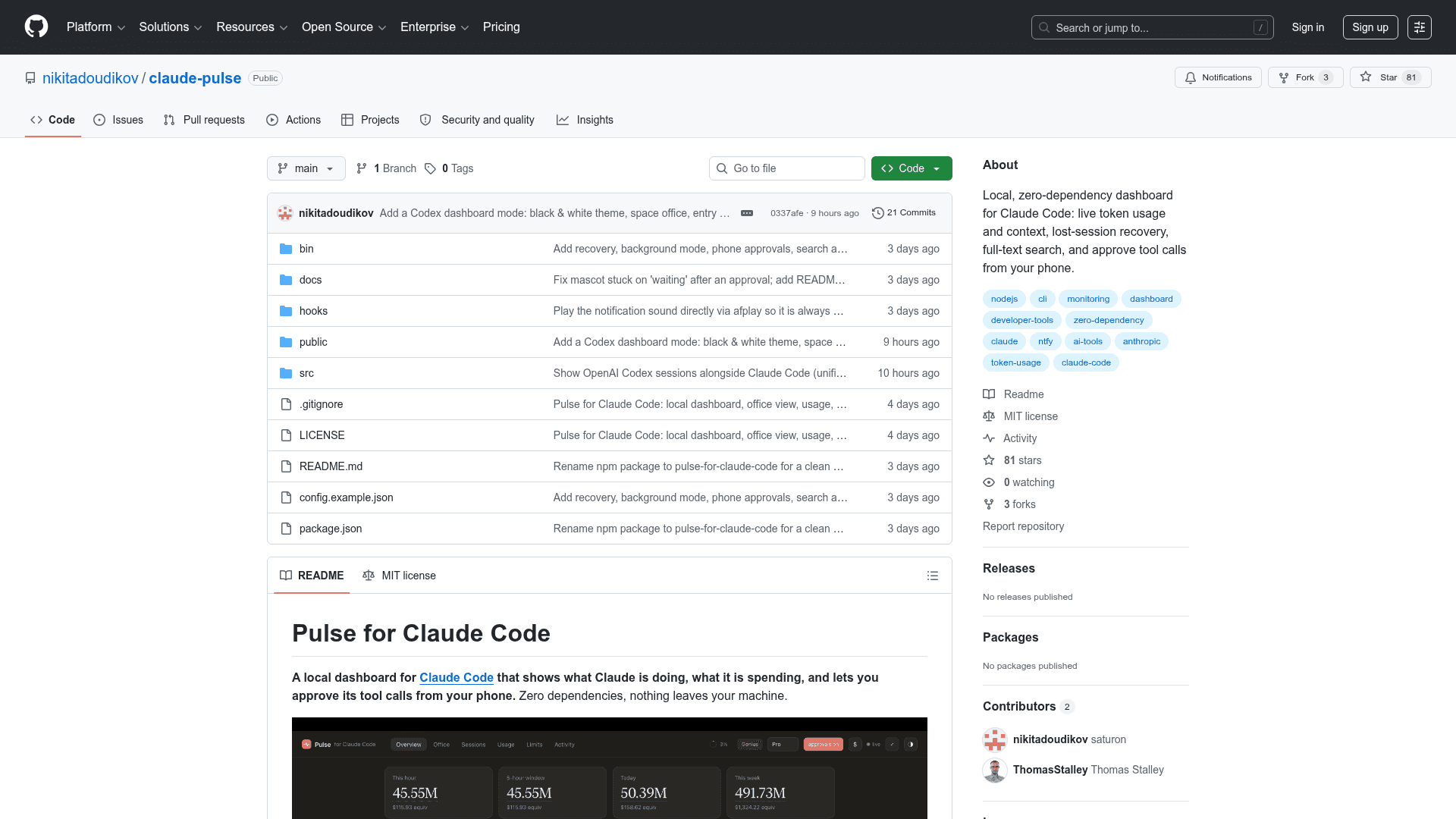
A local, zero-dependency dashboard for Claude Code that shows live token usage, session recovery, full-text search, and lets you approve tool calls from your phone.
At a Glance
Fully free and open source under the MIT license. No cost, no account required.
Engagement
Available On
Alternatives
Listed Jun 2026
About Pulse for Claude Code
Pulse for Claude Code is an open-source, MIT-licensed local dashboard built by Nikita Doudikov that runs entirely on your machine. It reads Claude Code's session files from ~/.claude in read-only mode and surfaces live token spend, context fill, session history, and tool-call approvals — all without any network calls, accounts, or telemetry.
What It Is
Pulse is a monitoring and control layer for Claude Code, Anthropic's agentic coding tool. Claude Code already writes every session to disk as JSONL files; Pulse reads those files and turns them into a live web dashboard served at 127.0.0.1:4317. The project is written in JavaScript, requires Node 18+, and has zero npm dependencies — no supply chain risk. It can be run instantly via npx pulse-for-claude-code or cloned and run directly.
Core Capabilities
- Live token dashboard — token spend by hour, day, and week, broken down by model and project, with configurable budget alerts
- Context fill meter — shows how full the active session's context window is in real time
- Ambient office view — a full-screen mascot view showing whether Claude is working, resting, or waiting, with a rough ETA
- Full-text search — scans every session on disk for a word or phrase and links directly to the transcript
- Session recovery —
claude-pulse recoverreconstructs a lost session from disk, compresses a 15 MB log to ~180 KB markdown, and saves it under~/.claude-pulse/exports/ - Auto-snapshots — while Pulse runs, it continuously snapshots active sessions so a crash never loses context
Phone Approval Workflow
The standout feature is approving Claude's tool calls from a phone without any Wi-Fi setup or open ports. When Claude wants to run a tool that needs permission, the PreToolUse hook fires, Pulse sends a push notification via the free ntfy service, and the notification carries working Allow / Allow all / Deny buttons. Tapping one sends the answer back through ntfy to a private reply topic that Pulse listens on. The flow works over cellular from anywhere. Pulse only acts on a reply while it is genuinely waiting for that exact request, so a stale notification cannot approve anything retroactively. If Pulse is not running or the approval timeout (60 seconds by default) expires, it falls back to the normal terminal prompt — Claude is never hung.
Architecture and Privacy Model
Pulse is local-first by design. Out of the box it binds only to 127.0.0.1, makes no outbound calls, and reads ~/.claude read-only. Two optional features extend the perimeter: enabling ntfyTopic routes approval prompts through the public ntfy.sh relay (or a self-hosted instance), and enabling bindLan exposes the dashboard on the local network so a phone on the same Wi-Fi can open the live /phone page. Both are opt-in and off by default. Runtime state, the device token, and configuration live in ~/.claude-pulse/ and are never committed or sent anywhere.
The server uses Server-Sent Events (SSE) to push live updates to the browser. Three small hooks — Notification, Stop, and PreToolUse — are wired into ~/.claude/settings.json via claude-pulse install-hooks, a single idempotent command that backs up existing settings and merges without duplicates.
Deployment and Lifecycle Management
Pulse can run in the foreground or as a detached background process (claude-pulse start/stop/status/restart). On macOS, claude-pulse install-service registers it as a login item via launchd so it starts at login and auto-restarts if it crashes. The export-all command writes every session into a single gzipped markdown file for backup.
Current Status
The repository was created in June 2026 and last pushed on June 23, 2026, indicating very recent and active development. The project had accumulated 82 stars and 3 forks within days of creation. It is licensed under MIT and published to npm as pulse-for-claude-code.
Community Discussions
Be the first to start a conversation about Pulse for Claude Code
Share your experience with Pulse for Claude Code, ask questions, or help others learn from your insights.
Pricing
Open Source
Fully free and open source under the MIT license. No cost, no account required.
- Live token usage dashboard
- Session recovery
- Full-text search
- Phone push approvals via ntfy
- Auto-snapshots
Capabilities
Key Features
- Live token usage dashboard by hour, day, and week
- Context fill meter for active sessions
- Approve Claude tool calls from phone via push notification
- Allow / Allow all / Deny buttons in push notifications
- Full-text search across all sessions on disk
- Session recovery from disk after crash or freeze
- Auto-snapshots of active sessions
- Ambient office mascot view with ETA
- Budget alerts via phone push when thresholds crossed
- Background daemon mode with start/stop/status/restart
- macOS login service via launchd
- Zero npm dependencies
- Local-only by default (127.0.0.1)
- Optional LAN access for phone dashboard view
- Export all sessions to gzipped markdown
- install-hooks command for one-step Claude Code integration