
pumaDB
pumaDB is a hosted memory layer for AI agents that provides durable JSON storage via MCP or REST API — no database setup required.
At a Glance
Hosted memory for agents with account-level limits included at no cost.
Engagement
Available On
Alternatives
Listed Jun 2026
About pumaDB
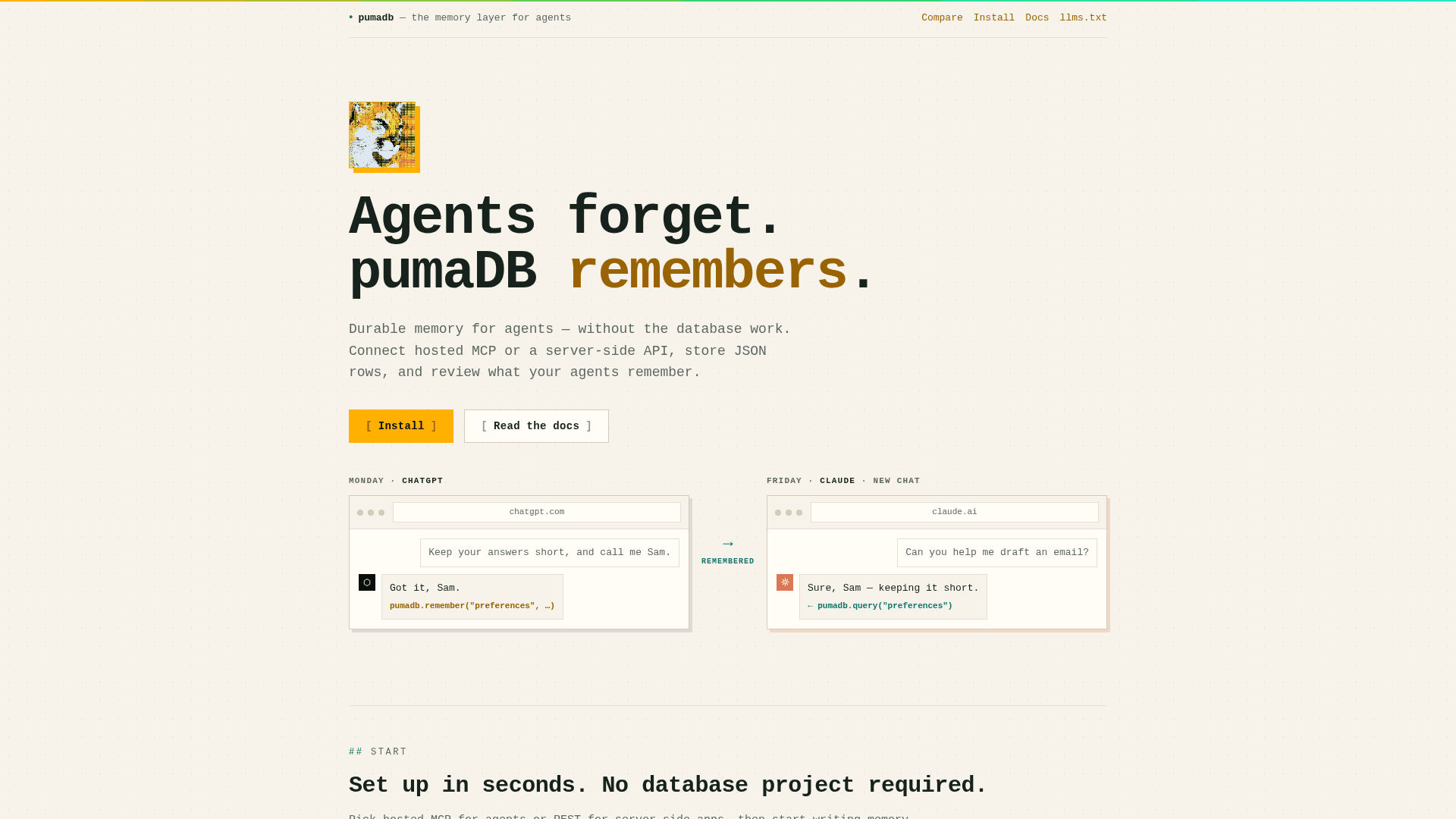
pumaDB provides durable, hosted memory for AI agents and server-side apps, letting developers store and retrieve JSON rows without managing a database. It exposes a hosted MCP (Model Context Protocol) endpoint and a REST API, making it accessible from agent clients like ChatGPT, Claude, Codex, and OpenClaw, as well as from backend code and serverless functions.
What It Is
pumaDB is a lightweight, cloud-hosted memory service purpose-built for AI agents. It solves the problem of agents losing context between sessions by providing a persistent, structured JSON store that agents can read from and write to using natural tool calls. The core abstraction is a simple table-and-row model: agents store named records (preferences, task state, research notes, project conventions) and retrieve them in future sessions, making tool calls smarter over time.
How the Memory Schema Works
pumaDB organizes memory into tables and rows of JSON. The service supports several common memory types out of the box:
- Skills markdown — reusable operating instructions and project-specific workflows
- Project conventions — repository facts, architecture notes, and decisions
- User preferences — communication style, formatting defaults, and workspace settings
- Research clippings — sources, summaries, and follow-up questions across sessions
- Task state — open threads, blockers, handoff notes, and lightweight status records
- Typed safe memory — code snippets, Markdown, commands, and config stored as inert records
The consolidated remember MCP tool handles common typed memory writes; older remember_* helpers remain compatible.
Two Access Paths: MCP and REST
pumaDB offers two integration surfaces from a single memory backend:
- Hosted MCP — a Streamable HTTP endpoint at
https://api.pumadb.ai/mcpwith OAuth discovery and dynamic client registration. Compatible with Codex, ChatGPT, Claude, OpenClaw, and any client supporting Streamable HTTP MCP. - Server-side REST API — HTTP routes (
GET,POST,DELETE) for backends, Workers, serverless functions, CLIs, and scripts using bearer API keys. The docs explicitly warn against putting API keys in client-side surfaces like React bundles, static sites, or mobile apps.
MCP tool calls include: add, query, batch, upsert, update_row, update_where, list_tables, count, delete, versions, restore, open_row, open_text_field, and remember.
Safety Rails and Recovery
pumaDB keeps agent memory deliberately bounded. Per the product page, account limits are set at 20 tables, 1,000 rows per table, and 25 MB total storage. Rate limits are 30 writes per minute and 60 reads per minute per key. Every update and delete archives the prior row content, with the last 10 versions kept for 30 days and restorable with a single call. Natural-language edit requests (e.g., "remember that I prefer short PR summaries") are supported as filtered updates without creating duplicate rows; bulk updates require explicit opt-in. Large result sets or explicit requests generate short-lived viewer and download links.
Setup Path
Setup requires no database provisioning. Users pick either the hosted MCP path (adding pumaDB as a custom MCP server via a URL) or the REST path (storing a puma_live_* API key in a backend environment). The install guide covers Codex, ChatGPT, Claude, and OpenClaw configurations.
Community Discussions
Be the first to start a conversation about pumaDB
Share your experience with pumaDB, ask questions, or help others learn from your insights.
Pricing
Free
Hosted memory for agents with account-level limits included at no cost.
- 20 tables per account
- 1,000 rows per table
- 25 MB total storage
- Hosted MCP endpoint with OAuth
- REST API access
Capabilities
Key Features
- Hosted MCP endpoint with OAuth and dynamic client registration
- REST API for server-side and serverless apps
- JSON row storage with table-and-row schema
- Version history: last 10 versions kept 30 days, restorable with one call
- Natural-language filtered updates without duplicate rows
- Scoped account limits: 20 tables, 1,000 rows/table, 25 MB total
- Per-key rate limits: 30 writes/min, 60 reads/min
- Short-lived viewer and download links for large results
- Bulk update opt-in safety gate
- Compatible with Codex, ChatGPT, Claude, OpenClaw, and any Streamable HTTP MCP client