
Memco
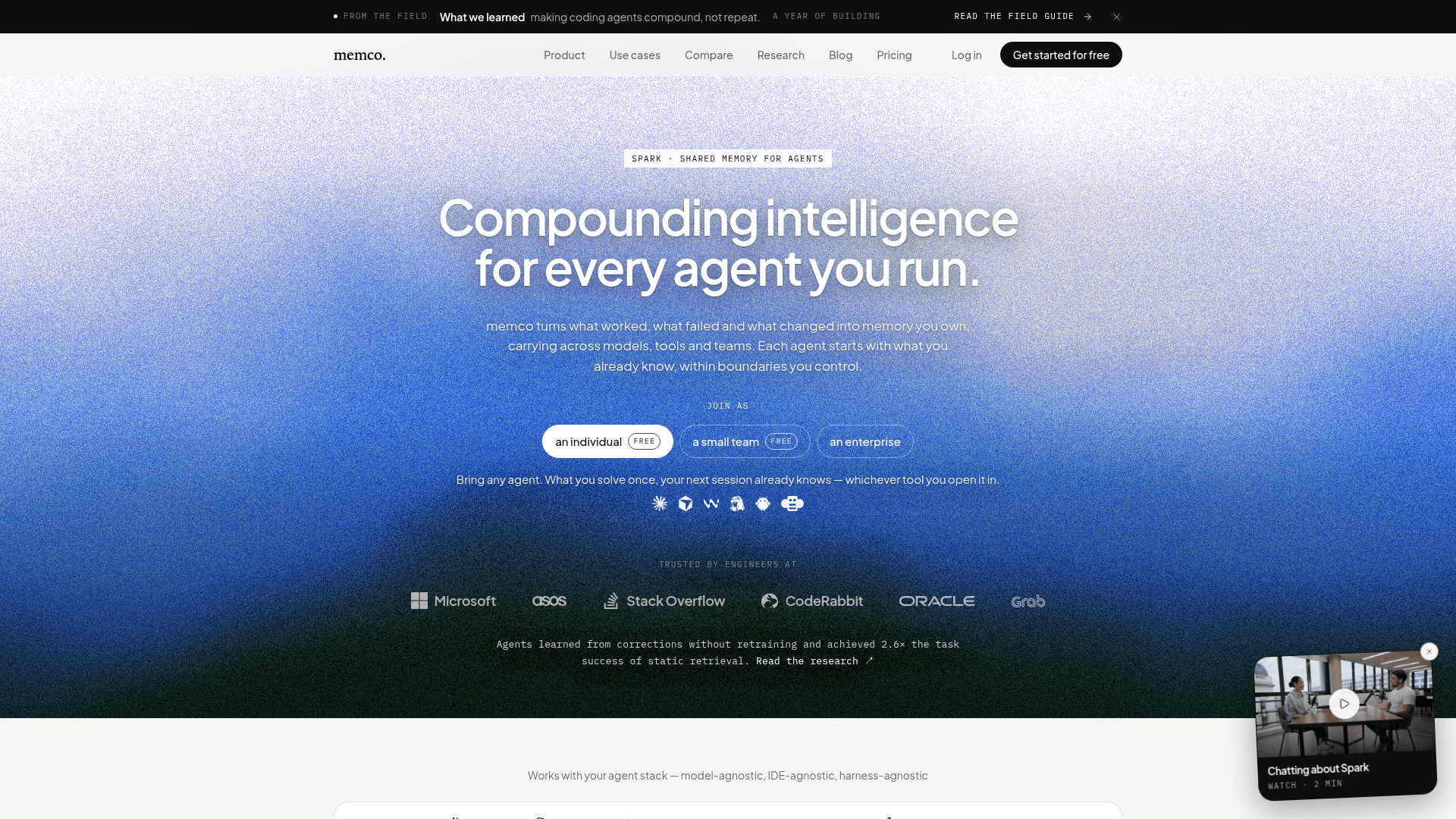
Memco is a shared memory layer for AI agents that captures lessons from agent runs and makes them available across models, tools, and teams so each agent starts with what the organization already knows.
At a Glance
About Memco
Memco builds Spark, a shared memory platform for AI coding agents, founded in 2025 and headquartered across London, San Francisco, and Stockholm. Rather than letting each agent session start from zero, Memco captures what worked, what failed, and what changed during a run, then makes those lessons available to every subsequent agent within boundaries the organization controls. The company was co-founded by Scott Taylor (former Global Head of AI Products at AIG Investments) and Valentin Tablan (former Lead Scientist for Amazon Alexa), with Kristoffer Bernhem owning the retrieval and ranking architecture.
What It Is
Memco Spark is a governed, shared memory layer that sits between AI agents and the knowledge they produce. When an agent completes a task, the run generates a trace — a fix, a dead end, or a human correction. A reviewer promotes the useful part into a scoped, owned lesson. The next agent recalls that lesson before it starts spending tokens. The core claim, backed by a published benchmark (arXiv:2607.22157), is that agents using shared memory achieved 2.6× the task success of a static-RAG baseline on τ-bench banking tasks, converting 49% of previously unsolved tasks and retaining 88% of learned solutions — with zero weight updates or fine-tuning.
How the Memory Loop Works
Spark exposes four MCP/CLI tool calls that agents use organically during work:
- search — retrieves relevant memories at task start or on errors, ranked by a hybrid of vector similarity, BM25 full-text match, and Bayesian trust weighting
- create_memory — stores a new insight when an agent discovers an undocumented behavior or workaround; enters the store with an initial trust score
- enrich_memory — refines an existing memory by attaching the outcome of a task to the rule that informed it
- share_feedback — positive and negative scores feed the Bayesian trust model, shaping retrieval ranking for every future session
Trust is modeled as a probability distribution per memory, not a scalar. Memories that stop earning positive feedback gradually lose confidence and decay out of retrieval without manual intervention. Retirement is also a first-class action: memories can be edited, deduplicated, or explicitly retired.
Architecture and Deployment
Spark runs as a single instance that multiple agent nodes connect to over MCP and CLI. It maintains two isolated memory scopes: private organization memory (the default, never leaving the tenant) and an opt-in read-only public community pool covering widely-used libraries and frameworks. Memco offers three deployment options:
- Managed tenant — a dedicated Spark instance in Memco's cloud, isolated at data and compute level, deployable in hours
- VPC — the Spark instance runs inside the customer's cloud boundary, with UK/EU residency options
- On-premises — entirely behind the customer's firewall; organization memory never leaves customer-controlled infrastructure
The platform is model-agnostic (Claude, OpenAI, Gemini, Llama, DeepSeek, Qwen), IDE-agnostic (Cursor, Windsurf, Zed, JetBrains, VS Code, GitHub), and harness-agnostic (Claude Code, Codex, Copilot).
Enterprise Governance
For larger organizations, Memco provides RBAC and permissioned sharing down to the memory-entry level, full provenance tracing every memory back to the originating run and human correction, exportable audit logs for compliance, and SSO/SAML. The company states SOC 2 Type II is in progress (as of July 2026) and a DPA is available for GDPR readiness. Private memory pools can be scoped per-team, per-repo, per-org, or per-deployment, and sharing across boundaries is opt-in and explicit. The company explicitly states it does not train models on customer data.
Benchmark and Research Signal
Memco publishes its benchmark methodology openly on arXiv (2607.22157), running 97 tasks × 4 trials across two models with 2,700+ simulated conversations against a static-RAG baseline. The company also publishes internal evaluations claiming −40% LLM costs at steady state, −34% wall-clock time per task, and −31% agent steps to completion on SWE-bench (March 2026, Memco-controlled evaluation). The homepage attributes trust from engineers at Microsoft, Stack Overflow, and CodeRabbit, per vendor-published claims.
Community Discussions
Be the first to start a conversation about Memco
Share your experience with Memco, ask questions, or help others learn from your insights.
Pricing
Developer
For individual developers building with public APIs, SDKs, frameworks and open-source tools.
- Public memory for APIs, SDKs and frameworks
- Works in Claude Code, Codex, Cursor, Copilot
- Public memory access without monthly caps
- Community support
- Cloud only
Team
For engineering teams that want AI work to compound across people, repos and tools.
- Everything in Developer
- Private team memory across repos, tools and agents
- Decisions, fixes and patterns captured once, reused
- Same memory in Claude Code, Cursor, Codex, Copilot and custom agents
- Review, edit, deduplicate and retire shared memories
- Memory reuse, agent activity and token-savings insights
Enterprise
Platform and programme licensing for organisations running agents across teams, tools, models and governed workflows.
- Everything in Team
- SSO / SCIM, RBAC and audit logs
- Policy-seeded memory and provenance
- Client / programme memory scoping
- VPC, on-prem and UK/EU residency
- Dedicated support and paid pathfinders
Capabilities
Key Features
- Shared memory across agents, models, IDEs, and harnesses
- Bayesian trust modeling with decay for stale memories
- Hybrid retrieval: vector similarity + BM25 + trust weighting
- Human review gate before lessons are promoted to shared memory
- Full provenance on every lesson (run, reviewer, scope)
- Memory retirement as a first-class action
- Scoped memory pools: team, org, public commons
- RBAC and permissioned sharing down to memory-entry level
- Audit logs exportable for compliance
- SOC 2 Type II (in progress), GDPR-ready, DPA available
- SSO/SAML support
- VPC, on-premises, and UK/EU data residency options
- MCP and CLI integration
- Public community memory pool (opt-in, read-only)
- No metering on memory operations for normal use
- Memory reuse, agent activity, and token-savings insights dashboard