
Qase
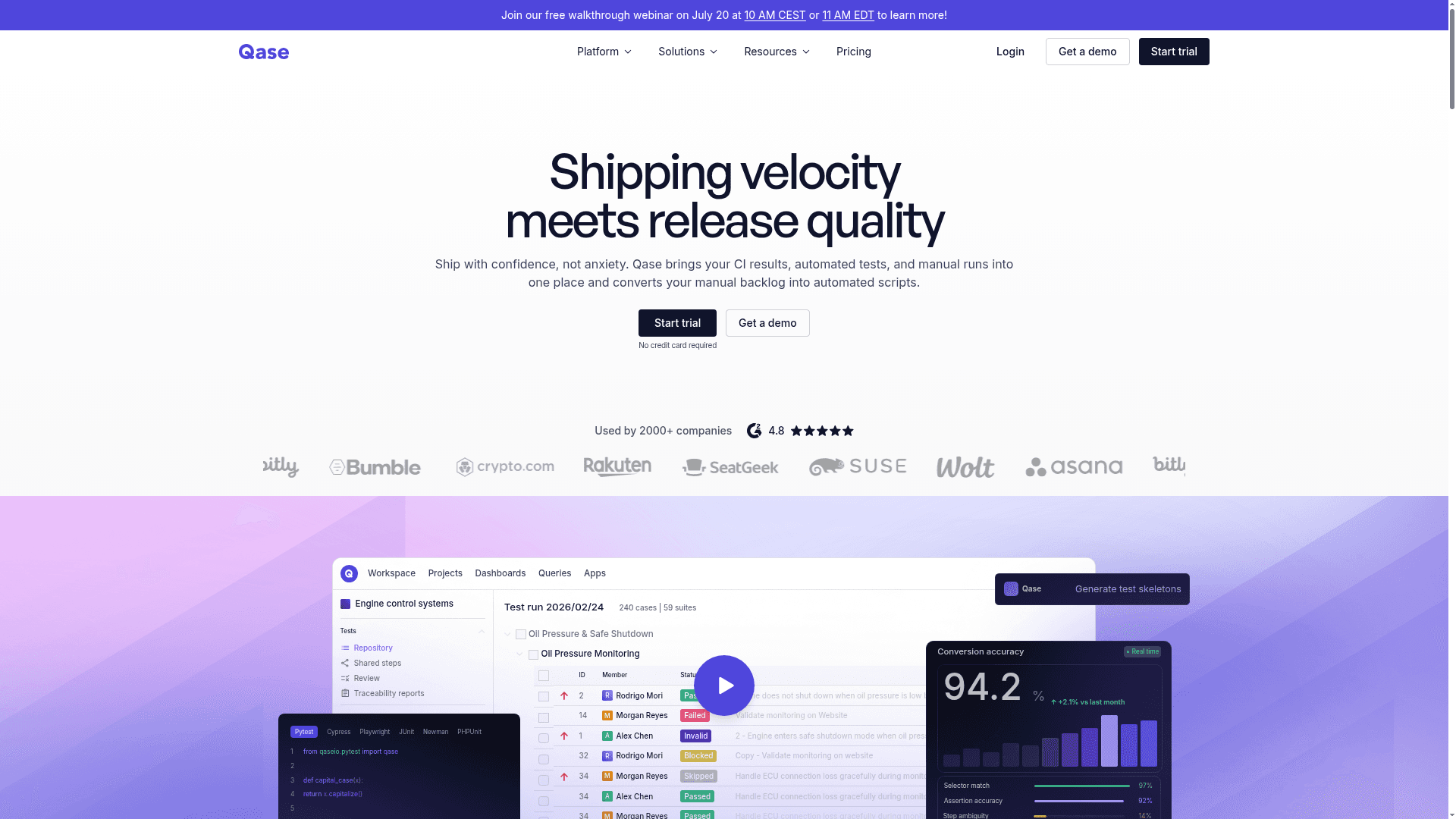
Qase is a test management platform that unifies CI results, automated tests, and manual runs into one place, with AI that converts manual test cases into automated scripts.
At a Glance
For students and hobbyists to learn the basics of a TMS.
14-day trial of the Business plan with no obligation or credit card required.
Engagement
Available On
Listed Jul 2026
About Qase
Qase is a cloud-based test management platform built for engineering and QA teams that need a single source of truth across manual and automated testing. The platform brings CI pipeline results, test framework output, and manual test runs into one unified dashboard, and uses AI to convert manual test backlogs into executable automation scripts for frameworks like Playwright, Cypress, and Selenium. According to the Qase website, the platform is used by 2,000+ companies and holds a 4.8 rating on G2.
What It Is
Qase is a test management system (TMS) that sits above the tools teams already run — connecting CI/CD pipelines, test automation frameworks, and issue trackers — rather than replacing them. Its core job is to give QA teams, SDETs, and engineering leaders a unified view of release readiness: what passed, what failed, what has coverage, and what doesn't. The platform positions itself against spreadsheet-based workflows, legacy standalone tools like TestRail, and Jira-native add-ons like Zephyr, arguing that none of those give a complete cross-system picture.
How the AI Layer Works
Qase's AI capabilities operate across three distinct layers:
- Test case generation: AI reads requirements from connected tools (Jira, GitHub, Notion, Confluence) and generates structured test cases with steps, ready for review before saving.
- Manual-to-autotest conversion: AI analyzes the existing test repository, grades each case by automation readiness (easy, medium, difficult), and bulk-converts approved cases into runnable scripts.
- Agentic execution: Converted tests can run in Qase Cloud with parallel execution across multiple browsers, with results flowing back into test runs automatically — no local infrastructure required.
AI credits are consumed per action and reset monthly. The Qase MCP server also lets AI coding assistants like Claude or GitHub Copilot read test cases and create test runs directly inside Qase.
Integrations and Developer Tooling
Qase advertises 35+ integrations described as "real, bidirectional" rather than surface-level connectors. Key integration categories include:
- Issue trackers: Jira, GitHub, GitLab, Azure DevOps, Linear, YouTrack
- CI/CD pipelines: Jenkins, GitHub Actions
- Test frameworks: Playwright, Cypress, Selenium, Jest, PHPUnit, Newman, JUnit, pytest
- Communication: Slack
- Requirements: Notion, Confluence
The Qase Query Language (QQL) lets teams filter and group test artifacts across runs, environments, and configurations. Webhooks notify external systems when test project data changes.
Traceability and Release Readiness
A central differentiator Qase emphasizes is end-to-end requirements traceability: every requirement maps to test cases, and every test case maps to results. The Requirement Traceability Matrix shows which requirements have coverage and which don't, so go/no-go release decisions are based on data rather than manual status checks. Customizable dashboards surface KPIs including pass rates, failure trends, flakiness patterns, coverage gaps, and cycle time per project or release. Read-only seats let stakeholders like PMs and executives view results without consuming full user seats.
Enterprise Deployment and Compliance
For larger organizations, Qase offers SAML 2.0 SSO (including pre-built configurations for Azure AD and Okta), SCIM provisioning for automated user management, role-based access control, and dedicated cluster deployment for infrastructure isolation. The platform is certified under SOC 2 Type II, SOC 3, ISO/IEC 27001:2022, and is GDPR compliant. A 99.9% uptime SLA and dedicated Customer Success Manager are included at the Enterprise tier. The enterprise page states that migration support from tools like TestRail or Zephyr Enterprise is available, and teams typically have their first test cases in the system within days of onboarding.
Community Discussions
Be the first to start a conversation about Qase
Share your experience with Qase, ask questions, or help others learn from your insights.
Pricing
Free
For students and hobbyists to learn the basics of a TMS.
- Up to 3 users
- Up to 2 projects
- 500 MB storage
- 30-day test history
- 25k/mo API results
Business Trial
14-day trial of the Business plan with no obligation or credit card required.
- Full access to Business plan features
Startup
Level up QA efficiency and speed. Gain insights with custom reports.
- Up to 20 users
- Unlimited test runs & projects
- 100 GB storage
- MCP Server
- 1,000/mo AI credits
- 90-day test history (paid option to extend)
- Dashboards + reporting
- 35+ integrations
- Custom fields
- 100k/mo API results
- Webhooks
- Manage requirements
Business
Powerful test orchestration and advanced features.
- Up to 100 users
- Unlimited storage
- MCP Server
- 2,000/mo AI credits
- Role-based access control
- 1-year test history (paid option to extend)
- Test case review
- Qase query language
- Requirements traceability
- Premium support
Enterprise
Enterprise level security, customizations, and support.
- Unlimited users
- Single sign-on (SAML 2.0)
- Multi-workspace SSO (SAML 2.0)
- SCIM provisioning
- MCP Server
- 4,000/mo AI credits
- SLA
- Unlimited data history
- Success manager
- Enterprise support
- Dedicated cluster
- Custom domain
Capabilities
Key Features
- Unified test management for manual and automated tests
- AI test case generation from requirements
- Manual-to-autotest conversion (Playwright, Cypress, Selenium)
- Automation readiness grading (easy/medium/difficult)
- Agentic test execution in Qase Cloud
- MCP server for AI coding assistant integration
- Requirements traceability matrix
- Customizable dashboards and KPI reporting
- Qase Query Language (QQL) for advanced filtering
- 35+ bidirectional integrations
- Flaky test visibility and historical pass/fail patterns
- Centralized run history across CI and manual runs
- Role-based access control
- SAML 2.0 SSO and SCIM provisioning
- Dedicated cluster deployment
- SOC 2 Type II, ISO 27001, GDPR compliance
- Read-only stakeholder seats
- Webhooks and API results ingestion
- Shared steps and Smart Test Wizard
- 24/5 live chat and email support