
Quiver GTM
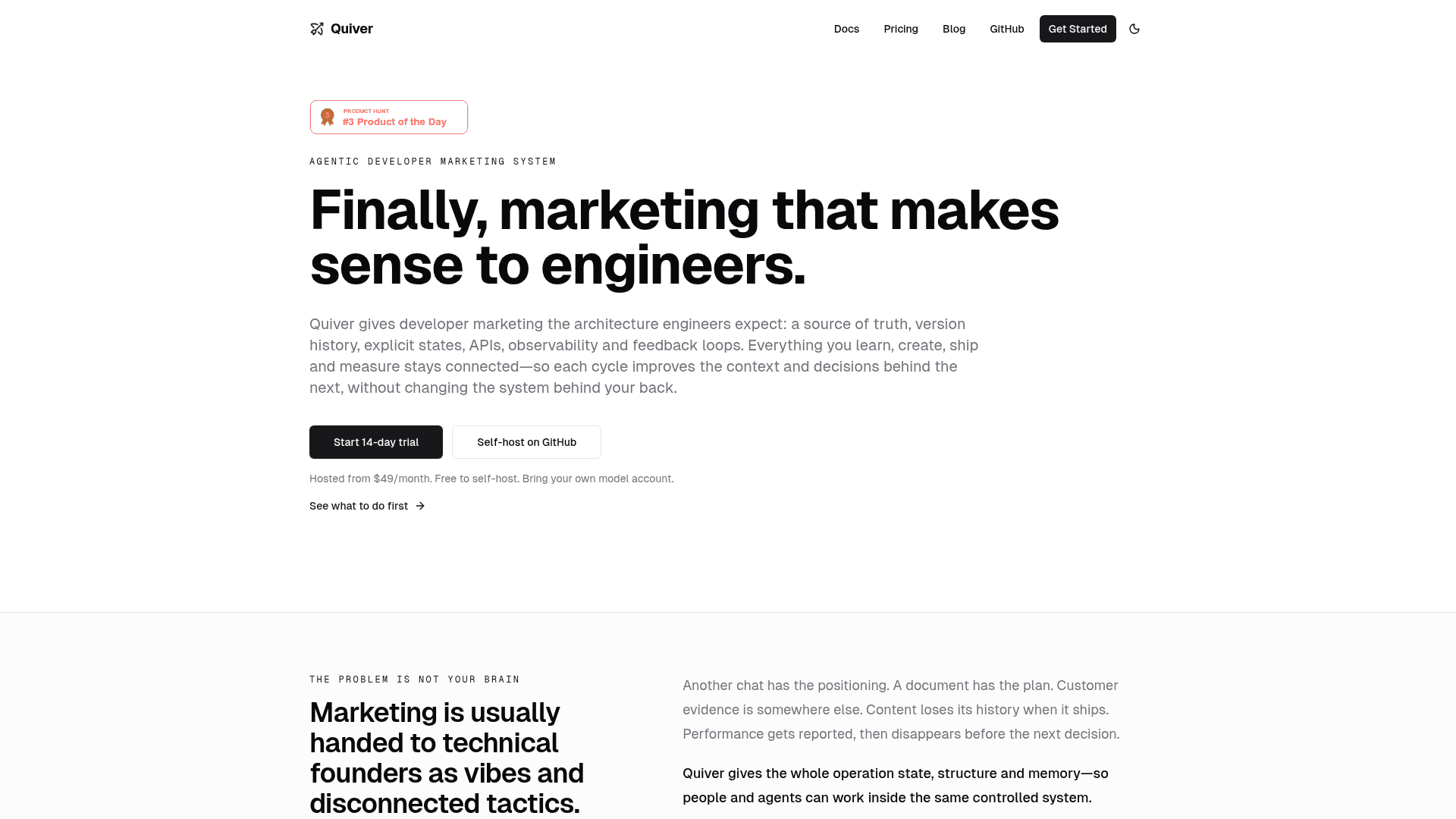
An agentic developer marketing system that gives technical founders and developer marketing teams a versioned source of truth, explicit workflow states, and an MCP interface for AI agents.
At a Glance
MIT-licensed self-hosted foundation for technical founders comfortable owning the stack. Unlimited seats on your own infrastructure.
14-day trial of hosted Quiver (Founder or Team). Card required; cancel any time.
Engagement
Available On
Alternatives
Listed Oct 2026
About Quiver GTM
Quiver GTM is an open-source, self-hosted AI-powered marketing command center built specifically for technical founders and developer marketing teams. Created by Tessa Kriesel under Built for Devs, LLC, it applies engineering primitives—version control, state machines, observability, and feedback loops—to the full developer marketing lifecycle. The project is MIT-licensed and available on GitHub, with a hosted option for teams that prefer managed infrastructure.
What It Is
Quiver is an agentic developer marketing system that keeps product context, customer evidence, active work, shipped output, and measured results connected in one controlled system. Rather than wrapping a chatbot in a marketing skin, it models the marketing operation as an engineering system: a versioned source of truth, explicit artifact states (Draft → Review → Approved → Live → Archived), a Content API serving approved work as structured JSON, and an MCP server that lets external AI agents operate the system through structured tools. Every session—whether run by a person or an agent—starts from the same approved, versioned context.
Architecture and Core Primitives
The product is organized around six engineering properties applied to marketing:
- Source of truth — A single active marketing context stores positioning, ICP, messaging, customer language, proof points, and hypotheses. Agents can propose changes; a human approves what becomes true.
- Version history — Every context and artifact change is versioned and restorable. Silent drift is prevented by design.
- State machines — Artifacts move through explicit production states rather than disappearing into chat history.
- Interfaces — A public Content API serves approved content as structured JSON; an MCP server exposes the full product surface to compatible AI clients (Claude Desktop, Cursor, Windsurf, and others).
- Observability — Campaigns connect the plan, sessions, research, content, tasks, and performance behind an initiative.
- Feedback loops — Logging results produces proposed context updates that a human reviews before they affect future sessions.
Agent Runtime and Session Modes
Quiver ships five purpose-built session modes—Strategy, Create, Feedback, Analyze, and Optimize—each loading the context most relevant to that job. Sessions can also be initiated by external agents over MCP. The MCP tool surface covers context management, campaigns, artifacts, content, research, sessions, tasks, and workspace summaries. A key design constraint: agents write drafts but cannot publish content; promoting work to live is always a human action.
Competitive Intelligence Layer
The product includes a built-in competitor monitoring feature. A workspace can watch up to three competitors and up to fifteen pages each. Quiver re-reads those pages on a configurable schedule (off, monthly, or weekly), detects what actually changed, and produces a structured brief comparing findings against the workspace's own marketing context. Page fetching is handled by Quiver; AI analysis of changes runs through the user's own connected model provider account. Raw page text is never persisted—only a content hash per page and structured field extractions.
Deployment Model
Quiver offers two deployment paths. The MIT-licensed open-source edition is free to self-host on Vercel with a Supabase Postgres database; self-hosting takes approximately 30 minutes following the documented setup path. The hosted edition provides managed infrastructure, team invitations, built-in tasks (not included in the open-source edition), and a ready-to-connect MCP endpoint with OAuth or scoped token authentication. Both paths use a bring-your-own-model-key (BYOK) approach supporting Anthropic, OpenAI, Google, OpenRouter, and any OpenAI-compatible endpoint.
Tech Stack and Current Status
The project is built on Next.js 14 (App Router), TypeScript in strict mode, Tailwind CSS, shadcn/ui with Radix UI, Supabase (Postgres + Auth), Prisma ORM, Anthropic SDK, Vitest, and Vercel. The GitHub repository shows v1.2.0 as the latest release, with the repository created in April 2026 and last updated in September 2026. The project has 27 stars and 6 forks on GitHub as of the available data.
Community Discussions
Be the first to start a conversation about Quiver GTM
Share your experience with Quiver GTM, ask questions, or help others learn from your insights.
Pricing
Open Source
MIT-licensed self-hosted foundation for technical founders comfortable owning the stack. Unlimited seats on your own infrastructure.
- Versioned product context with restore
- Strategy, Create, Feedback, Analyze and Optimize modes
- Versioned artifacts with approval and publish states
- Campaigns linking sessions, research, content and results
- Customer research synthesis and Voice of Customer library
14-Day Hosted Trial
14-day trial of hosted Quiver (Founder or Team). Card required; cancel any time.
- Full hosted feature set
- Built-in tasks
- Shared workspace
- Managed infrastructure
Founder
Ready-to-use hosted shared system for a technical founder and up to two teammates (up to 3 seats).
- Versioned product context with restore
- Strategy, Create, Feedback, Analyze and Optimize modes
- Versioned artifacts with approval and publish states
- Campaigns linking sessions, research, content and results
- Customer research synthesis and Voice of Customer library
- Hypothesis evidence tracking
- Content calendar, SEO/social metadata and repurposing
- Distribution records and content metric history
- Public Content API for approved content
- Performance synthesis and reviewed context proposals
- Ready-to-connect MCP endpoint (OAuth or scoped tokens)
- BYOK with per-job model selection
- Built-in tasks, assignments and reminders
- Ready-to-invite shared workspace
- Managed authentication, infrastructure and updates
Team
Hosted team product with unlimited seats for the whole company.
- Versioned product context with restore
- Strategy, Create, Feedback, Analyze and Optimize modes
- Versioned artifacts with approval and publish states
- Campaigns linking sessions, research, content and results
- Customer research synthesis and Voice of Customer library
- Hypothesis evidence tracking
- Content calendar, SEO/social metadata and repurposing
- Distribution records and content metric history
- Public Content API for approved content
- Performance synthesis and reviewed context proposals
- Ready-to-connect MCP endpoint (OAuth or scoped tokens)
- BYOK with per-job model selection
- Built-in tasks, assignments and reminders
- Ready-to-invite shared workspace
- Managed authentication, infrastructure and updates
- Unlimited seats
Capabilities
Key Features
- Versioned product context with restore
- Five AI session modes: Strategy, Create, Feedback, Analyze, Optimize
- Artifact library with versioning and status workflow (Draft → Review → Approved → Live → Archived)
- Campaign workspace linking sessions, artifacts, content, research, and performance
- Customer research synthesis with Voice of Customer quote library
- Hypothesis evidence tracking
- Content calendar with SEO/social metadata and repurposing lineage
- Distribution records and content metric history
- Public Content API serving approved content as structured JSON
- MCP server for external AI agent integration (stdio and HTTP)
- Competitive intelligence monitoring for up to 3 competitors
- Performance synthesis and reviewed context proposals
- Built-in task system with assignments, due dates, and reminders (hosted plans)
- BYOK model support: Anthropic, OpenAI, Google, OpenRouter, OpenAI-compatible
- Changelog drafting from pull requests via agent + MCP