
Rakazo
Open-source, self-hosted AI agent platform that gives each bot a sandboxed browser and shell, memory, routines, and human-in-the-loop approvals — running on your own machine with your own model keys.
At a Glance
About Rakazo
Rakazo is an Apache-2.0-licensed open-source alternative to Grok Bot, built by Inbox Zero Inc. and published on GitHub. It lets you deploy autonomous AI bots that sign into your tools, execute real browser and shell tasks inside sandboxed Docker containers, and return to you only when they need approval. The project is described as early/beta, with notable changes tracked in a CHANGELOG.md file.
What It Is
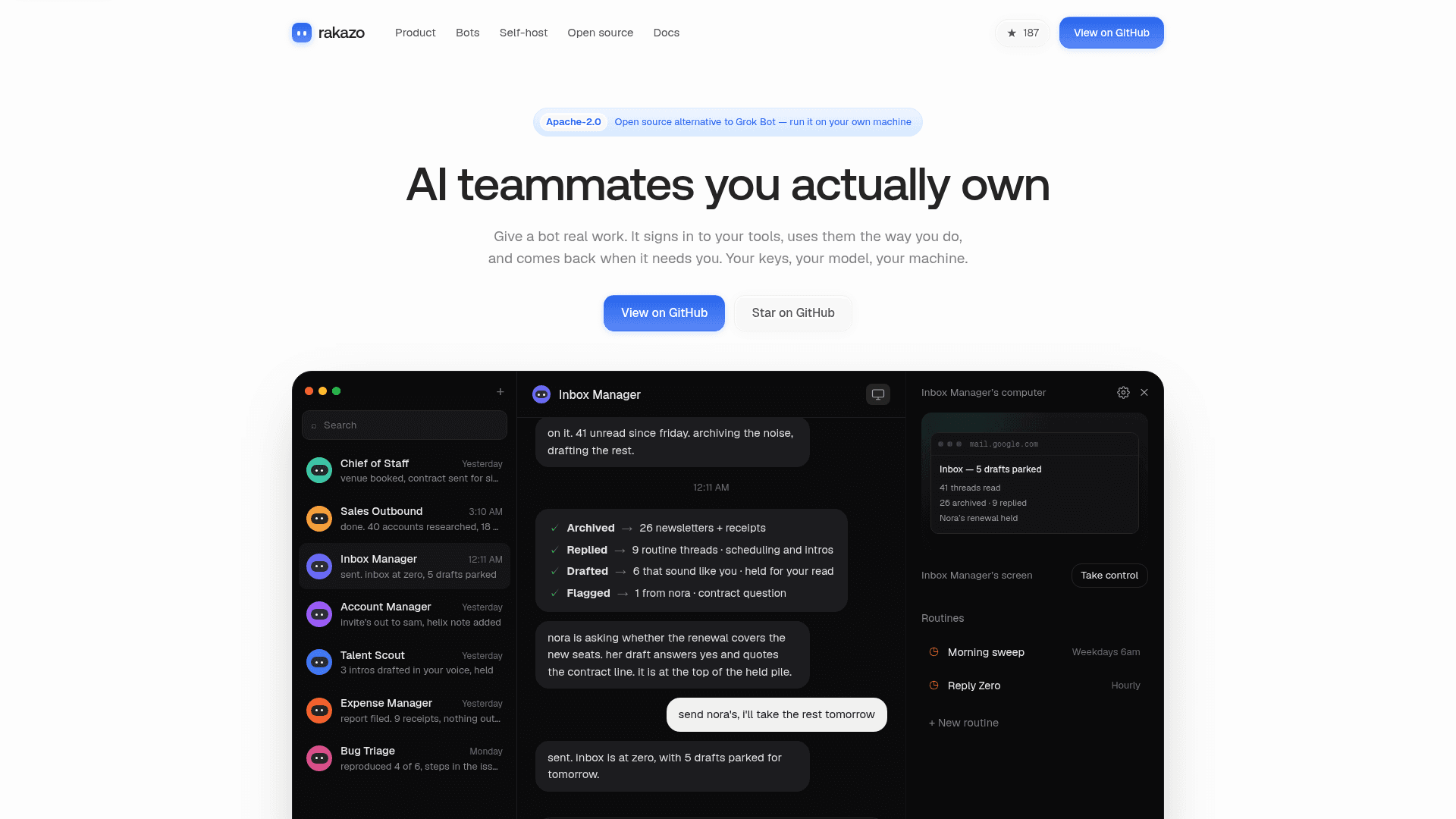
Rakazo is a self-hosted multi-agent framework where each bot gets a dedicated sandboxed Linux desktop with a browser, persistent memory, readable Markdown routines, and a full audit log. Bots can spawn peer bots or run short-lived subagents within a turn. The entire core product runs without a Rakazo-operated control plane — you bring your own model keys and your own machine.
Architecture and Stack
The repository is a TypeScript monorepo covering web, desktop (Electron), and mobile (Expo) clients that all talk to the same API. Key components include:
- API / Worker: Hono, oRPC, Graphile Worker
- Database: Postgres with Prisma
- Auth: Better Auth
- Sandbox providers: Docker (default), E2B (remote, for multi-user deployments), or a direct desktop process
- Model routing: OpenRouter key or direct sign-in with ChatGPT Plus/Pro, GitHub Copilot, or SuperGrok/X Premium
- Integrations: Composio (optional, for connecting bots to live apps)
Docker is the recommended quick-start sandbox for single-machine self-hosting. E2B provides stronger isolation for public or multi-user deployments.
Bot Templates and Workflow
Rakazo ships with a roster of pre-built bot roles. When you create a new bot, it interviews you about the work, your writing style, and which tools it lives in, then begins operating. The homepage lists these example roles:
- Inbox Manager — archives noise, replies to routine threads, parks drafts for review
- Sales Outbound — researches accounts overnight, scores intent, drafts outreach in your voice
- Talent Scout — reads applicants, shortlists against your bar, writes intro emails
- Bug Triage — reproduces reports in a real browser and attaches steps to issues
- Expense Manager — matches receipts to charges, files reports, asks before guessing
- Chief of Staff — runs weekly briefings, bookings, and handoffs between other bots
Routines are saved as plain Markdown that you can read, edit, and commit to version control.
Human-in-the-Loop and Ownership Model
A core design principle is configurable autonomy: you set what each bot may do alone and what it must ask about. Every action lands in an audit log you own. Sessions and credentials never leave your Docker environment. The homepage states "nothing is gated, nothing phones home."
Deployment Model and Current Status
Self-hosting via Docker is available today. A managed Cloud edition (bring your own keys, Rakazo runs the computers) is listed as "coming soon" with a waitlist. The GitHub repository was created in August 2026 and had 290 stars at last update, with the README noting the product is "still early (beta)." The project is built on top of a runtime called Pi and supports unlimited bots with no seat limits under the open-source license.
Community Discussions
Be the first to start a conversation about Rakazo
Share your experience with Rakazo, ask questions, or help others learn from your insights.
Pricing
Open Source (Self-host)
Full open-source release under Apache-2.0. Run on your own machine with your own model keys. Unlimited bots, no seats, no limits, community support on GitHub.
- Docker runner and sandboxed browser
- Bring your own model keys
- Routines, memory, and audit log
- Unlimited bots, no seats, no limits
- Community support on GitHub
Capabilities
Key Features
- Self-hosted AI agent platform
- Sandboxed browser and shell per bot (Docker or E2B)
- Bring your own model keys (OpenRouter, ChatGPT, Copilot, SuperGrok, local models)
- Persistent bot memory
- Readable Markdown routines
- Human-in-the-loop approvals
- Full audit log
- Bot spawning and subagents
- Pre-built bot templates (Inbox Manager, Sales Outbound, Bug Triage, etc.)
- Web, desktop (Electron), and mobile (Expo) clients
- Composio integration for live app connections
- No seats, no limits, no control plane required