
Ray
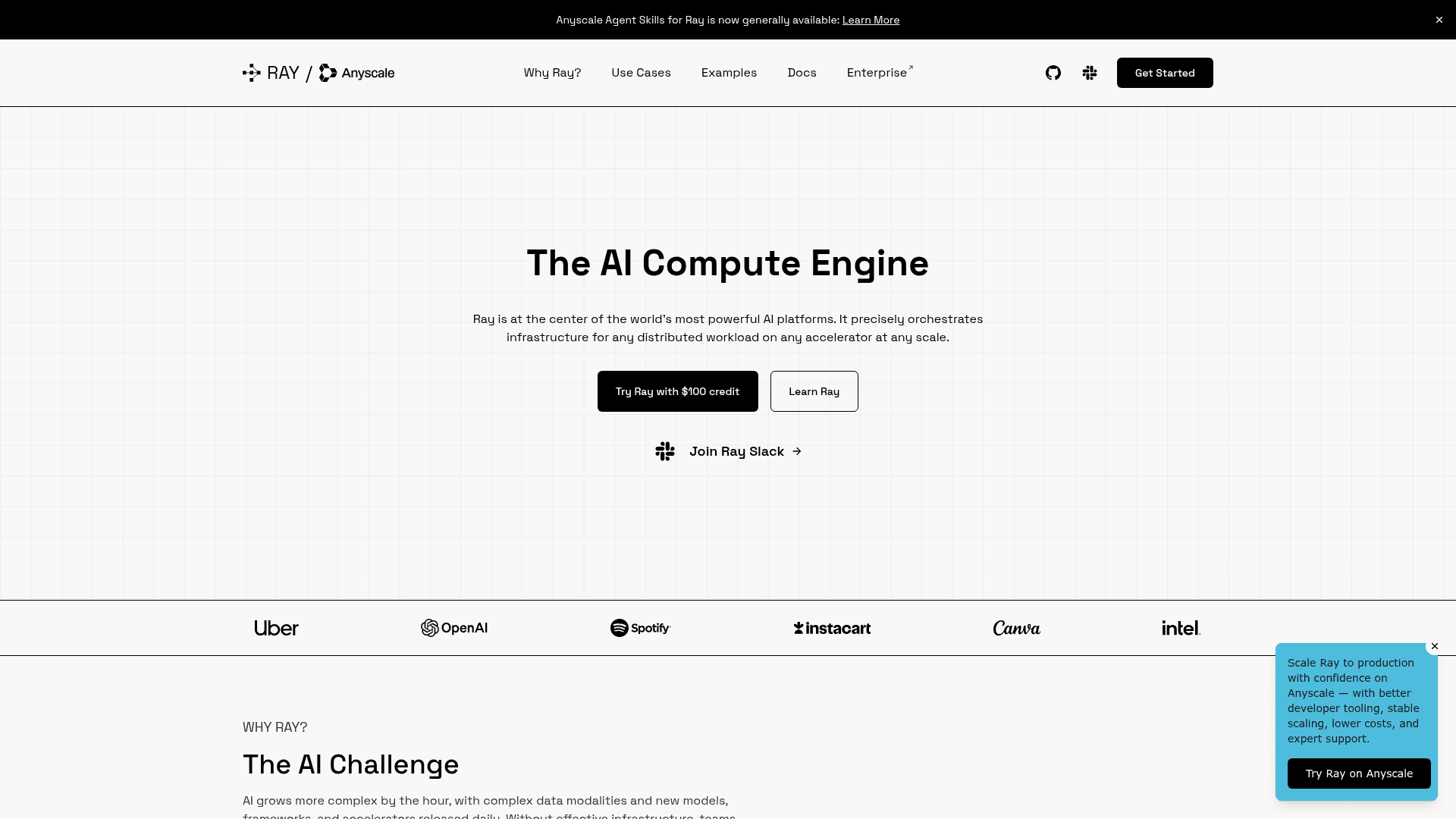
Ray is an open-source AI compute engine that pairs a distributed Python runtime with libraries for training, tuning, serving, and reinforcement learning.
At a Glance
About Ray
Ray is an open-source AI compute engine built around a distributed Python runtime and a set of high-level AI libraries. It is designed to scale machine learning and Python workloads from a single laptop to clusters of thousands of GPUs and CPUs, with native support for heterogeneous accelerators and fine-grained, independent scaling. Ray is Python-native and built by developers for developers, with simple primitives like @ray.remote decorators that turn ordinary Python functions and classes into distributed tasks and actors.
Ray originated at UC Berkeley's RISELab and is now stewarded by Anyscale alongside a large open-source community. According to the project site, Ray has 34.8k+ GitHub stars, 1,000+ contributors, and 40k+ repository downloads, and is used in production by companies including Instacart, Pinterest, Canva, and Amazon to handle workloads ranging from foundation model training to exabyte-scale data processing. The framework is released under the Apache License 2.0.
The project is split into Ray Core — the distributed runtime providing tasks, actors, and objects — and a set of AI Libraries that sit on top: Ray Data, Ray Train, Ray Tune, Ray Serve, and Ray RLlib. These cover multi-modal data processing, distributed training of traditional ML and Gen AI models, hyperparameter tuning, scalable model serving, and production-grade reinforcement learning. Ray also supports LLM inference, batch inference, and LLM fine-tuning workflows, and integrates with PyTorch, TensorFlow, JAX, XGBoost, and Kubernetes.
- Ray Core distributed runtime — Scale Python tasks, actors, and objects across CPUs, GPUs, and machines with a small set of primitives and decorators like
@ray.remote. - Ray Train — Distributed training for foundation models, time-series models, and traditional ML such as XGBoost, compatible with major ML frameworks.
- Ray Tune — Hyperparameter optimization with state-of-the-art search algorithms and distributed experiment execution.
- Ray Serve — Scalable model serving for ML models and LLMs, with independent scaling and fractional resource allocation.
- Ray Data — Distributed data processing for structured and unstructured data including images, video, and audio, used for ML pipelines and batch inference.
- Ray RLlib — Production-grade reinforcement learning with distributed RL workloads behind a unified API.
- LLM inference and fine-tuning — Online and batch LLM serving plus fine-tuning workflows that scale across heterogeneous accelerators.
- Cluster and cloud ready — Run on any cloud, Kubernetes, or on-prem, with autoscaling and integrations across the ML ecosystem.
- Apache 2.0 open source — Free to use, modify, and distribute under the Apache License 2.0; install with
pip install ray.
Community Discussions
Be the first to start a conversation about Ray
Share your experience with Ray, ask questions, or help others learn from your insights.
Pricing
Open Source
Ray is free and open source under the Apache License 2.0. Install via pip and run on your laptop, cluster, cloud, or Kubernetes.
- Ray Core distributed runtime
- Ray Data, Train, Tune, Serve, and RLlib libraries
- LLM inference and fine-tuning workflows
- Cluster autoscaling on any cloud or Kubernetes
- Community support via Slack, Discourse forum, and GitHub
Capabilities
Key Features
- Ray Core distributed runtime with tasks, actors, and objects
- Ray Train for distributed ML and foundation model training
- Ray Tune for hyperparameter optimization
- Ray Serve for scalable model and LLM serving
- Ray Data for distributed multi-modal data processing
- Ray RLlib for production-grade reinforcement learning
- Online and batch LLM inference
- LLM fine-tuning workflows
- Heterogeneous CPU and GPU scheduling
- Cluster autoscaling on any cloud or Kubernetes
- Ray Dashboard for monitoring and debugging
- Apache License 2.0 open source