
Rebuno
An open-source execution runtime for AI agents that records every LLM and tool call as a durable step, enabling interrupted runs to resume and enforcing human-approval policies.
At a Glance
Self-hosted open-source runtime available under the MIT License. Free to use, modify, and distribute.
Engagement
Available On
Alternatives
Listed Sep 2026
About Rebuno
Rebuno is an open-source execution runtime for production AI agents, released under the MIT License by Nathan Wong. It intercepts every LLM call and tool call, records them as durable steps in an immutable event log, and enforces policy rules before any effect is executed. The project is hosted on GitHub and also offers a hosted cloud option.
What It Is
Rebuno sits between your agent framework and the outside world — LLM providers, external APIs, and side-effecting tools — acting as a kernel that governs what the agent is allowed to do. Rather than relying on prompts or application-level guards, Rebuno enforces rules at the runtime layer. If a run is interrupted (crash, timeout, restart), it resumes from the last recorded step instead of starting over, preventing duplicate side effects.
How Durability Works
Every effect is recorded before it happens. When a run resumes, the runtime reads the stored result back from the log rather than re-executing the step. This means:
- LLM calls are intercepted via an HTTP client shim (
http_client()/rebunoFetch) so they replay durably - Tool calls are decorated with an idempotency mode (
at_most_once, etc.) so the runtime knows how to handle retries - The event log is immutable — every state transition from
execution.createdthroughexecution.completedis stored in order
Policy and Approval Model
Rebuno introduces a YAML-based policy language that the runtime enforces on every step. Policies can allow, deny, or hold a step for human approval. A paused execution can wait days for a human to approve before resuming — the state is fully persisted. This is distinct from prompt-level instructions: the model cannot override a runtime policy.
Framework Compatibility
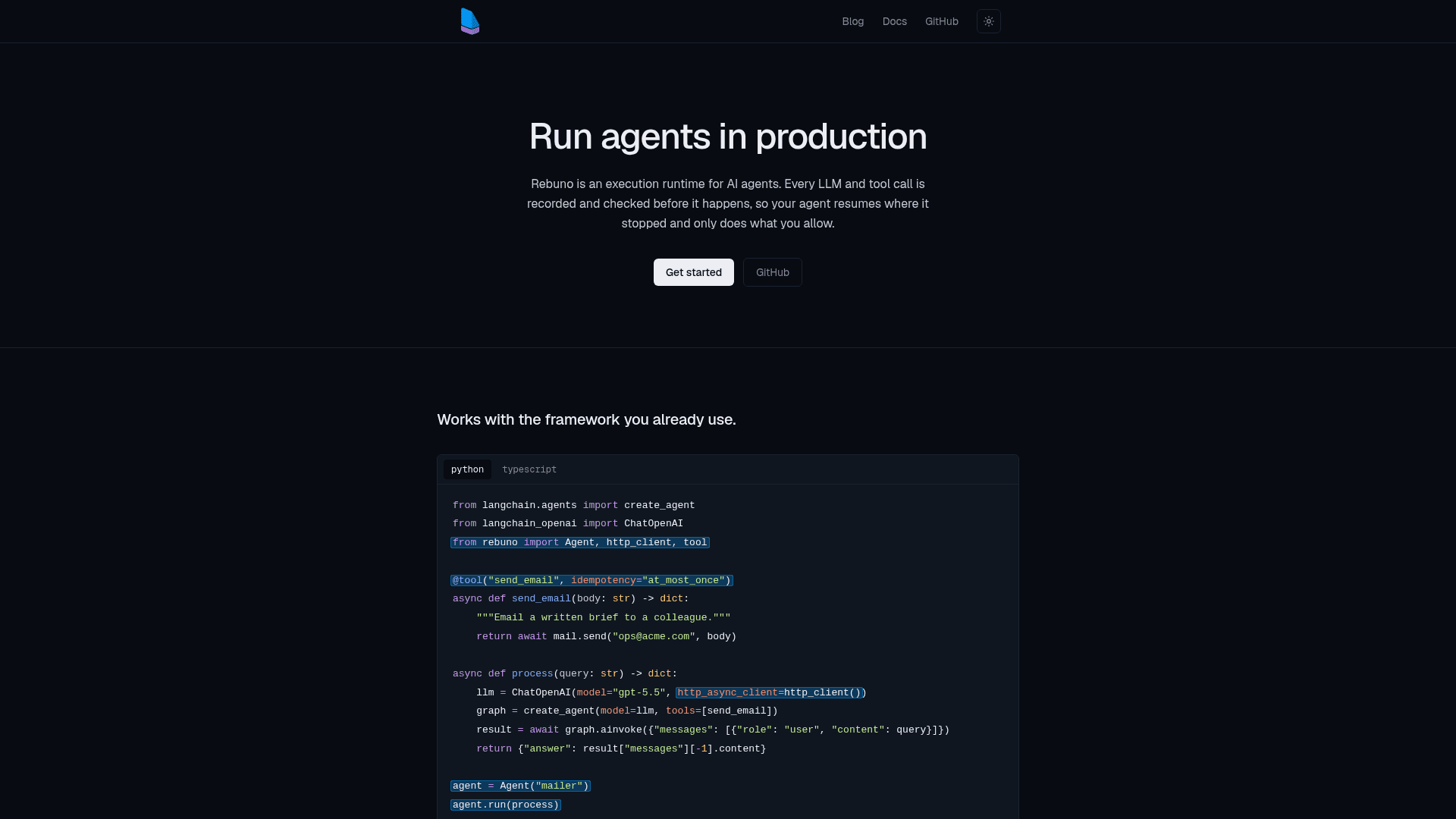
Rebuno is designed to wrap existing agent frameworks with minimal code changes. The homepage shows integration examples for:
- Python: LangChain, PydanticAI, CrewAI
- TypeScript: Vercel AI SDK, Mastra, LangChain
The integration pattern is consistent: swap in the Rebuno HTTP client, decorate tools with @tool / defineTool, and wrap the agent entrypoint with Agent("name").run(process).
Architecture and Deployment
The runtime is written in Go and ships as a CLI binary (rebuno). A dev kernel can be started locally with rebuno dev --config rebuno.dev.yaml. For production, the kernel runs as a standalone server with Docker support. The Python and TypeScript SDKs are installed separately via pip install rebuno and npm install rebuno. A web dashboard is available for viewing executions, steps, events, and agent activity. A hosted cloud option is also referenced on the site.
Update: v0.26.0
The latest release is v0.26.0, published on September 14, 2026. The repository was created in March 2026 and has been actively updated, with the last push on September 15, 2026. The project is in early-stage development (sub-1.0 versioning) but is tracking toward production readiness with a full reference documentation set covering agents, tools, LLM calls, streaming, policy, events, HTTP API, CLI, deployment, and SDKs.
Community Discussions
Be the first to start a conversation about Rebuno
Share your experience with Rebuno, ask questions, or help others learn from your insights.
Pricing
Open Source
Self-hosted open-source runtime available under the MIT License. Free to use, modify, and distribute.
- Full execution runtime (Go kernel)
- Python and TypeScript SDKs
- CLI for managing executions
- Durable step recording and replay
- Policy engine (allow/deny/require-approval)
Capabilities
Key Features
- Durable step recording for every LLM and tool call
- Automatic resume from last recorded step after interruption
- Human-in-the-loop approval with indefinite pause support
- YAML-based policy language for allow/deny/require-approval rules
- Immutable event log for full execution audit trail
- Idempotency modes for tool calls (at_most_once)
- HTTP client shim for durable LLM call replay
- Web dashboard for viewing executions, steps, and events
- CLI for managing executions and watching event logs
- Python and TypeScript SDKs
- Docker support for production kernel deployment
- Streaming support for live token deltas