
Recurse
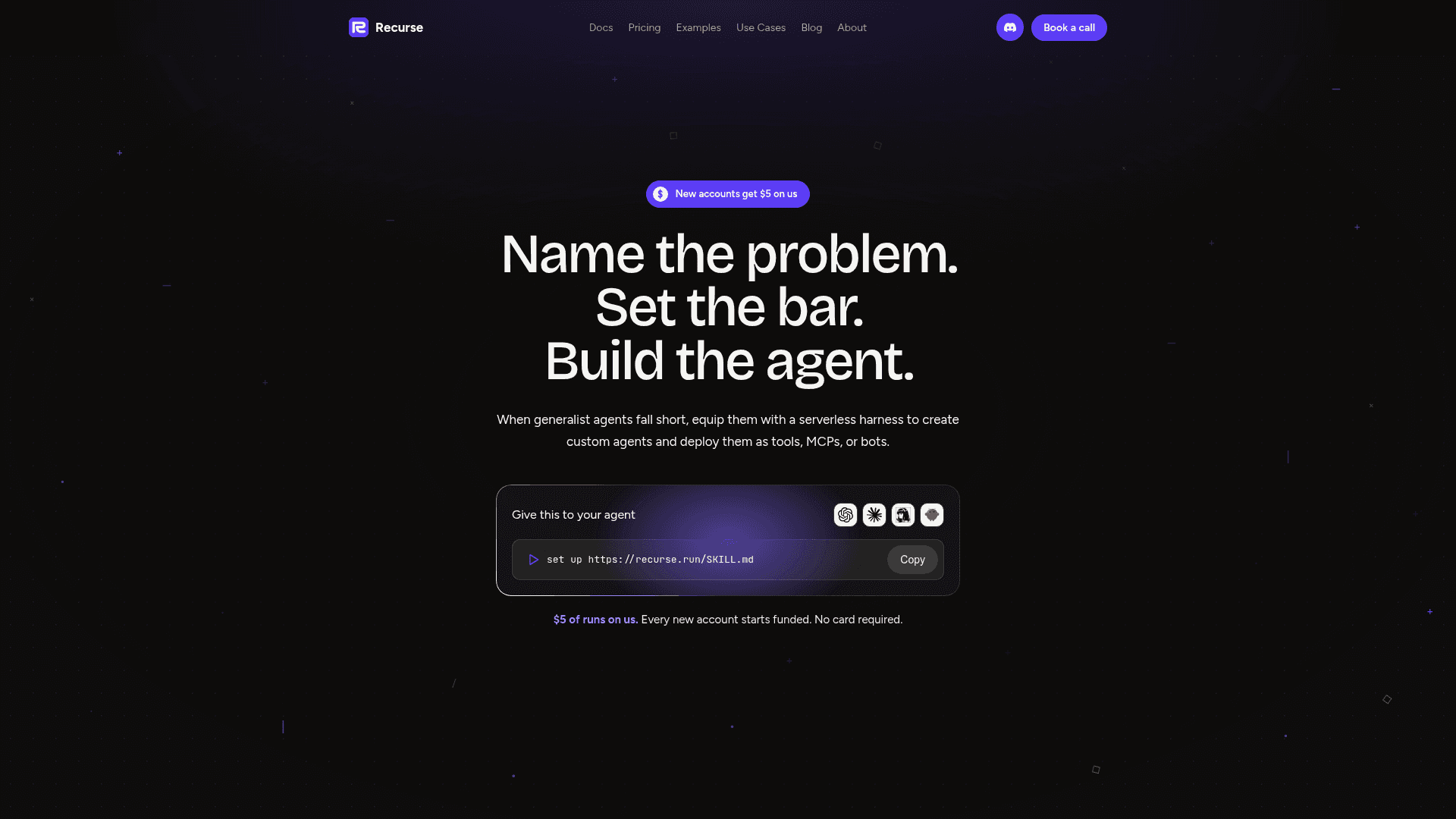
A serverless harness that lets coding agents build, test, and deploy custom specialist agents as tools, MCPs, or bots for verifiable agentic workloads.
At a Glance
About Recurse
Recurse is a serverless agent harness built by Synnada, an AI lab founded by engineers from Stanford, Meta, and Apache DataFusion. It gives coding agents like Codex and Claude Code the infrastructure to create, iteratively test, and deploy custom specialist agents for tasks that require measurable feedback and iterative refinement. New accounts start with funded credit and no card required.
What It Is
Recurse sits between a generalist coding agent and a production deployment target. When a generalist model falls short on a specific, verifiable task, Recurse provides the harness for that coding agent to design a specialist: writing the prompt, Python tools, verifiers, and a manifest (agent.yaml), then running and measuring candidates in a serverless environment until one clears the bar. The resulting specialist can be deployed as a one-time run, an MCP tool, or a bot endpoint.
The Manifest-Driven Contract
At the core of Recurse is the agent.yaml manifest — described by the product as "not configuration" but "the boundary of what the model can do." The manifest pins:
- Identity and runtime — what the agent is and how it runs
- Input schema — validated and defaulted before the model sees them
- Output schema — every successful run must return values matching the contract
- Tool registry — only pertinent functions are registered, cutting noise
The engine refuses a manifest it does not recognize, enforcing a stable contract even as execution adapts.
How the Build Loop Works
The workflow separates concerns across four roles: the user defines the desirable outcome and constraints; the coding agent writes and revises the Recurse agent's prompt, tools, verifiers, and manifest; the Recurse agent uses those tools to explore candidates within a single run; and the Recurse harness executes tool calls, retains return values, resolves dependencies, and surfaces results back to the agent. The coding agent improves the specialist across development runs; the specialist explores candidates within each run.
Recurse works best for tasks with:
- An objective that distinguishes better candidates from worse ones
- Choices the agent can make (geometry, model parameters, construction methods)
- Verifiers that return measurements or diagnostics about each candidate
- Explicit stopping conditions
Deployment and Integration
Agents can be executed for one-time use with recurse run or deployed as persistent MCP tools via recurse deploy --as mcp. The MCP integration means specialists can be added directly to coding agents with commands like codex mcp add recurse or claude mcp add recurse. Recurse also exposes llms.txt, llms-full.txt, and a SKILL.md file so coding agents can self-configure against the platform.
Use Cases and Demonstrated Results
The use cases page lists seven specialist categories, two with published write-ups. Recurse publishes these as single-deployment records, not guarantees:
- Level designer — writes and simulates game levels, only passing levels that clear pacing and reachability checks; the site notes 50+ levels under 2 minutes each
- RNA sequence designer — designs candidate sequences, measures minimum-energy folds, and repairs mismatched bases; the site notes 19/20 exact matches with failed cases repaired in 2 trials
- Game play testing — 10k sessions per night (write-up forthcoming)
- QA / chaos monkey — 63 crashes reproduced in one release (write-up forthcoming)
- Query optimization — p95 latency −41% (write-up forthcoming)
- Model training — 2.3× faster to target metric (write-up forthcoming)
- Kernel development — 1.8× throughput on target GPU (write-up forthcoming)
Backing and Team
Recurse is built by Synnada Inc., backed by Day One Ventures, Expeditions Fund, Collective Spark, StartX, and E2 Ventures. Angel investors listed on the about page include Marcin Zukowski (Snowflake founder), Wes McKinney (creator of pandas and Arrow), and Steve Ciesinski (ex-President of Stanford SRI). The two co-founders are Mehmet Ozan Kabak (CEO) and Sami Can Tandogdu (COO).
Community Discussions
Be the first to start a conversation about Recurse
Share your experience with Recurse, ask questions, or help others learn from your insights.
Pricing
New Account Credit
Every new account starts with $5 of credit for first runs. No credit card required.
- $5 credit on signup
- No credit card required
- Access to serverless harness
- Usage-based billing after credit
Usage-Based
Pay-as-you-go usage billing for LLM calls and secure serverless execution. No markup on model token rates.
- LLM calls billed at model token rates with no markup
- Secure serverless execution at $0.013/minute
- Only active requests billed
- Non-preemptible direct runs at 3× CPU/memory rate
- Multiple model options (GPT-5.6 and GPT-6 series)
Capabilities
Key Features
- Serverless agent harness for custom specialist agents
- agent.yaml manifest with stable input/output contracts
- Iterative candidate generation, measurement, and refinement loop
- Deploy agents as MCP tools, one-time runs, or bots
- Python tool and verifier authoring
- Built-in tool registry with selective function registration
- Input schema validation with defaults
- Structured runtime state and artifact preservation
- Loop control with explicit states for reasoning, evaluation, recovery, and escalation
- Domain instruments for acting on real environments
- Feedback-driven redirection and escalation
- SKILL.md for coding agent self-configuration
- llms.txt and llms-full.txt for agent-readable docs
- Secure serverless execution environment
- Usage-based billing with no markup on model token rates