
Repo
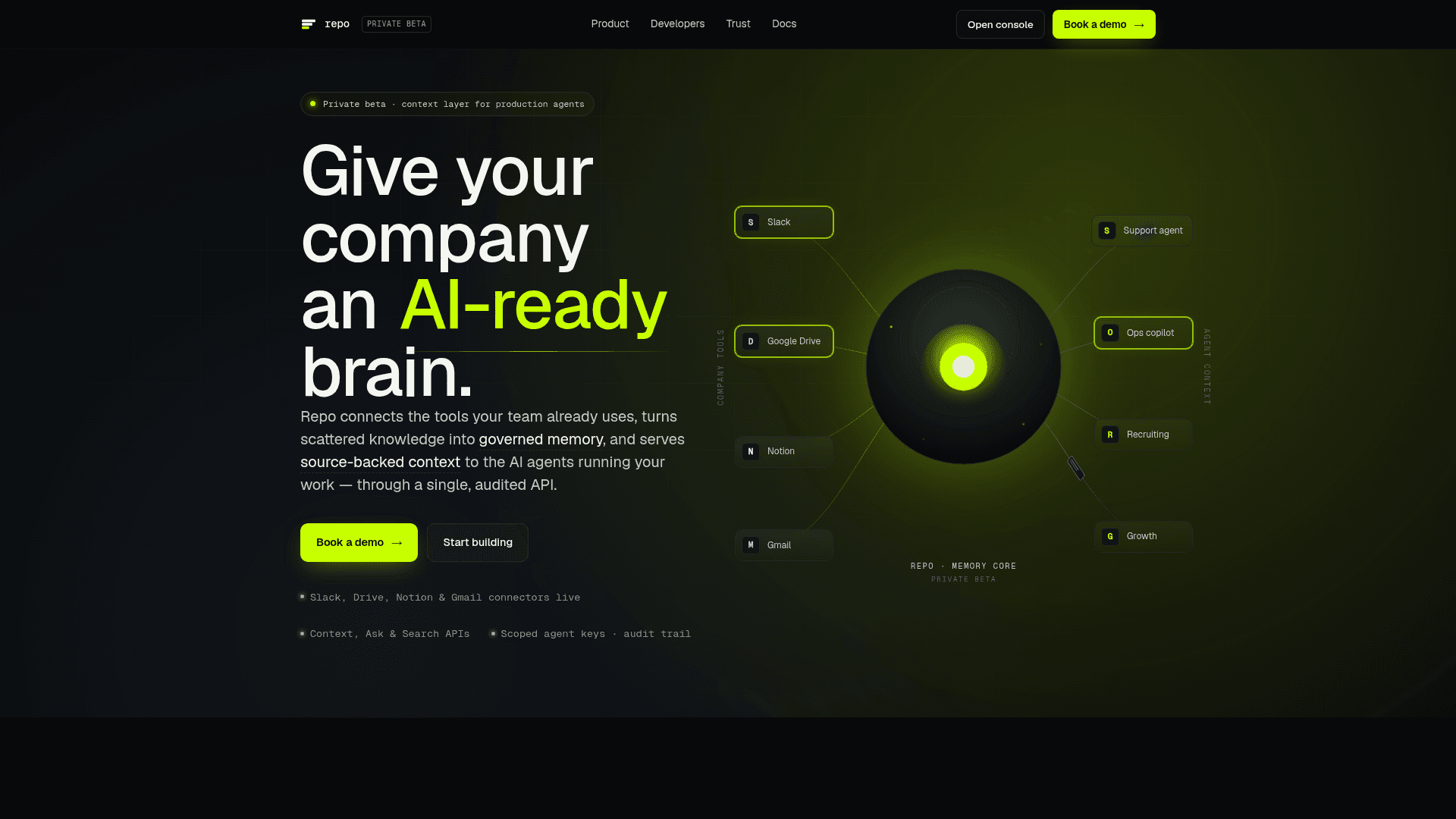
Repo connects company tools like Slack, Drive, Notion, and Gmail into governed organizational memory, serving source-backed context to AI agents through a single audited API.
At a Glance
Early access for founders and operators during private beta. Access via console or API by booking a demo.
Engagement
Available On
Alternatives
Listed Jun 2026
About Repo
Repo is a context layer for production AI agents, built by Repo Labs and currently in private beta. It connects the tools a team already uses — Slack, Google Drive, Notion, and Gmail — ingests and structures their content into governed memory, and serves source-backed context to AI agents through a single audited API. The product is designed for founders and operators who need their company's institutional knowledge to be reliably readable by the agents they ship.
What It Is
Repo sits between a company's existing tools and the AI agents running on top of them. Rather than bolting document search onto a chat interface, Repo functions as an infrastructure layer: connectors pull data in, a governed memory canvas structures and stores it, and a Context API serves ranked, cited, and freshness-stamped context out. The core output is a "Context Contract" — a versioned response envelope containing evidence, citations, freshness metadata, scope, and limitations that agents can pass directly into model prompts.
How the Three-Layer Architecture Works
Repo's design separates ingestion, storage, and retrieval into distinct layers:
- Connect: OAuth-based connectors for Slack, Google Drive, Notion, and Gmail are live; Linear and Confluence are listed as coming soon. Operators choose scopes and channel allowlists before any data moves.
- Ingest and govern: Repo chunks, embeds, and extracts entities and relationships from ingested content, writing them onto a memory canvas. Each node carries provider, channel or folder basis, freshness timestamps, and access policy.
- Serve: The Context API accepts a query and a scoped key, returning a structured Context Contract with evidence, citations, per-result freshness, allowed providers, exclusions, and limitations.
Trust and Governance Model
The trust architecture is a central design emphasis. Key properties the product page describes include:
- Citations on every claim: context returned carries the exact messages, files, and folders it was built from — nothing is generated, only retrieved, ranked, and shaped.
- Freshness tracking: every memory node carries source, ingestion, and last-sync timestamps; the Context Contract reports per-result age.
- Scoped agent keys: each agent gets its own API key bound to allowed actions (search, context, ask, ingest, admin) and allowed providers, with per-key rate limiting and rotation without redeployment.
- ACL pass-through: Repo preserves Google Drive sharing metadata and Slack channel basis, reporting what was excluded from any retrieval.
- Audit trail (metadata only): every
/v1/contextcall writes an audit event keyed by request ID with actor, scope, evidence IDs, freshness, and limitations — never the snippet text itself.
Developer API Surface
Five endpoints cover the primary agent use cases:
POST /v1/context— source-backed context envelope with evidence, freshness, scope, citations, and limitationsPOST /v1/ask— synthesized answer with inline citations generated from the Context ContractPOST /v1/search— vector + keyword search across memory, scoped by API keyGET /v1/memory-canvas— provider-namespaced graph of channels, folders, and entitiesGET /v1/audit-events— admin-only retrieval audit trail keyed by request ID
Authentication uses scoped Bearer API keys. The API is versioned at v1 and currently in private beta.
Current Status: Private Beta
Repo is in private beta as of the time of writing. The product page states the team is "working closely with a small group of founders and operators" and invites interested teams to book a demo or access the console directly. Slack, Google Drive, Notion, and Gmail connectors are described as live; Linear and Confluence are listed as coming soon. The console provides a single operator surface for managing connected sources, browsing the memory canvas, querying via Ask, reviewing activity, and managing developer keys.
Community Discussions
Be the first to start a conversation about Repo
Share your experience with Repo, ask questions, or help others learn from your insights.
Pricing
Private Beta
Early access for founders and operators during private beta. Access via console or API by booking a demo.
- Slack, Google Drive, Notion, Gmail connectors
- Context, Ask & Search APIs
- Scoped agent keys
- Audit trail
- Memory canvas
Capabilities
Key Features
- Context API with source-backed evidence and citations
- Memory canvas with provider-namespaced entity graph
- Ask API for synthesized answers with inline citations
- Vector + keyword search across governed memory
- Audit trail with metadata-only event logging
- Scoped agent API keys with per-key rate limiting
- ACL pass-through from source providers
- Freshness timestamps on every memory node
- Context Contract v1 versioned response envelope
- OAuth-based connectors for Slack, Google Drive, Notion, Gmail
- Operator console for managing sources and agent keys
- Channel allowlists and scope controls