Rune
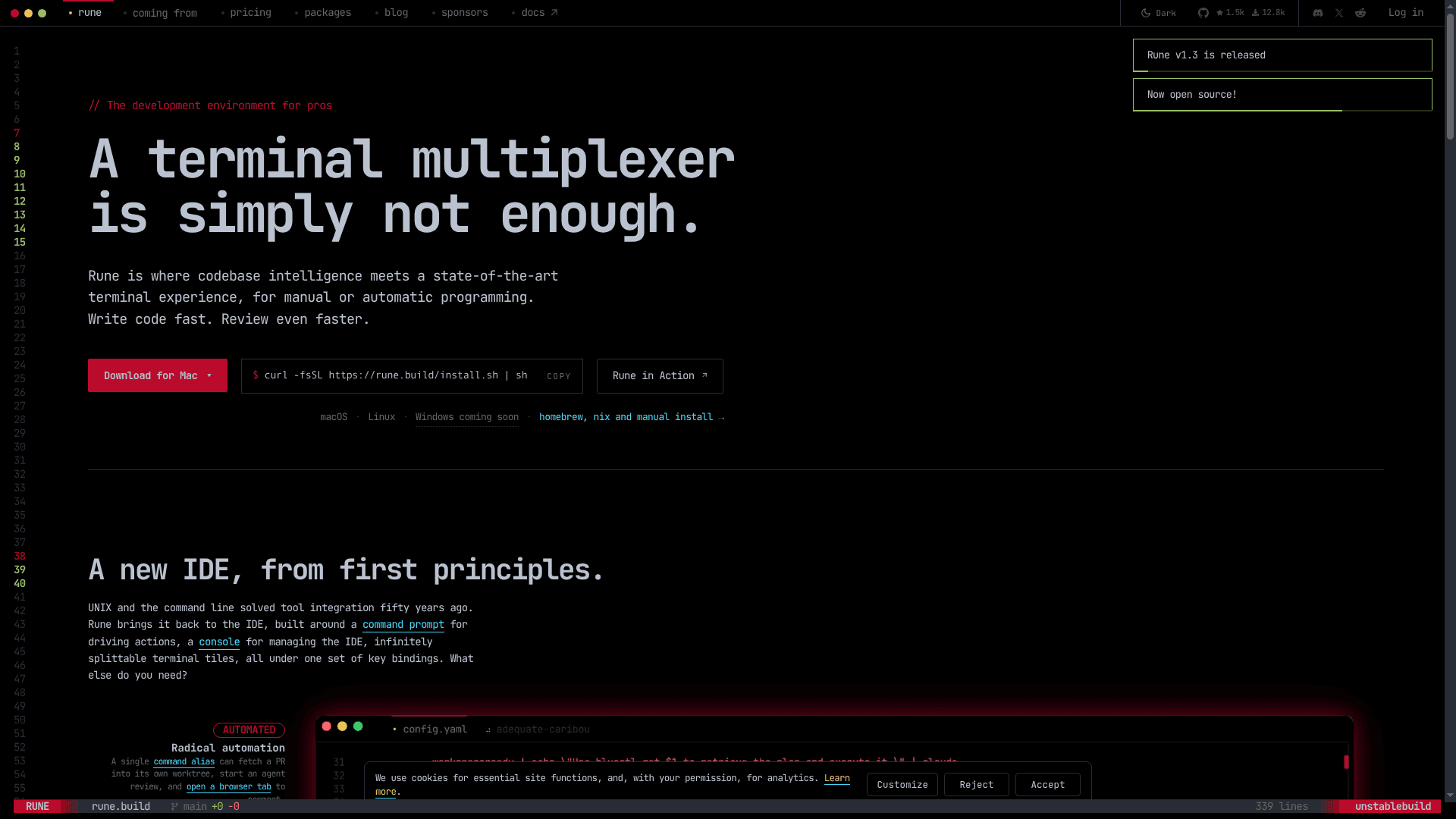
A GPU-accelerated, open-source IDE and terminal multiplexer for manual and AI-agent-assisted programming.
At a Glance
About Rune
Rune is an IDE and terminal multiplexer from Unstable Build LLC, released as open source under GNU GPLv3. It is a native application for macOS and Linux that combines terminals, code intelligence, and AI agent support in one keyboard-driven environment. The latest release listed on GitHub is v1.3.4.
What It Is
Rune is built around a command prompt, a console for managing the IDE, and infinitely splittable terminal tiles, all under one set of key bindings. It uses a native graphics pipeline (OpenGL on Linux, Metal on macOS) rather than Electron. Any program that runs in a terminal, such as Vim or Claude Code, runs inside Rune. It can also be bound to a key or turned into a task.
Agents and Code Intelligence
Rune includes its own agent and can also host agent CLIs such as Claude Code, OpenCode, and Pi. Agents can query a symbol index for definitions, references, implementations, docs, and diagnostics instead of grepping the codebase. Users can type # in the chat input to attach symbols to a turn. Every apply_patch waits for LSP diagnostics and feeds them back to the agent. Programs that support OSC 7501 report status and progress across workspaces, and runectl status wrap wraps other programs.
Workspaces and Rune Network
The UI offers nine workspace slots with unlimited terminals, tabs, and tiled windows. Rune instances form an end-to-end encrypted peer network powered by headscale, so a workspace can be opened from another machine with rune://<machine>/. A headless mode runs in Docker or under systemd, launchd, OpenRC, or runit to serve a workspace to other machines.
Languages and Extensibility
Rune covers 300+ languages across three support tiers. Tier 1 languages include Go, Python, Rust (beta), Zig (beta), and TypeScript (beta). Extension happens through aliases, the runectl CLI, SDKs, and packages installable from Git repositories. VSCode extensions are not supported.
Models and Privacy
Inference runs wherever the user points it: Anthropic, OpenAI, or Google API keys, existing ChatGPT or Claude subscriptions via OAuth, or local models such as Ollama for offline use. Rune says it does not host or proxy inference and that source code is never sent to its servers.
Community Discussions
Be the first to start a conversation about Rune
Share your experience with Rune, ask questions, or help others learn from your insights.
Pricing
Free
Free, open source (GNU GPLv3) download for macOS and Linux with Rune Network for up to 2 connected nodes.
- Rune Network: up to 2 Rune nodes at a time
- Free downloads for macOS and Linux
- The complete source code under GNU GPLv3
- Community support
Rune Pro
Increases Rune Network limit to 10 nodes with premium support.
- Rune Network: up to 10 Rune nodes at a time
- Funds ongoing open-source development
- Premium support
Enterprise
Rune for teams with unlimited nodes, SSO & SCIM, and enterprise support.
- Unlimited Rune Network nodes per user
- On-prem networking stack
- Managed deployment and updates for teams
- Centralized billing and admin panel
- SSO & SCIM
- Dedicated account manager & enterprise support
- Volume seats
Capabilities
Key Features
- GPU-accelerated native IDE (OpenGL on Linux, Metal on macOS)
- Terminal multiplexer with splittable tiles, tabs, and nine workspace slots
- Symbol index with fuzzy search
- LSP diagnostics fed back to agents after patches
- Built-in agent plus support for external agent CLIs
- OSC 7501 program status reporting
- Command aliases and runectl CLI
- Rune Network e2e-encrypted peer connections
- Headless mode and containerized workspaces
- 300+ languages across three support tiers
- Sixteen built-in themes
- Package and plugin system installable from Git
Integrations
Demo Video