
Ryugi
A development workflow for coding agents that combines composable skills to brainstorm with mockups, approve a spec, and build under TDD.
At a Glance
Ryugi workflow skills and bootstrap for coding agents, released under the MIT License. Runs locally with no subscription.
Engagement
Available On
Alternatives
Listed Nov 2026
About Ryugi
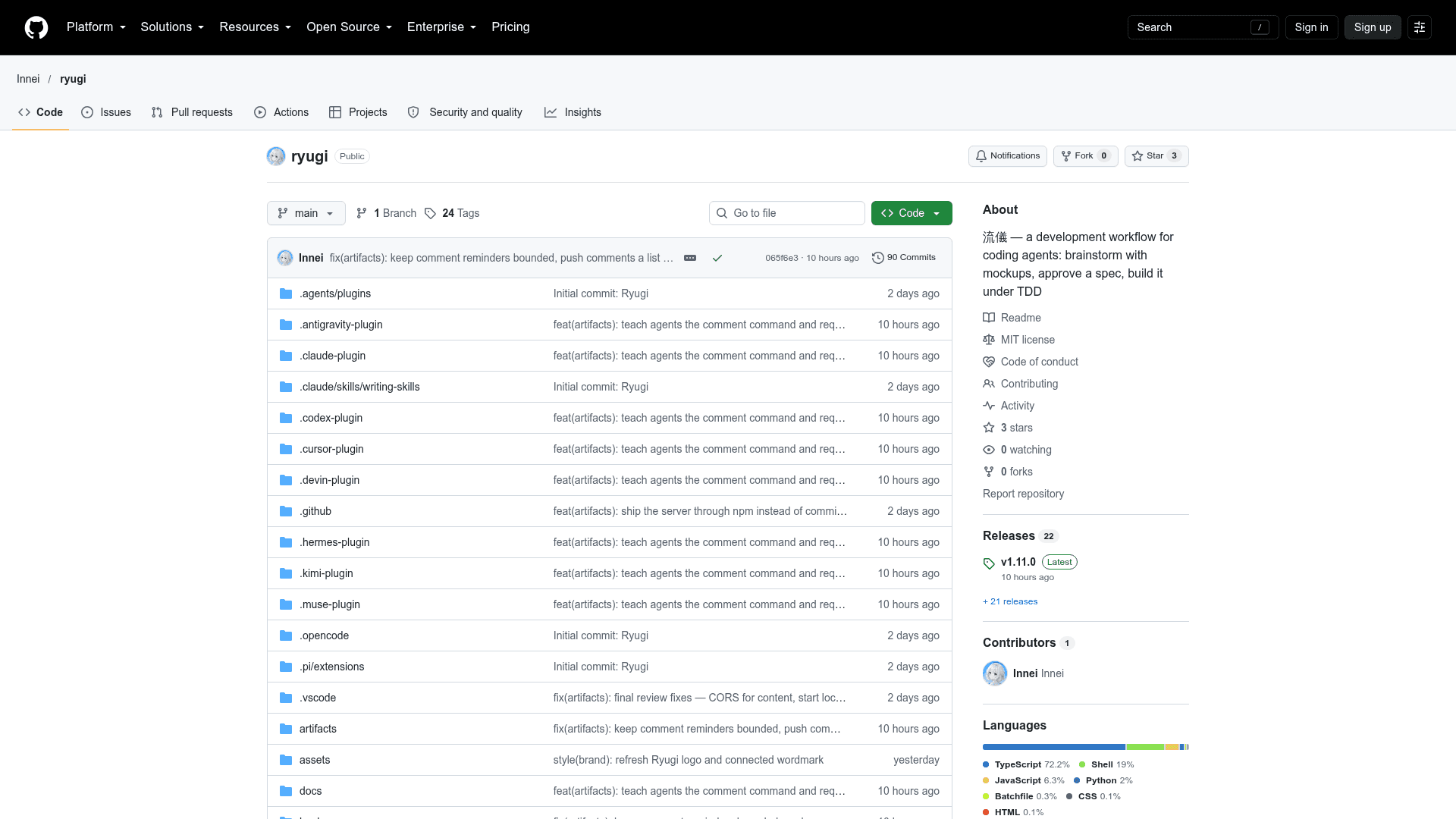
Ryugi (流儀) is an open-source software development workflow for coding agents, published by Innei on GitHub under the MIT License. It bundles a small set of composable skills with a bootstrap that makes the agent use them, and it began as a fork of Superpowers v7.0.0 by Jesse Vincent. The workflow centers on brainstorming with mockups, approving a spec, and building inline under test-driven development.
What It Is
Ryugi is a skills-and-plugin package for coding agents rather than a standalone app. When the agent detects that you are building something, it asks what you are trying to do before writing code, then draws a spec out of the conversation and presents it in short chunks. The bootstrap skill, using-ryugi, makes the agent check for relevant skills before any task.
How the Workflow Runs
The core skills are brainstorming, executing-specs, test-driven-development, systematic-debugging, using-git-worktrees, and artifacts. After a spec is approved, the agent can build it inline: it slices the spec into tasks and implements each with red/green TDD. It keeps a ledger of judgment calls and gets one fresh review of the whole branch. It then reports with landing options of squash (default), rebase, PR, or keep, and never makes a merge commit.
Artifacts and Mockups
When something is clearer to see than to read, Ryugi opens local artifacts in the browser. These include documents, artboards of mockups, and live HTML pages that update as the agent rewrites them. HTML pages can use a bundled Web Component kit based on Lobe UI. The README states everything runs locally.
Installation Across Harnesses
Ryugi is not listed in any harness's official marketplace and is installed from the repository. The README documents install paths for Claude Code, Antigravity, Codex, Cursor, Devin CLI, Factory Droid, Gemini CLI, Kimi Code, OpenCode, Pi, Qwen Code, Hermes Agent, and Muse. Users of more than one harness install it in each.
Community Discussions
Be the first to start a conversation about Ryugi
Share your experience with Ryugi, ask questions, or help others learn from your insights.
Pricing
Open Source
Ryugi workflow skills and bootstrap for coding agents, released under the MIT License. Runs locally with no subscription.
- MIT License
- Composable skills: brainstorming, executing-specs, test-driven-development, systematic-debugging, using-git-worktrees, artifacts
- Runs locally; no subscription
- Installable on Claude Code, Antigravity, Codex, Cursor, Devin CLI, Factory Droid, Gemini CLI, Kimi Code, OpenCode, Pi, Qwen Code, Hermes Agent, Muse
Capabilities
Key Features
- Brainstorming skill that clarifies intent before code is written
- Mockups on local artboards and live HTML artifacts
- Bundled Web Component UI kit based on Lobe UI
- Inline spec execution with task slicing and a decision ledger
- Enforced RED-GREEN-REFACTOR test-driven development
- Systematic root-cause debugging skill
- Git worktree isolation skill
- One fresh review of the whole branch with squash, rebase, PR, or keep landing options
- using-ryugi bootstrap that triggers skills automatically