
sepia
A portable Agent Skill that removes AI tells from fiction and professional writing by repairing narrative architecture and matching venue-specific rules.
At a Glance
sepia is a free, MIT-licensed Agent Skill that can be used without an account.
Engagement
Available On
Alternatives
Listed Oct 2026
About sepia
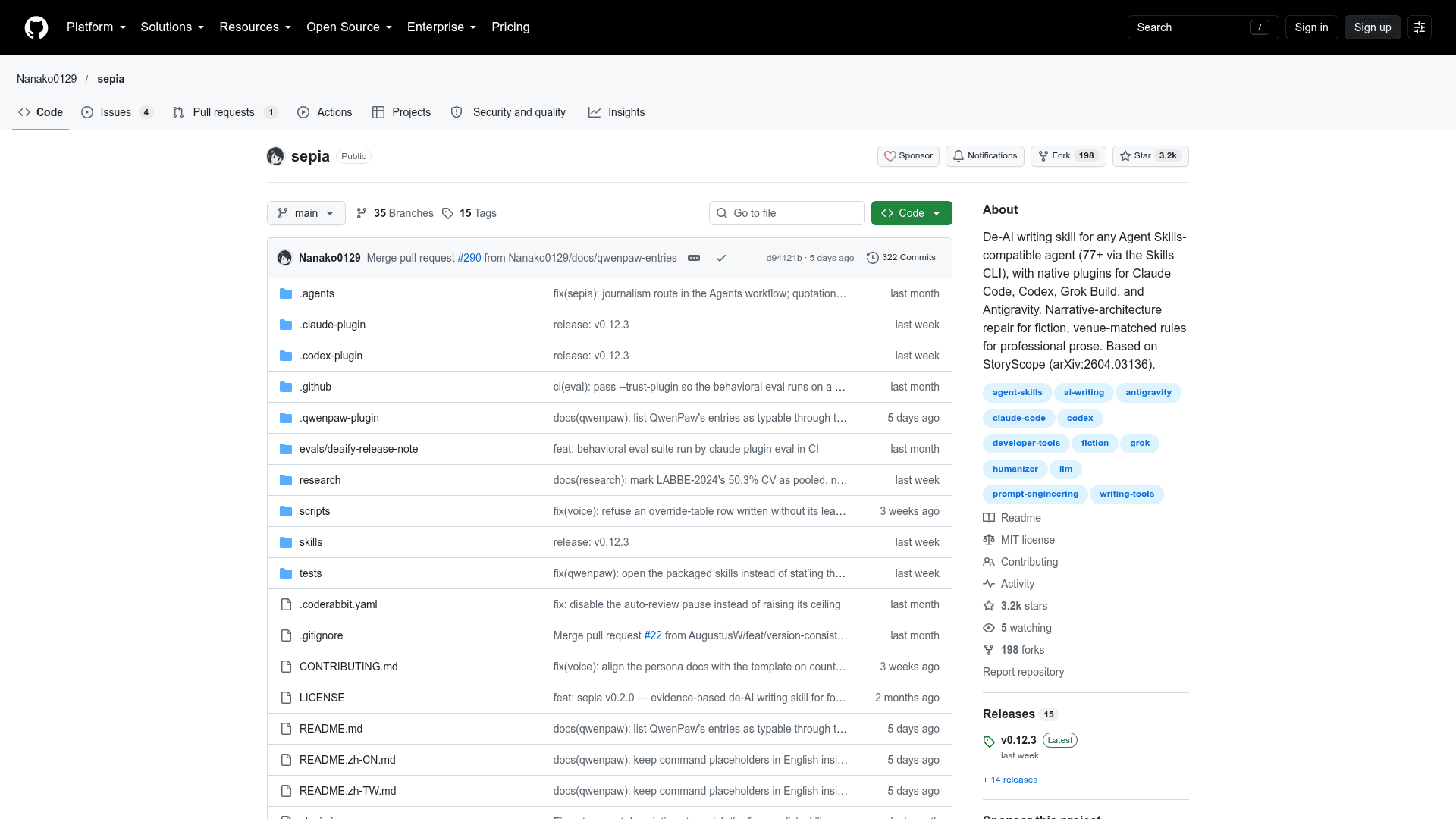
sepia is an open-source Agent Skill from Nanako0129 for de-AI writing. It works on fiction and on professional documents such as release notes, PR replies, postmortems, tickets, and technical articles. The latest release listed is v0.12.3, and the project is MIT licensed.
It ships as one canonical SKILL.md that any agent supporting the Agent Skills standard can load. The Skills CLI installs it, and Claude Code, Codex, Grok Build, Antigravity, and QwenPaw also get native plugin packaging.
What It Is
sepia is a writing and revision skill that runs inside an AI agent. It offers four operations: write (create new prose), review (diagnose only), refactor (minimal in-place edits), and recreate (full rewrite from source facts and intent). The plugin package adds a general router plus direct entries such as /sepia-write, /sepia-review, /sepia-refactor, /sepia-recreate, and /sepia-hemingway.
Three-Pass Protocol
The README says sepia is based on StoryScope (arXiv:2604.03136), which reports that narrative-structure features alone detect AI fiction at 93.2% macro-F1. The skill therefore works in three passes:
- Narrative architecture for fiction, such as not explaining the theme, loosening the causal chain, and naming real things.
- Discourse flow, such as de-templating paragraph sequences and varying rhythm.
- Surface style, covering clichés, syntax templates, vocabulary, and register.
A 30-feature diagnosis rubric and per-model fingerprints apply when the writing model is known. The governing principle is to calibrate to the human distribution rather than invert the AI one, so only 3-5 moves are selected per story.
Professional Writing Rules
Each document type gets a thin rule file on top of a shared checklist. Release notes lead with user impact. PR replies answer first and cite file:line. Postmortems are blameless toward people. Tickets use testable acceptance criteria. Technical articles open at the problem. Long-form journalism has its own rules.
Voice Skills and Chinese Calibration
An experimental, opt-in interface lets a voice or style skill stack on top of sepia. Built-in profiles include Hemingway, Taiwan long-form journalism, and a Nyaneko persona, and a persona template is checked by scripts/check_persona.py. Chinese text loads a language reference that calibrates the style pass using several evidence layers, including the HC3 corpus and Taiwan writing conventions.
Setup Path
Install for any supported agent with npx skills add Nanako0129/sepia -g. Native installers exist for Claude Code, Codex, Grok Build, Antigravity, and QwenPaw. A project-scope install is also possible by committing skills/sepia/ into a repo.
Community Discussions
Be the first to start a conversation about sepia
Share your experience with sepia, ask questions, or help others learn from your insights.
Pricing
Open Source (MIT)
sepia is a free, MIT-licensed Agent Skill that can be used without an account.
- MIT License
- Portable Agent Skill installable via the Skills CLI
- Native plugin packaging for Claude Code, Codex, Grok Build, Antigravity, and QwenPaw
- Operations: write, review, refactor, recreate, hemingway
- Optional Patreon support for the maintainer
Capabilities
Key Features
- Four operations: write, review, refactor, recreate
- Three-pass protocol: narrative architecture, discourse flow, surface style
- 30-feature diagnosis rubric
- Per-model fingerprints for Claude, GPT, Gemini, DeepSeek, Kimi
- Venue-matched rules for release notes, PR replies, postmortems, tickets, technical articles, and journalism
- Opt-in voice skill interface with Hemingway, Taiwan journalism, and persona profiles
- Chinese language calibration
- Persona profile validator script
- Direct slash command entries per operation