
Shatterpoint
A Claude Code skill that replaces generic AI feedback with a structured interrogation — one probing question at a time — to find the single assumption your plan rests on before you build.
At a Glance
Fully free and open-source under the MIT license. Clone and use with no cost.
Engagement
Available On
Alternatives
Listed Aug 2026
About Shatterpoint
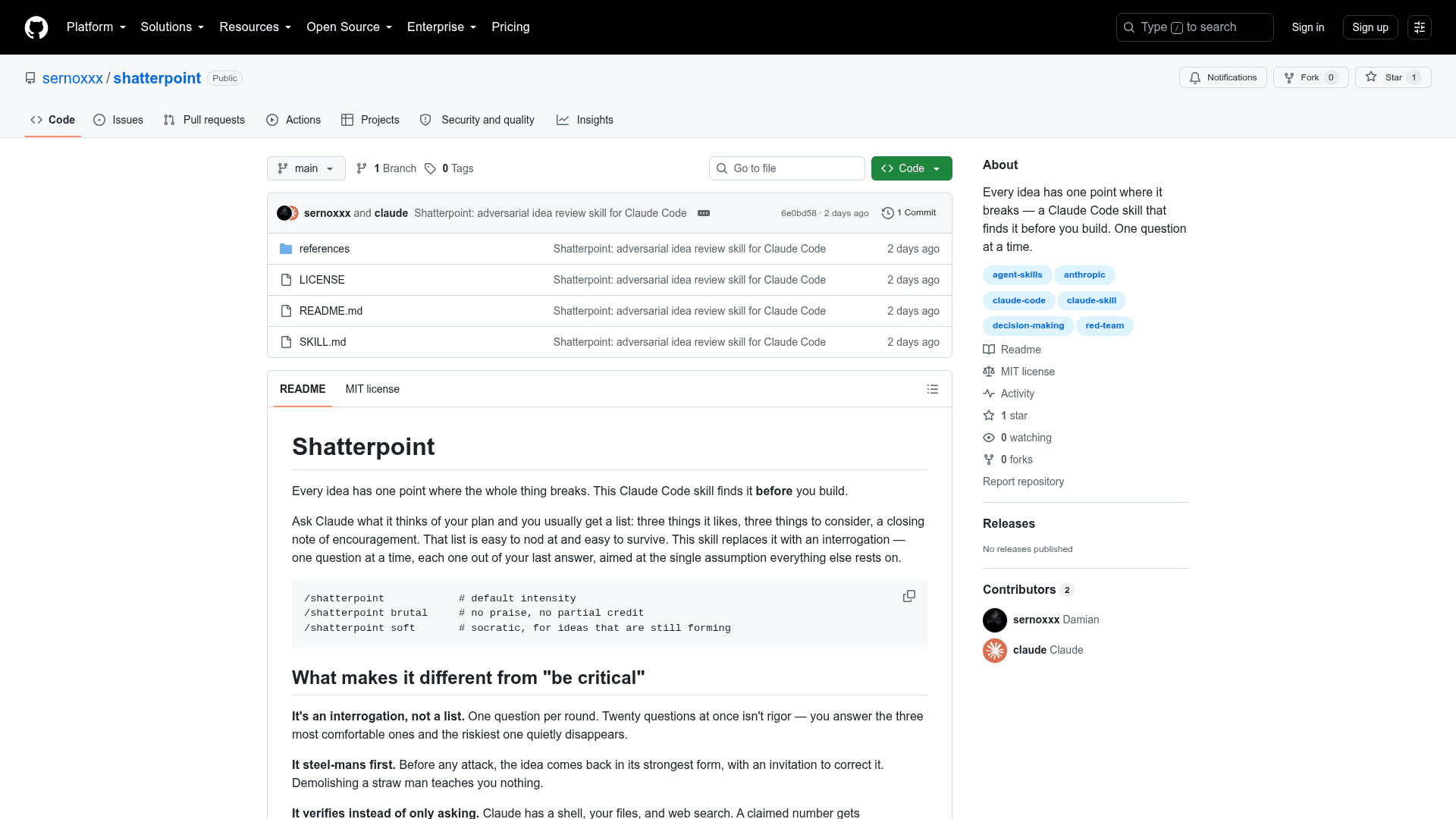
Shatterpoint is an open-source Claude Code skill published under the MIT license by GitHub user sernoxxx. It was created to replace the typical AI response to a plan — a polite list of pros, cons, and encouragement — with a focused, single-question interrogation that targets the load-bearing assumption your idea depends on.
What It Is
Shatterpoint is a skill file for Claude Code, Anthropic's agentic coding assistant. When triggered, it runs a structured protocol across several phases: steel-manning your idea in its strongest form, identifying at most three load-bearing assumptions ranked by lethality and uncertainty, conducting a one-question-per-round interrogation, running a pre-mortem, and ending with the single cheapest disconfirming test you could run in under a week. It is invoked via slash commands directly inside Claude Code sessions.
How the Interrogation Protocol Works
The skill defines a precise run sequence rather than leaving Claude to improvise:
- Steel-man phase — Claude restates your idea in its strongest form and invites correction before any attack begins, avoiding the straw-man problem.
- Load-bearing assumptions — At most three assumptions are surfaced, ranked by the product of "if false → dead?" and "how uncertain?"
- One question per round — A vague answer means the same spot again, harder. Twenty questions at once lets you dodge the riskiest one.
- Verification, not just rhetoric — Claude uses its shell access, your files, and web search to recompute claimed numbers, read claimed code behavior, and search claimed markets.
- Verdict and test — The session ends with a Holds / Breaks / Unknown ruling and exactly one concrete action that could come back negative.
The skill also knows when to stop: if the decision is already made, if being wrong is cheap and reversible, if there is no alternative, or if the question is pure taste, it says so instead of staging a fake interrogation.
Intensity Levels
Three invocation modes are supported:
/shatterpoint— default intensity/shatterpoint brutal— no praise, no partial credit/shatterpoint soft— Socratic mode for ideas still forming
Repository Layout and Architecture
The skill is structured as a small directory of Markdown files that Claude reads on demand:
SKILL.md— the core protocol: phases, intensity levels, and prohibitionsreferences/lenses.md— 14 attack lenses, each with a tell for when it is sharpreferences/tells.md— 15 evasion patterns and how to counter themreferences/domains.md— 7 domains with their typical causes of death
Claude reads SKILL.md when the skill triggers and pulls in a reference file only when the run actually needs it, keeping context usage lean.
Setup Path
Installation is a single git clone into either the global Claude skills directory (~/.claude/skills/shatterpoint) or a per-project .claude/skills/shatterpoint directory so the skill ships with the repo. After restarting Claude Code, the skill responds to natural-language triggers like "tear this apart", "red team this plan", or "stress-test this", as well as the direct /shatterpoint slash command.
Current Status
The repository was created and last pushed on August 11, 2026, making it a very recent release. It carries 1 star and 0 forks at the time of indexing. The project is MIT-licensed and free to use, modify, and distribute.
Community Discussions
Be the first to start a conversation about Shatterpoint
Share your experience with Shatterpoint, ask questions, or help others learn from your insights.
Pricing
Open Source
Fully free and open-source under the MIT license. Clone and use with no cost.
- Full interrogation protocol
- Three intensity levels (default, brutal, soft)
- 14 attack lenses
- 15 evasion pattern counters
- 7 domain cause-of-death patterns
Capabilities
Key Features
- One-question-per-round interrogation protocol
- Steel-man phase before any critique
- Load-bearing assumption ranking by lethality × uncertainty
- Three intensity levels: default, brutal, soft
- Verification via shell, file access, and web search
- Pre-mortem and graveyard analysis
- Holds / Breaks / Unknown verdict with cause of death
- Cheapest disconfirming test recommendation
- Knows when to stop (reversible decisions, pure taste, no alternatives)
- 14 attack lenses reference file
- 15 evasion pattern counter-measures
- 7 domain-specific cause-of-death patterns
- Natural language trigger support
- Per-project or global installation