
Shep
Open-source, local-first orchestrator that runs parallel AI coding agents in isolated git worktrees and drives each feature through CI to a pull request.
At a Glance
Free, MIT-licensed, local-first CLI and dashboard; bring your own agent subscription (external cost).
Engagement
Available On
Alternatives
Listed Oct 2026
About Shep
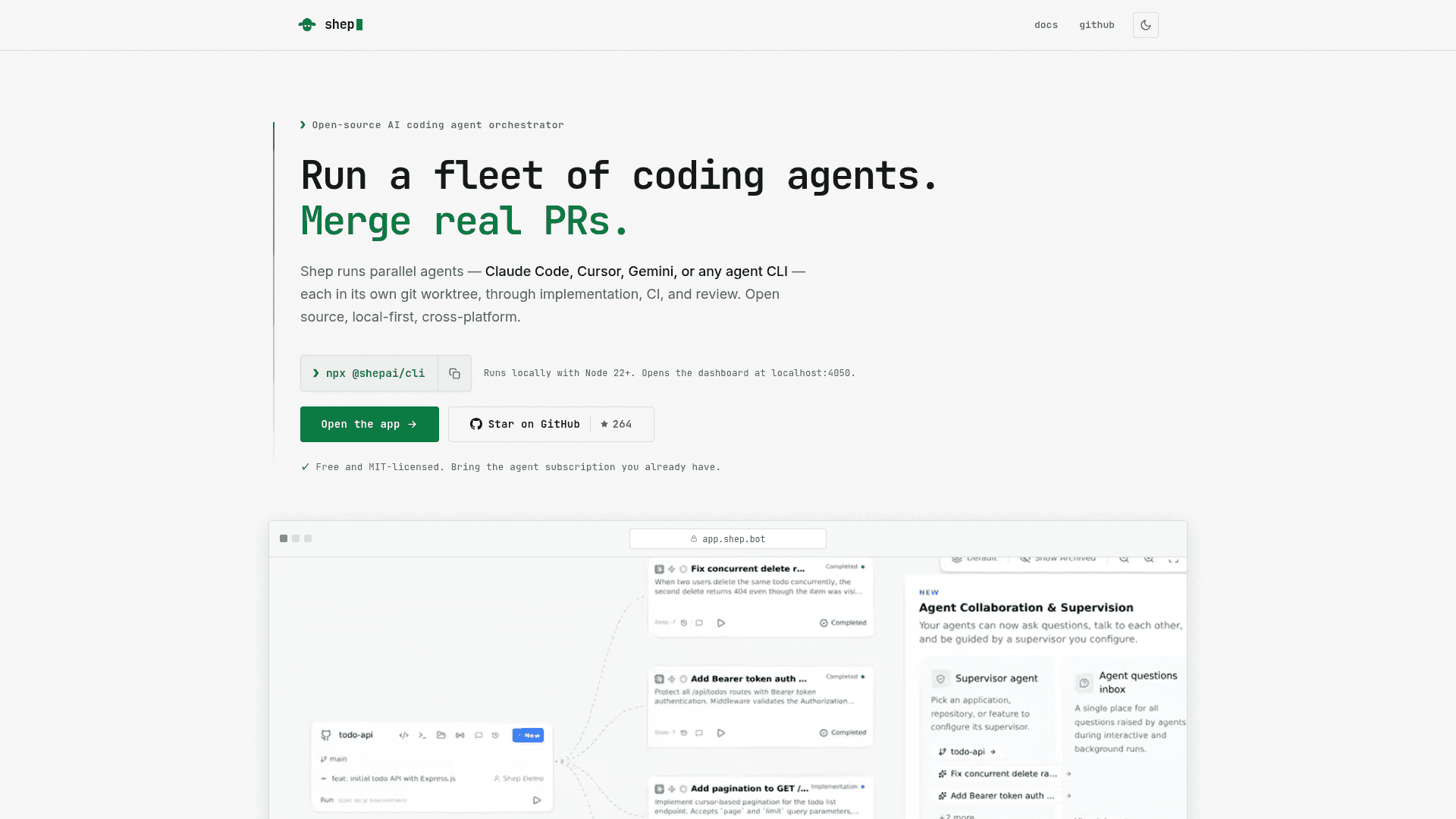
Shep is an open-source orchestrator from Shep AI that runs multiple AI coding agents in parallel, each in its own git worktree. It takes a feature from a one-line description through optional spec gates, implementation, commit, push, CI watching, and a draft pull request. It is MIT-licensed, local-first, and works from a CLI or a local web dashboard.
What It Is
Shep is an AI coding agent orchestrator: a control layer around agent CLIs such as Claude Code, Cursor CLI, and Gemini CLI. The README also lists built-in support for Kimi Code, Codex CLI, Copilot CLI, and Cline, plus HTTP-based providers like OpenRouter, Together AI, Ollama, and OpenAI-compatible proxies. Shep handles the git workflow around the agent: branch, worktree, commit, push, PR creation, and CI monitoring. Engineers who already use coding agents can run several features at once without agents touching the same checkout.
How the Workflow Runs
A feature starts with a sentence, entered in the dashboard or with shep feat new. Shep creates a branch and worktree, runs the chosen agent, then commits, pushes, and opens a draft PR. After a push it watches CI; if checks fail, the agent reads the logs and pushes a fix, with three retries by default (configurable). For complex work, the --no-fast flag enables spec-driven mode, where requirements, research, and a plan are written as YAML artifacts and pause at approval gates before code is written. Nothing merges without approval unless --allow-merge is passed.
Dashboard, Apps, and Configuration
The web control center at localhost:4050 shows a live graph of repositories and features with status, diff review, chat, and one-click open in an IDE; the CLI exposes the same actions. Shep can also start new apps (shep app new) with either a plan-first flow or a Vite + React quick-prototype starter. Per-feature flags control pushing, PR creation, model choice, target repo, attachments, and gate auto-approval, and shep settings sets global defaults.
Local-First and Safety Model
All state is stored in ~/.shep/ as SQLite, and code goes only to the agent you configure. The README notes that Shep passes permission-bypass flags to agents by default, relying on worktree isolation, draft PRs, and your CI as safeguards, and that it is not a security scanner. Anonymous usage metrics are on by default and can be disabled with shep telemetry off.
Community Discussions
Be the first to start a conversation about Shep
Share your experience with Shep, ask questions, or help others learn from your insights.
Pricing
Open Source (MIT)
Free, MIT-licensed, local-first CLI and dashboard; bring your own agent subscription (external cost).
- MIT-licensed core
- Runs locally with Node 22+; dashboard at localhost:4050
- No Shep account, no usage meter, no Shep servers
- Parallel agents in isolated git worktrees
- CI watch and auto-fix
Capabilities
Key Features
- Parallel AI coding agents, each in its own git worktree
- Agent-agnostic: Claude Code, Cursor CLI, Gemini CLI, Codex CLI, Copilot CLI, Kimi Code, Cline, or any agent CLI
- Automatic commit, push, and draft PR creation
- CI watch with agent auto-fix and configurable retries
- Optional spec-driven mode with YAML requirements, research, plan, and approval gates
- Local web dashboard and full CLI
- Multi-repo support and app scaffolding
- Audit logs and emergency stop for agent runs
- Local-first SQLite state storage