
ShipCheck
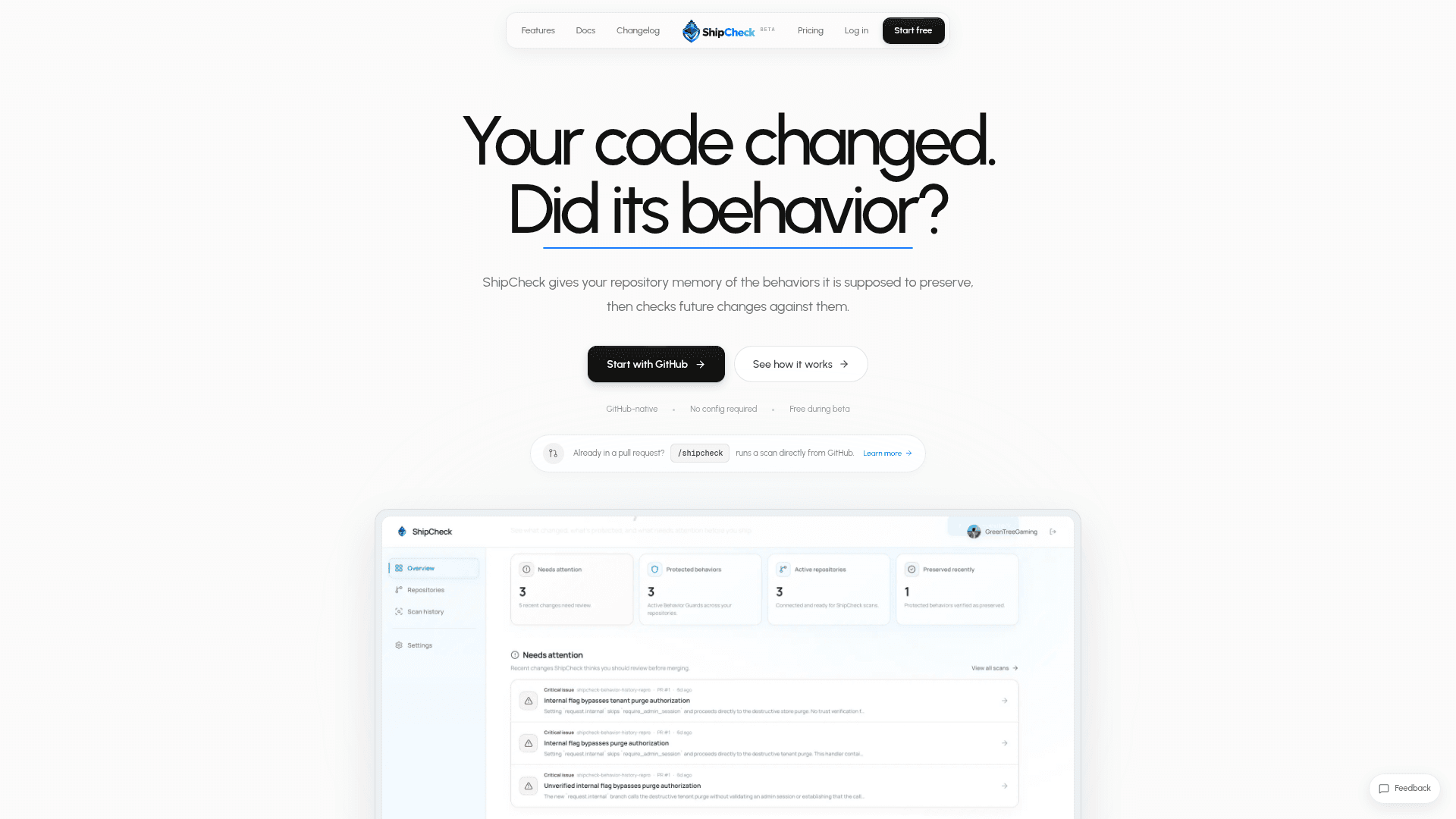
ShipCheck gives your repository persistent behavioral memory, discovering important safeguards and contracts, then checking future pull requests against them to catch regressions before they ship.
At a Glance
Full behavioral-memory workflow with expanded beta limits. No credit card required.
Engagement
Available On
Alternatives
Listed Sep 2026
About ShipCheck
ShipCheck is a GitHub-native code review tool currently in beta that focuses on behavioral memory rather than line-by-line diff analysis. Instead of asking whether changed code looks correct, it asks whether a pull request changed something the software was already supposed to keep doing — catching authorization regressions, removed safeguards, and broken contracts that can look harmless in a diff.
What It Is
ShipCheck sits in the AI-assisted code review category but takes a distinct approach: it builds a persistent model of what a repository is expected to do, called Behavior Guards, and evaluates every future pull request against that model. The core workflow covers Behavior Discovery, Behavior Guards, Behavioral Diff, Behavior History, and Historical Origin Tracing — all available on every plan, including the free tier.
How the Behavioral Memory Workflow Works
The product operates in four connected stages:
- Behavior Discovery — ShipCheck scans implementation code, tests, authorization logic, validation, callers, schemas, and error handling to surface candidate behaviors the repository already depends on. Developers review candidates and choose which to protect.
- Behavior Guards — A protected behavior becomes a persistent expectation (e.g., "Only subscription owners may cancel subscriptions") that future pull requests are verified against, complete with supporting evidence, origin commit, and confidence score.
- Behavioral Diff — Instead of a line diff, ShipCheck produces a behavioral summary of a pull request: which behaviors were preserved, intentionally changed, violated, newly introduced, or restored.
- Behavior History — Each Guard accumulates a lifecycle timeline (Introduced → Preserved → Changed intentionally → Violated → Restored) across commits and pull requests, separate from raw Git history.
Historical origin tracing extends this further: ShipCheck mines Git history across related implementation and test files to identify the commit where a protected behavior first became true, attaching a confidence score and cross-file evidence.
GitHub-Native Integration
ShipCheck connects through a GitHub App and requires no configuration files in the repository. Key integration points include:
- Automatic pull-request scanning triggered by GitHub webhook events
- The
/shipcheckpull-request comment command, which queues a scan of the current revision without leaving GitHub - Scan results published back as GitHub comments with verdict, score, and findings
- Machine-applicable fix plans and regression tests delivered as focused commits via the GitHub integration
Only users with write, push, maintain, or admin permission on a repository can trigger /shipcheck scans, preventing read-only users from consuming scan capacity.
What ShipCheck Analyzes
ShipCheck combines deterministic checks with repository-aware AI reasoning across five finding categories: Security (authorization regressions, removed access checks, unsafe APIs), Reliability (broken error handling, null assumptions, state cleanup failures), Quality/Contracts (broken API contracts, incomplete refactors, caller mismatches), Accessibility (keyboard regressions, missing accessible names, semantic regressions), and Testing (changed behavior without tests, missing edge-case coverage, untested failure paths). Findings carry severity levels — Critical, Warning, Info, and Passed — and are fingerprinted across rescans so the same issue can be tracked as New, Still Present, Resolved, or Reopened.
Repairs and Regression Tests
Eligible findings can generate bounded code repairs (Apply Fix) and focused regression tests. The repair system is intentionally scoped: machine-applicable plans are limited to a small number of related files and edits rather than allowing unrestricted repository rewrites. Applying an already-generated fix does not consume another AI analysis allowance. Regression-test generation is metered separately by plan.
Current Status: Beta
ShipCheck is currently in public beta. The free tier receives expanded beta limits — three repositories, 30 behavioral AI analyses, and 10 regression-test generations per month — specifically so developers can fully test the behavioral-memory workflow before deciding whether it belongs in their process. Paid plans (Pro, Max, Team) are listed as "coming soon" on the pricing page, indicating they are not yet available for purchase. The product compares itself directly against Greptile, Qodo, CodeRabbit, Cursor BugBot, and Graphite on dedicated comparison pages.
Community Discussions
Be the first to start a conversation about ShipCheck
Share your experience with ShipCheck, ask questions, or help others learn from your insights.
Pricing
Free
Full behavioral-memory workflow with expanded beta limits. No credit card required.
- Behavior Discovery
- Behavior Guards
- Behavioral Diff
- 30-day behavior and scan history
- 3 repositories
Pro
For individual developers who want persistent behavioral memory across repositories they ship from regularly.
- Behavior Discovery
- Behavior Guards
- Behavioral Diff
- Historical behavior origin
- 90-day behavior and scan history
- 5 repositories
- Unlimited deterministic verification
- 100 behavioral AI analyses per month
- 25 regression tests per month
- Full repository-aware behavioral analysis
- /shipcheck verification reruns
- Ship Score and verdict
- Suggested fixes and Apply Fix
- Multi-file Apply Fix
- Per-repository controls
- Faster verification priority
Max
Maximum individual capacity for developers maintaining behavioral memory across many active projects.
- Full behavioral memory (Discovery, Guards, Diff, History, origin tracing, evidence)
- Unlimited repositories
- 1-year behavior and scan history
- Historical origin tracing
- Cross-file behavior evidence
- Unlimited deterministic verification
- 500 behavioral AI analyses per month
- 100 regression tests per month
- Deep repository-aware behavioral analysis
- Maximum behavior-analysis context
- Multi-file Apply Fix
- Highest individual priority
- Advanced repository insights
- Early access to power features
Team
Shared behavioral memory, policies, history, and analysis capacity across an engineering team. 3-seat minimum.
- Shared behavioral memory
- Shared Behavior Guards
- Team Behavior History
- Organization behavior policies
- Unlimited repositories
- Unlimited deterministic verification
- 250 pooled behavioral AI analyses per seat per month
- 50 pooled regression tests per seat per month
- Shared workspace
- Shared repository settings
- Roles and permissions
- Central billing
- Team analytics
- Highest verification priority
Capabilities
Key Features
- Behavior Discovery — finds important behaviors already encoded in tests, authorization logic, validation, and implementation code
- Behavior Guards — persistent expectations future pull requests are verified against
- Behavioral Diff — describes preserved, changed, violated, restored, and new behavior per pull request
- Behavior History — tracks how protected behaviors evolve across commits and pull requests
- Historical Origin Tracing — mines Git history to find where a behavior first became true
- Mine Historical Fixes — converts past bug fixes into candidate Behavior Guards
- Finding lifecycle tracking — New, Still Present, Resolved, Reopened across rescans
- Suggested fixes and Apply Fix — bounded machine-applicable code repairs
- Regression test generation — focused tests for eligible findings
- Ship Score and verdict — clear ship / do-not-ship signal per scan
- /shipcheck pull-request command — trigger scans directly from GitHub comments
- Repository-aware AI analysis combining deterministic checks and behavioral reasoning
- Per-repository controls — enable/disable categories, ignored paths, ignored rules
- Compare branches — analyze behavioral differences between branches without a PR
- GitHub App integration with webhook-driven pull-request events
- Multi-file Apply Fix on paid plans
- Finding feedback controls for beta improvement