
Silica Core
Local retrieval tools that index markdown, code, PDFs and office files and serve ranked, located passages to coding agents over MCP or the shell.
At a Glance
Self-hosted, local silica-core under the MIT License; free to use, copy, modify, and distribute.
Engagement
Available On
Alternatives
Listed Nov 2026
About Silica Core
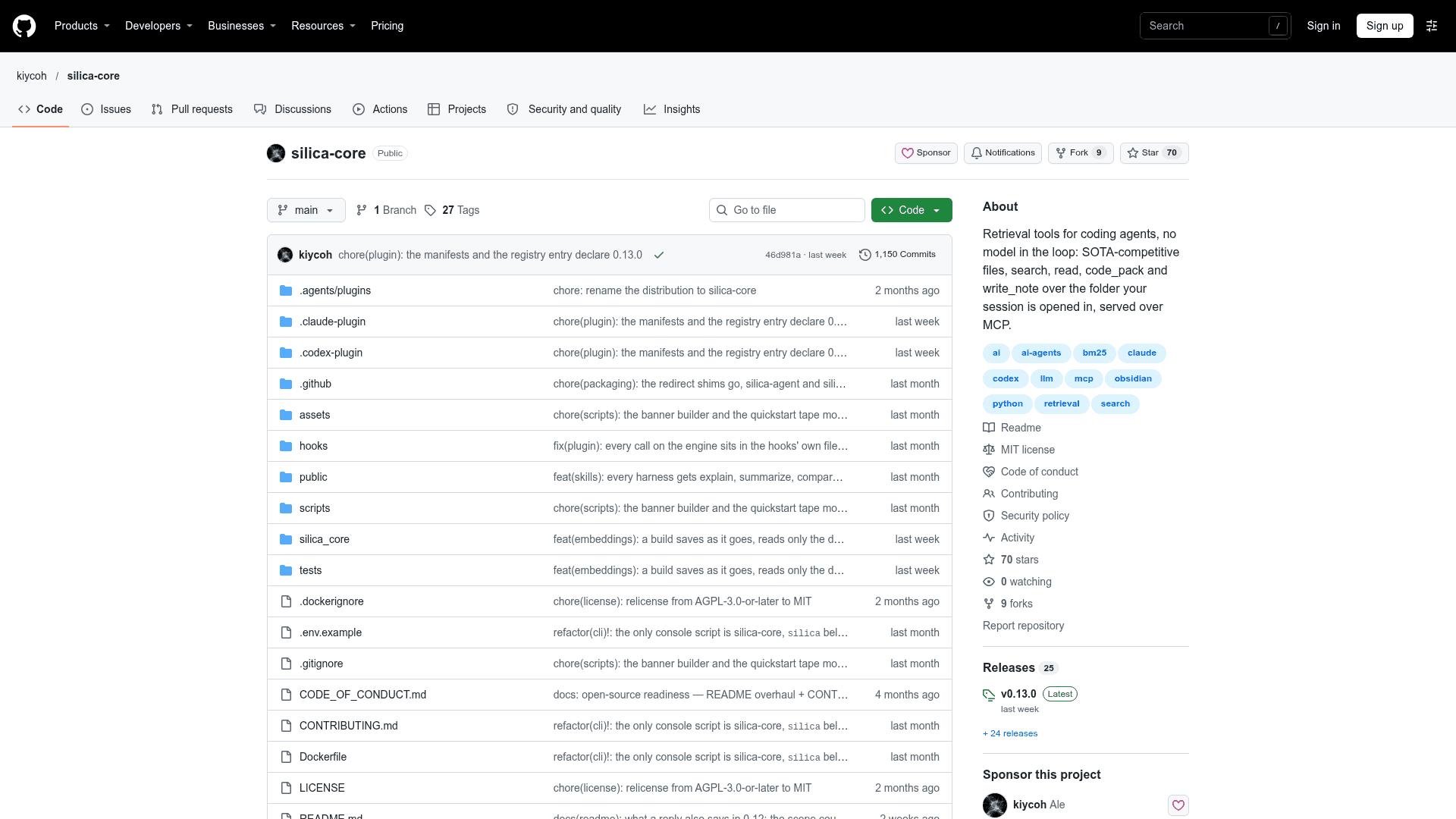
Silica Core is an open-source Python package that indexes the markdown, code, PDFs and office files under one root folder and serves them to agent harnesses such as Claude Code, Cursor, Codex and OpenCode. It runs as MCP tools or as shell commands that print the same JSON. A hit is a path, a section, a line, a window of text and the numbers to judge it by. The harness owns the loop.
What It Is
Silica is a local evidence retrieval layer for code and research. It locates the source, symbol, page or passage an agent needs rather than running an agent loop itself. Five tools cover the workflow: silica_files (inventory and index state), silica_search (ranked passages), silica_read (slices by line or heading, or by page in a PDF), silica_code_pack (an AST context pack for one source file within a character budget) and silica_write_note (an atomic, linted write). In a source tree each function, method, class and constant is its own unit, so a hit's section is the symbol. The README states that nothing needs an API key or a network.
How search reports confidence
Each result carries signals about how well the corpus answers the query: coverage (the share of query idf mass the matched terms carry), terms_absent (query terms found nowhere in the corpus), matched_terms, and terms_near (closest corpus spellings of an absent word). Replies also report what the search could not read (scope), how many equally strong documents were not shown (unseen, with exclude for paging), and whether a converted note's original has changed (source_state). Silica exposes these signals and leaves the decision to stop, read or rephrase to the harness.
Retrieval modes and setup
The base install uses BM25 lexical search. An optional dense leg adds numpy and a static model2vec model (potion-retrieval-32M) with no torch or GPU, enabled with silica-core index --embed; any OpenAI-compatible embeddings endpoint can be used instead, only after an explicit remote grant. silica-core init adopts a folder, and silica-core setup <client> writes the MCP registration for clients including Claude Code, Codex, Cursor, Windsurf, Zed, Cline, Continue, Goose, OpenCode, Gemini, Hermes and others. Claude Code also has a plugin that brings its own server, an Index button and skills; the README says the plugin does not send files, prompts or conversations anywhere.
Supported content and benchmarks
It reads markdown, text, rst and text-layer PDFs directly, converts DOCX, EPUB, FB2, RTF, XLS and ODF, and handles scanned PDFs, images, PPTX and XLSX via MinerU import. The README publishes benchmarks on BEIR SciFact and NFCorpus and a SWE-QA code-localization replay against zvec-grep and ck, plus agent-workload experiments; the README itself notes these are separate experiments and not a universal claim. It has no memory lane, prompt injection or summaries.
Current Status
The latest release listed is v0.13.0, published 2026-11-08, under the MIT license.
Community Discussions
Be the first to start a conversation about Silica Core
Share your experience with Silica Core, ask questions, or help others learn from your insights.
Pricing
Open Source (MIT)
Self-hosted, local silica-core under the MIT License; free to use, copy, modify, and distribute.
- MIT-licensed core product
- Local indexing and search of markdown, code, PDFs and office files
- Served as MCP tools or shell commands
- Optional dense leg via the [dense] extra
- Nothing needs an API key or a network
Capabilities
Key Features
- MCP server and shell CLI printing the same JSON
- BM25 lexical search over documents and sections
- Optional local dense retrieval with a static model2vec model
- Symbol-level indexing of source code
- AST code context packs within a character budget
- Search confidence signals: coverage, terms_absent, terms_near, unseen
- Atomic linted note writes
- Reads markdown, PDFs, DOCX, EPUB and other office formats
- Claude Code plugin with skills
- One-command setup for many agent clients
- Local operation with no API key required